




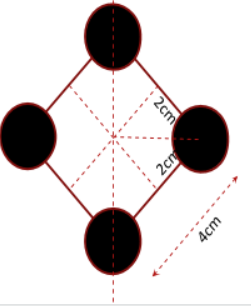
Four solid spheres each of diameter $\sqrt 5 cm$ and mass 0.5kg are placed with their centres at the corners of a square of side 4cm. The moment of inertia of the system about the diagonal of the square is $N \times {10^{ - 4}}Kg{m^2}$then N is?
Answer
 Verified
667.2k+ views
Hint: The moment of inertia of a system of solid bodies about any axis is the sum of moments of inertia of individual bodies about that axis. The moment of inertia of a sphere of radius R about the centre of mass is \[I' = \dfrac{2}{5}M{R^2}\]
Complete Step by Step answer:
We know the moment of inertia of a body is given as $I = \sum\limits_i {{m_i}{r_i}^2} $
Now here we have 4 individual groups of masses. We know the moment of inertia of each of them individually but we are asked the combined moment of inertia.
we can split the summation in eqn(1) as \[I = {\left. {\sum\limits_i {{m_i}{r_i}^2} } \right|_A} + {\left. {\sum\limits_i {{m_i}{r_i}^2} } \right|_B} + {\text{ }}{\left. {\sum\limits_i {{m_i}{r_i}^2} } \right|_C} + {\left. {\sum\limits_i {{m_i}{r_i}^2} } \right|_D}\]
So we see that the total moment of inertia $I$ is the sum of individual moments of inertia : ${I_A}$, ${I_B}$, ${I_C}$, and ${I_D}$,
$I = {I_A} + {I_B} + {I_C} + {I_D}$
Here, we have 4 spheres placed at the corners of a square as shown in the diagram. Since the square is rotating about the diagonal, two of the spheres will be rotating along an axis passing through their centre of mass, but two of them are away from the axis and would rotate in circles.
Their distances from the axis is :
$\sqrt {{2^2} + {2^2}} = \sqrt 8 = 2\sqrt 2 cm$
Now, we know the moment of inertia of a sphere about an axis through the centre is :
\[I' = \dfrac{2}{5}M{R^2}\]
But for a sphere rotating at a distance $L$ away from the axis, the moment of inertia has to be found using the parallel axis theorem. According to this theorem, the moment of inertia of a body along any axis is the sum of its moment of inertia about a parallel axis passing through its centre of mass and the product of mass and square of distance from the axis.
${I_L} = {I_{com}} + M{L^2}$
Now, we can find the moment of inertia of spheres A and B in the diagram as:
${I_A} = {I_B} = \dfrac{2}{5}M{R^2}$
Let's substitute the values given in the question into our equation
${I_A} = {I_B} = \dfrac{2}{5}0.5{\text{ }}{\left( {\dfrac{{\sqrt 5 }}{2}} \right)^2} = 0.25kgc{m^2}$
Similarly, for the masses C and D,
${I_C} = {I_D} = \dfrac{2}{5}M{R^2} + M{L^2}$
since we now know $L = 2\sqrt 2 cm$, we can substitute it in
\[{I_C} = {I_D} = \dfrac{2}{5}0.5{\text{ }}{\left( {\dfrac{{\sqrt 5 }}{2}} \right)^2} + 0.5{\left( {2\sqrt 2 } \right)^2} = 4.25\]
Now net moment of inertia is $I = {I_A} + {I_B} + {I_C} + {I_D}$
$I = 0.25 + 0.25 + 4.25 + 4.25 = 9kgc{m^2}$
Converting it to $kg{m^2}$gives :
\[9kg{\left( {{{10}^{ - 2}}m} \right)^2} = 9 \times {10^{ - 4}}Kg{m^2}\]
Comparing this with \[N \times {10^{ - 4}}Kg{m^2}\] gives \[N = 9\]. This is the required answer.
Note: Parallel axis theorem can only be applied if the moment of inertia about the centre of mass is known. If the moment of inertia about some other axis is given, we will first have to find the moment of inertia about the centre of mass and then use it to find the unknown moment of inertia.
Complete Step by Step answer:
We know the moment of inertia of a body is given as $I = \sum\limits_i {{m_i}{r_i}^2} $
Now here we have 4 individual groups of masses. We know the moment of inertia of each of them individually but we are asked the combined moment of inertia.
we can split the summation in eqn(1) as \[I = {\left. {\sum\limits_i {{m_i}{r_i}^2} } \right|_A} + {\left. {\sum\limits_i {{m_i}{r_i}^2} } \right|_B} + {\text{ }}{\left. {\sum\limits_i {{m_i}{r_i}^2} } \right|_C} + {\left. {\sum\limits_i {{m_i}{r_i}^2} } \right|_D}\]
So we see that the total moment of inertia $I$ is the sum of individual moments of inertia : ${I_A}$, ${I_B}$, ${I_C}$, and ${I_D}$,
$I = {I_A} + {I_B} + {I_C} + {I_D}$
Here, we have 4 spheres placed at the corners of a square as shown in the diagram. Since the square is rotating about the diagonal, two of the spheres will be rotating along an axis passing through their centre of mass, but two of them are away from the axis and would rotate in circles.
Their distances from the axis is :
$\sqrt {{2^2} + {2^2}} = \sqrt 8 = 2\sqrt 2 cm$
Now, we know the moment of inertia of a sphere about an axis through the centre is :
\[I' = \dfrac{2}{5}M{R^2}\]
But for a sphere rotating at a distance $L$ away from the axis, the moment of inertia has to be found using the parallel axis theorem. According to this theorem, the moment of inertia of a body along any axis is the sum of its moment of inertia about a parallel axis passing through its centre of mass and the product of mass and square of distance from the axis.
${I_L} = {I_{com}} + M{L^2}$
Now, we can find the moment of inertia of spheres A and B in the diagram as:
${I_A} = {I_B} = \dfrac{2}{5}M{R^2}$
Let's substitute the values given in the question into our equation
${I_A} = {I_B} = \dfrac{2}{5}0.5{\text{ }}{\left( {\dfrac{{\sqrt 5 }}{2}} \right)^2} = 0.25kgc{m^2}$
Similarly, for the masses C and D,
${I_C} = {I_D} = \dfrac{2}{5}M{R^2} + M{L^2}$
since we now know $L = 2\sqrt 2 cm$, we can substitute it in
\[{I_C} = {I_D} = \dfrac{2}{5}0.5{\text{ }}{\left( {\dfrac{{\sqrt 5 }}{2}} \right)^2} + 0.5{\left( {2\sqrt 2 } \right)^2} = 4.25\]
Now net moment of inertia is $I = {I_A} + {I_B} + {I_C} + {I_D}$
$I = 0.25 + 0.25 + 4.25 + 4.25 = 9kgc{m^2}$
Converting it to $kg{m^2}$gives :
\[9kg{\left( {{{10}^{ - 2}}m} \right)^2} = 9 \times {10^{ - 4}}Kg{m^2}\]
Comparing this with \[N \times {10^{ - 4}}Kg{m^2}\] gives \[N = 9\]. This is the required answer.
Note: Parallel axis theorem can only be applied if the moment of inertia about the centre of mass is known. If the moment of inertia about some other axis is given, we will first have to find the moment of inertia about the centre of mass and then use it to find the unknown moment of inertia.
Recently Updated Pages
If x a + bt + ct2 where x is in meters and t is in class 11 physics CBSE

A car covers the first half distance between two places class 11 physics CBSE
The resultant of two vectors overrightarrow P and overrightarrow class 11 physics CBSE
Find the value of cos 135 class 11 maths CBSE
A mass M is held in place by an applied force F and class 11 physics CBSE
A solution of glucose in water is labelled as 10 dfracwv class 11 chemistry CBSE
Trending doubts
One Metric ton is equal to kg A 10000 B 1000 C 100 class 11 physics CBSE
Find the value of the expression given below sin 30circ class 11 maths CBSE
What do you mean by retardation What is its SI uni class 11 physics CBSE
Draw a diagram of nephron and explain its structur class 11 biology CBSE
10 examples of friction in our daily life
Difference between physical and chemical change class 11 chemistry CBSE