




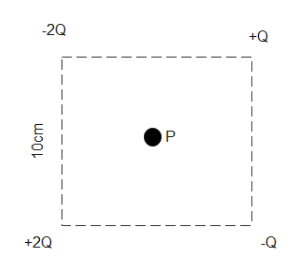
Four electrical charges are arranged on the corners of a $10cm$ square as shown. What would be the resulting electric field at the centre point P.
Answer
 Verified
543k+ views
Hint:Observe the given charges in the diagram and the distance of the charges from each other. Taking Pythagoras’ theorem, calculate each distance from the point P. Now applying the formula of electric field, find the field due to each point charge at the centre point P.
Complete step by step answer:
Now at first let us calculate the value of the electric field at P due to all the given charges. We know Electric field a point due to a positive charge Q is given by:
$F = \dfrac{Q}{{4\pi {\varepsilon _o}{r^2}}}$
Where F = Field at point P, Q is the charge, ${\varepsilon _o}$ is the permittivity of free space and ‘r’ is the distance between the point P and the charge Q.
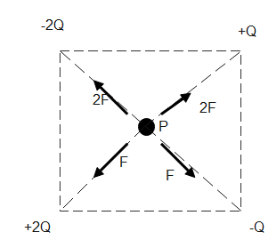
Then we will represent the direction of the field due to each charge. Remember that the direction of the field due to a negative charge will be opposite to the direction of the field due to a positive charge. The direction of the field due to a positive charge is always away from it, and for a negative charge will be towards it. We are given each charge in terms of Q; thus, we can generalise the electric field too in terms of, say F.
The directions are according to the diagrams shown.
Thus, the resultant field is as follows: -
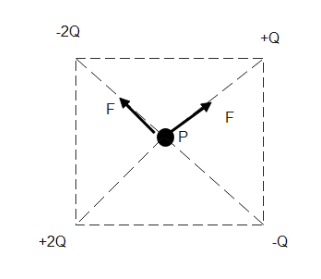
Hence the resultant field at the point P is $\sqrt 2 F$ and it is bisecting the two resultant F vectors as shown in the figure. The direction is vertically upwards, between the $ - 2Q$ and the $ + Q$ charges.
Note:It is to be kept in mind while solving that the directions are very fundamental and the fact that we do not get confused between the values of electrical field and electric potential. Also note that we always have to mention the direction of the electric field along with its magnitude.
Complete step by step answer:
Now at first let us calculate the value of the electric field at P due to all the given charges. We know Electric field a point due to a positive charge Q is given by:
$F = \dfrac{Q}{{4\pi {\varepsilon _o}{r^2}}}$
Where F = Field at point P, Q is the charge, ${\varepsilon _o}$ is the permittivity of free space and ‘r’ is the distance between the point P and the charge Q.
Then we will represent the direction of the field due to each charge. Remember that the direction of the field due to a negative charge will be opposite to the direction of the field due to a positive charge. The direction of the field due to a positive charge is always away from it, and for a negative charge will be towards it. We are given each charge in terms of Q; thus, we can generalise the electric field too in terms of, say F.
The directions are according to the diagrams shown.
Thus, the resultant field is as follows: -
Hence the resultant field at the point P is $\sqrt 2 F$ and it is bisecting the two resultant F vectors as shown in the figure. The direction is vertically upwards, between the $ - 2Q$ and the $ + Q$ charges.
Note:It is to be kept in mind while solving that the directions are very fundamental and the fact that we do not get confused between the values of electrical field and electric potential. Also note that we always have to mention the direction of the electric field along with its magnitude.
Recently Updated Pages
Master Class 12 Business Studies: Engaging Questions & Answers for Success

Master Class 12 Chemistry: Engaging Questions & Answers for Success
Master Class 12 Biology: Engaging Questions & Answers for Success
Class 12 Question and Answer - Your Ultimate Solutions Guide
Master Class 11 English: Engaging Questions & Answers for Success
Master Class 11 Social Science: Engaging Questions & Answers for Success
Trending doubts
Which are the Top 10 Largest Countries of the World?
Draw a labelled sketch of the human eye class 12 physics CBSE
Differentiate between homogeneous and heterogeneous class 12 chemistry CBSE
Differentiate between Pyramid of energy and pyramid class 12 biology CBSE
Why is the cell called the structural and functional class 12 biology CBSE
Draw the diagram of the pyramid of energy Explain In class 12 biology CBSE