




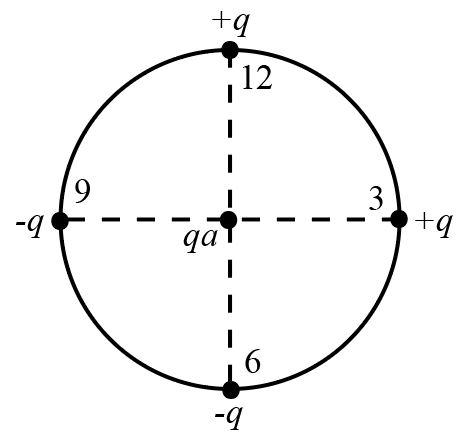
Four charges are placed at the circumference of the dial of a clock as shown in the figure. If the clock has only hour hand, then the resultant force on a positive charge $q_{0}$ placed at the center, points in the direction which shows the time as: -
A. 1:30
B. 7:30
C. 4:30
D. 10:30
Answer
 Verified
606.9k+ views
Hint: In this question we have to apply the concept of force on a point charged particle due to point charges. We have to find the direction of the net force being applied on the charge ${q_0}$ present at the center. we have to match the direction with either of the options in the question and conclude the answer.
Complete step by step answer:
To solve this question, we have to find the force acting on the charge placed at the center. We will calculate the net charge acting in the directions of both axes.
First, we will consider the charges placed in the x-axis and the force which they are applying on the charge present at the center.
The force acting on a charged particle due to another charged particle is given by the following relation:
$F = \dfrac{{K{q_1}{q_2}}}{{{r^2}}}\,\,\mathop r\limits^ \wedge $, where ${q_1},{q_2}$ are the magnitude of charges on the particles, r is the distance between them and K is a constant, and $\mathop r\limits^ \wedge $ is the direction vector which gives the direction.
Here the magnitude of the charges present at the circumference of the dial is the same, therefore we only have to calculate the direction of the forces.
Since the charge present in the center of the direct is a positive charge, the charge present at the 12 o'clock position and the 3 o'clock position will repel it. And the charge present at the 9 o'clock position and the 6 o'clock position will attract it.
The direction of the forces applied by the charge present at the circumference to the charge present at the center can be explained with the diagram given below:
The forces acting on the charge can be recorded in the x and y axis and it will be as shown below:
Now we have to find the resultant of the two forces acting in the direction of x and y axis, if we represent the direction of the resultant of the two forces, we will get the direction which is shown in the figure below:
Therefore, we now have the direction of the resultant of the force acting on the charge placed at the center due to the charges present at the circumference.
If we consider that the hour hand is placed in this direction, then the hour hand must be pointing at a value between 6 and 9 hours, if we try to find an option which is between 6 and 9 hours it is the option B which is 7:30.
Hence the correct option is (B) 7:30.
Note:
In questions like these, the calculation is not as important but the visualization part is more important. Questions can be easily solved if the students visualize the direction of the forces acting rather than calculating the direction vector. If one tries to calculate the direction vector and then solve the question, it will take a lot more time.
Complete step by step answer:
To solve this question, we have to find the force acting on the charge placed at the center. We will calculate the net charge acting in the directions of both axes.
First, we will consider the charges placed in the x-axis and the force which they are applying on the charge present at the center.
The force acting on a charged particle due to another charged particle is given by the following relation:
$F = \dfrac{{K{q_1}{q_2}}}{{{r^2}}}\,\,\mathop r\limits^ \wedge $, where ${q_1},{q_2}$ are the magnitude of charges on the particles, r is the distance between them and K is a constant, and $\mathop r\limits^ \wedge $ is the direction vector which gives the direction.
Here the magnitude of the charges present at the circumference of the dial is the same, therefore we only have to calculate the direction of the forces.
Since the charge present in the center of the direct is a positive charge, the charge present at the 12 o'clock position and the 3 o'clock position will repel it. And the charge present at the 9 o'clock position and the 6 o'clock position will attract it.
The direction of the forces applied by the charge present at the circumference to the charge present at the center can be explained with the diagram given below:
The forces acting on the charge can be recorded in the x and y axis and it will be as shown below:
Now we have to find the resultant of the two forces acting in the direction of x and y axis, if we represent the direction of the resultant of the two forces, we will get the direction which is shown in the figure below:
Therefore, we now have the direction of the resultant of the force acting on the charge placed at the center due to the charges present at the circumference.
If we consider that the hour hand is placed in this direction, then the hour hand must be pointing at a value between 6 and 9 hours, if we try to find an option which is between 6 and 9 hours it is the option B which is 7:30.
Hence the correct option is (B) 7:30.
Note:
In questions like these, the calculation is not as important but the visualization part is more important. Questions can be easily solved if the students visualize the direction of the forces acting rather than calculating the direction vector. If one tries to calculate the direction vector and then solve the question, it will take a lot more time.
Recently Updated Pages
Master Class 12 Business Studies: Engaging Questions & Answers for Success

Master Class 12 Chemistry: Engaging Questions & Answers for Success
Master Class 12 Biology: Engaging Questions & Answers for Success
Class 12 Question and Answer - Your Ultimate Solutions Guide
Master Class 9 General Knowledge: Engaging Questions & Answers for Success
Master Class 9 Maths: Engaging Questions & Answers for Success
Trending doubts
Which are the Top 10 Largest Countries of the World?
Draw a labelled sketch of the human eye class 12 physics CBSE
Differentiate between homogeneous and heterogeneous class 12 chemistry CBSE
Sulphuric acid is known as the king of acids State class 12 chemistry CBSE
Why is the cell called the structural and functional class 12 biology CBSE
A dentist uses a small mirror that gives a magnification class 12 physics CBSE