




What is formed immediately after fertilization?
A. Placenta
B. Foetus
C. Embryo
D. Zygote
Answer
 Verified
607.8k+ views
Hint: Fertilization is a process during which the spermatozoon fuses with the egg cell in the uterine tube. The fertilization results in the formation of a fertilized ovum and it takes about five days to succeed in the uterus from the fallopian tube.
Complete answer: Fertilization is the method during which haploid gametes fuse to create a diploid cell known as a Zygote. To confirm that every cell has the proper range of chromosomes, just one spermatozoon will fuse with one egg. There are various stages of human development mentioned below:
-Zygotic stage: The cell is created once the male germ cell (sperm) and feminine germ cell (egg) fuse.
-Blastocyst stage: The acellular cell begins to divide into a solid ball of cells. Then, it becomes a hollow ball of cells known as a blastula, attaching to the liner of the mother's female internal reproductive organ.

-Embryonic stage: The most important internal organs and external options begin to emerge, forming an associate embryo. During this stage, the heart, brain, and funiculus come into view. Arms and legs begin to develop.
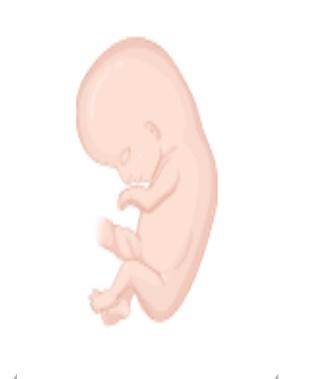
-Fetal stage: Once the shaped options of the embryo begin to grow and develop, the organism is taken into account a craniate. Differentiation and specialization of structures happen throughout this point. The placenta on the other hand acts as a structural and functional unit between the embryo and the mother.
Hence, option D-Zygote is the correct answer.
Note: Human fertilization occurs or takes place in the fallopian tube. Many of us have this misconception that human fertilization happens in the vagina, however, this is often not the case. Once spermatozoa enter the canal, they will move through the cervix, into the uterus, and to the top of the fallopian tube. If a spermatozoon is in a position to penetrate the associated egg cell, fertilization happens.
Complete answer: Fertilization is the method during which haploid gametes fuse to create a diploid cell known as a Zygote. To confirm that every cell has the proper range of chromosomes, just one spermatozoon will fuse with one egg. There are various stages of human development mentioned below:
-Zygotic stage: The cell is created once the male germ cell (sperm) and feminine germ cell (egg) fuse.
-Blastocyst stage: The acellular cell begins to divide into a solid ball of cells. Then, it becomes a hollow ball of cells known as a blastula, attaching to the liner of the mother's female internal reproductive organ.
-Embryonic stage: The most important internal organs and external options begin to emerge, forming an associate embryo. During this stage, the heart, brain, and funiculus come into view. Arms and legs begin to develop.
-Fetal stage: Once the shaped options of the embryo begin to grow and develop, the organism is taken into account a craniate. Differentiation and specialization of structures happen throughout this point. The placenta on the other hand acts as a structural and functional unit between the embryo and the mother.
Hence, option D-Zygote is the correct answer.
Note: Human fertilization occurs or takes place in the fallopian tube. Many of us have this misconception that human fertilization happens in the vagina, however, this is often not the case. Once spermatozoa enter the canal, they will move through the cervix, into the uterus, and to the top of the fallopian tube. If a spermatozoon is in a position to penetrate the associated egg cell, fertilization happens.
Recently Updated Pages
Master Class 12 Economics: Engaging Questions & Answers for Success

Master Class 12 English: Engaging Questions & Answers for Success
Master Class 12 Social Science: Engaging Questions & Answers for Success
Master Class 12 Maths: Engaging Questions & Answers for Success
Master Class 12 Physics: Engaging Questions & Answers for Success
Master Class 12 Business Studies: Engaging Questions & Answers for Success
Trending doubts
Which are the Top 10 Largest Countries of the World?
Draw a labelled sketch of the human eye class 12 physics CBSE
Differentiate between homogeneous and heterogeneous class 12 chemistry CBSE
Why is the cell called the structural and functional class 12 biology CBSE
Draw ray diagrams each showing i myopic eye and ii class 12 physics CBSE
Which is the correct genotypic ratio of mendel dihybrid class 12 biology CBSE