




Force between two plates of a capacitor is:
A). $\dfrac{Q}{{{\varepsilon _0}A}}$
B). $\dfrac{{{Q^2}}}{{2{\varepsilon _0}A}}$
C). $\dfrac{{{Q^2}}}{{{\varepsilon _0}A}}$
D). None of these
Answer
 Verified
653.4k+ views
Hint: In order to deal with this question we will apply the general equation of force in physics, so for it first we will write the magnitude of the electric field by anyone plate. Use the concept of electrostatics in order to solve the problem.
Formula used: $E = \dfrac{\sigma }{{2{\varepsilon _0}}},\sigma = \dfrac{Q}{A},\left| F \right| = \left| Q \right| \cdot \left| E \right|$ where E = Electric Field , $\sigma $= area density of charge , ${\varepsilon _0}$= vacuum permittivity ,Q= total charge on a plate ,A= area of each plate ,F= Force between two plates.
Complete step-by-step solution:
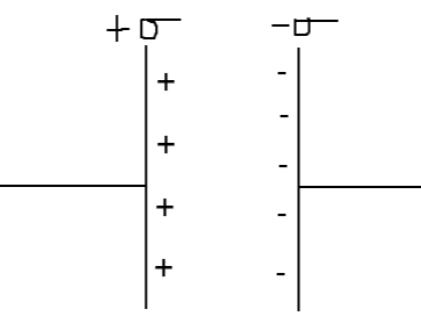
We know that the magnitude of the electric field by anyone plate is given as
$E = \dfrac{\sigma }{{2{\varepsilon _0}}}$
And we know that , $\sigma = \dfrac{Q}{A}$
$\therefore E = \dfrac{\sigma }{{2{\varepsilon _0}}} = \dfrac{Q}{{2A{\varepsilon _0}}}$
Now , the magnitude of the force between the two plates of the capacitor can be found as:
$\left| F \right| = \left| Q \right| \cdot \left| E \right|$
Substituting the value of electric field (E) , we will get
$
\left| F \right| = \left| Q \right| \cdot \left| E \right| \\
\Rightarrow F = Q \cdot \dfrac{Q}{{2A{\varepsilon _0}}} \\
\Rightarrow F = \dfrac{{{Q^2}}}{{2A{\varepsilon _0}}} \\
$
Hence, the force between two plates of a capacitor is $\dfrac{{{Q^2}}}{{2A{\varepsilon _0}}}$
So, the correct answer is option B.
Note: When two parallel plates are connected across a battery, the plates are charged and an electric field is established between them, and this setup is known as the parallel plate capacitor. A parallel plate capacitor behaves as open-circuited when we connect a DC source across it, while it acts as a short circuit when we connect an AC source to it. The said property of a parallel plate capacitor makes it suitable for filtering the harmonics from the AC supply.
Formula used: $E = \dfrac{\sigma }{{2{\varepsilon _0}}},\sigma = \dfrac{Q}{A},\left| F \right| = \left| Q \right| \cdot \left| E \right|$ where E = Electric Field , $\sigma $= area density of charge , ${\varepsilon _0}$= vacuum permittivity ,Q= total charge on a plate ,A= area of each plate ,F= Force between two plates.
Complete step-by-step solution:
We know that the magnitude of the electric field by anyone plate is given as
$E = \dfrac{\sigma }{{2{\varepsilon _0}}}$
And we know that , $\sigma = \dfrac{Q}{A}$
$\therefore E = \dfrac{\sigma }{{2{\varepsilon _0}}} = \dfrac{Q}{{2A{\varepsilon _0}}}$
Now , the magnitude of the force between the two plates of the capacitor can be found as:
$\left| F \right| = \left| Q \right| \cdot \left| E \right|$
Substituting the value of electric field (E) , we will get
$
\left| F \right| = \left| Q \right| \cdot \left| E \right| \\
\Rightarrow F = Q \cdot \dfrac{Q}{{2A{\varepsilon _0}}} \\
\Rightarrow F = \dfrac{{{Q^2}}}{{2A{\varepsilon _0}}} \\
$
Hence, the force between two plates of a capacitor is $\dfrac{{{Q^2}}}{{2A{\varepsilon _0}}}$
So, the correct answer is option B.
Note: When two parallel plates are connected across a battery, the plates are charged and an electric field is established between them, and this setup is known as the parallel plate capacitor. A parallel plate capacitor behaves as open-circuited when we connect a DC source across it, while it acts as a short circuit when we connect an AC source to it. The said property of a parallel plate capacitor makes it suitable for filtering the harmonics from the AC supply.
Recently Updated Pages
Master Class 12 Economics: Engaging Questions & Answers for Success

Master Class 12 Social Science: Engaging Questions & Answers for Success
Master Class 12 English: Engaging Questions & Answers for Success
Master Class 12 Maths: Engaging Questions & Answers for Success
Master Class 12 Physics: Engaging Questions & Answers for Success
Master Class 12 Biology: Engaging Questions & Answers for Success
Trending doubts
Draw a labelled sketch of the human eye class 12 physics CBSE
Which are the Top 10 Largest Countries of the World?
Draw ray diagrams each showing i myopic eye and ii class 12 physics CBSE
Which is the correct genotypic ratio of mendel dihybrid class 12 biology CBSE
Differentiate between homogeneous and heterogeneous class 12 chemistry CBSE
Which animal never drinks water in its entire life class 12 biology CBSE