




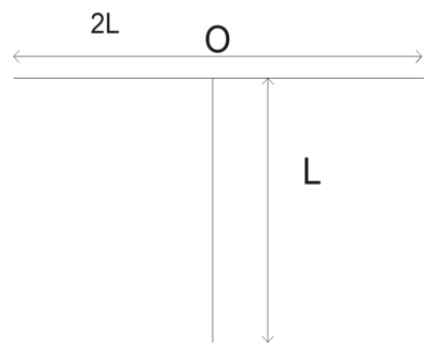
For the uniform T shaped structure, with mass 3M, moment of inertia about an axis normal to the plane and passing through O would be:
A.) $\dfrac{2}{3}M{{L}^{2}}$
B.) $M{{L}^{2}}$
C.) $\dfrac{M{{L}^{2}}}{3}$
D.) None of these
Answer
 Verified
557.1k+ views
Hint: Given questions deals with the moment of inertia of a rod. Moment of inertia is just another name given to rotational inertia, the moment of inertia is defined as the mass multiplied by the square of perpendicular distance with respect to the rotational axis.. It appears in the relationships for the dynamics of rotational motion. The moment of inertia must be specifically defined with respect to a specifically selected axis of rotation.
Complete Step-by-Step Solution:
For the rod of length 2l, we need to find out the moment of inertia at its center. The rod would have to be considered to be an infinite number of point masses, and each must be multiplied by the square of its distance from the axis. Integration of the points will give us:
${{I}_{1}}=\dfrac{1}{12}{{M}_{1}}{{(2L)}^{2}}$
For the rod of length l, we need to find out the moment of inertia at one of its end, which will be:
${{I}_{2}}=\dfrac{{{M}_{2}}}{3}{{L}^{2}}$
Using the center of mass equation, mass of both the rods can be calculated separately.
$M=\dfrac{{{M}_{1}}+{{M}_{2}}}{{{M}_{1}}{{M}_{2}}}$ and
$R=\dfrac{{{M}_{1}}{{r}_{1}}+{{M}_{2}}{{r}_{2}}}{{{M}_{1}}+{{M}_{2}}}$
Solving above equations, by considering O as center of mass, one would get, M1 = 2M and M2 = M
Hence, Total moment of inertia would be:
\[{{I}_{1}}+{{I}_{2}}=\dfrac{1}{12}2M{{(2L)}^{2}}+\dfrac{M}{3}{{L}^{2}}\]
$I=M{{L}^{2}}$
Note:
For a point mass, the moment of inertia is defined as the mass multiplied by the square of perpendicular distance with respect to the rotational axis. That point mass moment of inertia becomes the centre for all other moments of inertia since any object can be built from a collection of point masses. In the International System (SI), m is expressed in kilograms and r in metres, with I (moment of inertia) having the dimension kilogram-metre square.
Complete Step-by-Step Solution:
For the rod of length 2l, we need to find out the moment of inertia at its center. The rod would have to be considered to be an infinite number of point masses, and each must be multiplied by the square of its distance from the axis. Integration of the points will give us:
${{I}_{1}}=\dfrac{1}{12}{{M}_{1}}{{(2L)}^{2}}$
For the rod of length l, we need to find out the moment of inertia at one of its end, which will be:
${{I}_{2}}=\dfrac{{{M}_{2}}}{3}{{L}^{2}}$
Using the center of mass equation, mass of both the rods can be calculated separately.
$M=\dfrac{{{M}_{1}}+{{M}_{2}}}{{{M}_{1}}{{M}_{2}}}$ and
$R=\dfrac{{{M}_{1}}{{r}_{1}}+{{M}_{2}}{{r}_{2}}}{{{M}_{1}}+{{M}_{2}}}$
Solving above equations, by considering O as center of mass, one would get, M1 = 2M and M2 = M
Hence, Total moment of inertia would be:
\[{{I}_{1}}+{{I}_{2}}=\dfrac{1}{12}2M{{(2L)}^{2}}+\dfrac{M}{3}{{L}^{2}}\]
$I=M{{L}^{2}}$
Note:
For a point mass, the moment of inertia is defined as the mass multiplied by the square of perpendicular distance with respect to the rotational axis. That point mass moment of inertia becomes the centre for all other moments of inertia since any object can be built from a collection of point masses. In the International System (SI), m is expressed in kilograms and r in metres, with I (moment of inertia) having the dimension kilogram-metre square.
Recently Updated Pages
Master Class 12 Economics: Engaging Questions & Answers for Success

Master Class 12 Physics: Engaging Questions & Answers for Success
Master Class 12 English: Engaging Questions & Answers for Success
Master Class 12 Social Science: Engaging Questions & Answers for Success
Master Class 12 Maths: Engaging Questions & Answers for Success
Master Class 12 Business Studies: Engaging Questions & Answers for Success
Trending doubts
Which are the Top 10 Largest Countries of the World?
What are the major means of transport Explain each class 12 social science CBSE
Draw a labelled sketch of the human eye class 12 physics CBSE
Why cannot DNA pass through cell membranes class 12 biology CBSE
Differentiate between insitu conservation and exsitu class 12 biology CBSE
Draw a neat and well labeled diagram of TS of ovary class 12 biology CBSE