




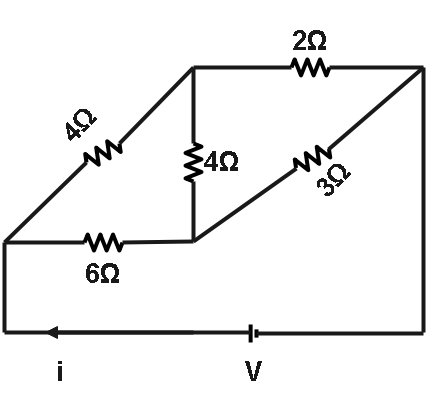
For the network shown in the figure the current $i$ is:
A. $\dfrac{{18V}}{5}$
B. $\dfrac{{5V}}{9}$
C. $\dfrac{{9V}}{{35}}$
D. $\dfrac{{5V}}{{18}}$
Answer
 Verified
495k+ views
Hint: To find the current in the circuit we need to find the equivalent resistance that is present in the circuit and we can see here that this is a Wheatstone bridge circuit and we know that a Wheatstone bridge is an electrical circuit used to measure an unknown electrical resistance by balancing two legs of a bridge circuit, one leg of which includes the unknown component. The primary benefit of the circuit is its ability to provide extremely accurate measurements. After finding the equivalent resistance we will find the current by applying Ohm’s law.
Complete step by step solution:
According to the question, Let’s say,
\[P = 4\Omega ,Q = 2\Omega ,R = 6\Omega ,S = 3\Omega \]
According to the Wheatstone bridge circuit here,
$\dfrac{P}{Q} = \dfrac{R}{S}$
So, it is the balanced condition and no current flow the middle resistance i.e., $4\Omega $,
Thus, we can remove from the circuit, and the new circuit will become as below,
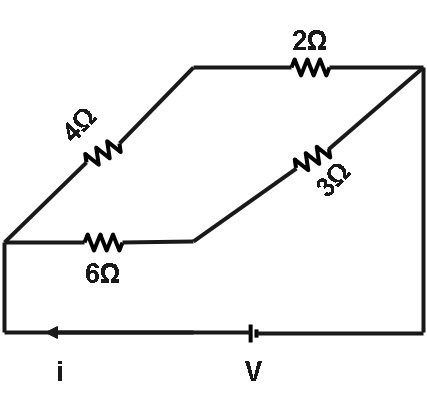
Now, here we can see the circuit is series and parallel and can solve for the equivalence resistance.
$
\dfrac{1}{{{R_{eq}}}} = \dfrac{1}{{{R_1}}} + \dfrac{1}{{{R_2}}} \\
\Rightarrow \dfrac{1}{{{R_{eq}}}} = \dfrac{{{R_1} + {R_2}}}{{{R_1} \times {R_2}}} \\
\Rightarrow {R_{eq}} = \dfrac{{{R_1} \times {R_2}}}{{{R_1} + {R_2}}} \\
$
Now, substituting the value according to the circuit,
$
{R_{eq}} = \dfrac{{{R_1} \times {R_2}}}{{{R_1} + {R_2}}} \\
\Rightarrow {R_{eq}} = \dfrac{{6 \times 9}}{{6 + 9}} \\
\Rightarrow {R_{eq}} = \dfrac{{54}}{{15}} \\
\Rightarrow {R_{eq}} = \dfrac{{18}}{5} \\
$
Now, applying Ohm’s law to find the current,
$
\because V = IR \\
\Rightarrow I = \dfrac{V}{R} \\
$
Now, substituting the values,
$
I = \dfrac{V}{R} \\
\Rightarrow I = \dfrac{{5V}}{{18}} \\
$
So, for the network shown in the figure the current $i$ is $\dfrac{{5V}}{{18}}$ .
Hence, the correct option is D.
Note:
In this type of question when you see there is a Wheatstone bridge circuit apply the application and solve for the equivalent resistance and after find out the required solution what is asked in the question and Ohm's law states that the current through a conductor between two points is directly proportional to the voltage across the two points.
Complete step by step solution:
According to the question, Let’s say,
\[P = 4\Omega ,Q = 2\Omega ,R = 6\Omega ,S = 3\Omega \]
According to the Wheatstone bridge circuit here,
$\dfrac{P}{Q} = \dfrac{R}{S}$
So, it is the balanced condition and no current flow the middle resistance i.e., $4\Omega $,
Thus, we can remove from the circuit, and the new circuit will become as below,
Now, here we can see the circuit is series and parallel and can solve for the equivalence resistance.
$
\dfrac{1}{{{R_{eq}}}} = \dfrac{1}{{{R_1}}} + \dfrac{1}{{{R_2}}} \\
\Rightarrow \dfrac{1}{{{R_{eq}}}} = \dfrac{{{R_1} + {R_2}}}{{{R_1} \times {R_2}}} \\
\Rightarrow {R_{eq}} = \dfrac{{{R_1} \times {R_2}}}{{{R_1} + {R_2}}} \\
$
Now, substituting the value according to the circuit,
$
{R_{eq}} = \dfrac{{{R_1} \times {R_2}}}{{{R_1} + {R_2}}} \\
\Rightarrow {R_{eq}} = \dfrac{{6 \times 9}}{{6 + 9}} \\
\Rightarrow {R_{eq}} = \dfrac{{54}}{{15}} \\
\Rightarrow {R_{eq}} = \dfrac{{18}}{5} \\
$
Now, applying Ohm’s law to find the current,
$
\because V = IR \\
\Rightarrow I = \dfrac{V}{R} \\
$
Now, substituting the values,
$
I = \dfrac{V}{R} \\
\Rightarrow I = \dfrac{{5V}}{{18}} \\
$
So, for the network shown in the figure the current $i$ is $\dfrac{{5V}}{{18}}$ .
Hence, the correct option is D.
Note:
In this type of question when you see there is a Wheatstone bridge circuit apply the application and solve for the equivalent resistance and after find out the required solution what is asked in the question and Ohm's law states that the current through a conductor between two points is directly proportional to the voltage across the two points.
Recently Updated Pages
Master Class 12 Economics: Engaging Questions & Answers for Success

Master Class 12 Physics: Engaging Questions & Answers for Success
Master Class 12 English: Engaging Questions & Answers for Success
Master Class 12 Social Science: Engaging Questions & Answers for Success
Master Class 12 Maths: Engaging Questions & Answers for Success
Master Class 12 Business Studies: Engaging Questions & Answers for Success
Trending doubts
Which are the Top 10 Largest Countries of the World?
What are the major means of transport Explain each class 12 social science CBSE
Draw a labelled sketch of the human eye class 12 physics CBSE
Why cannot DNA pass through cell membranes class 12 biology CBSE
Differentiate between insitu conservation and exsitu class 12 biology CBSE
Draw a neat and well labeled diagram of TS of ovary class 12 biology CBSE