




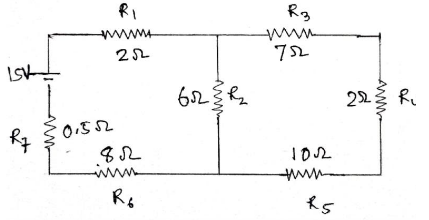
For the given circuit diagram, the equivalent resistance across the battery is:
(A) \[5\Omega \]
(B) \[10\Omega \]
(C) \[20\Omega \]
(D) \[15\Omega \]
Answer
 Verified
614.7k+ views
Hint:When the resistances \[\left( {{R_1},{R_2}............{R_n}} \right)\] are connected in series then equivalent resistance is given by \[{R_s}\],
\[{R_s} = {R_1} + {R_2} + ........... + {R_n}\]
When the resistances \[\left( {{R_1},{R_2}............{R_n}} \right)\]are connected in parallel the equivalent resistance is given by \[{R_p}\],
\[\dfrac{1}{{{R_p}}} = \dfrac{1}{{{R_1}}} + \dfrac{1}{{{R_2}}} + .......... + \dfrac{1}{{{R_n}}}\].
Complete step by step answer:
The total resistance of a series circuit is equal to the sum of individual resistances. It can be calculated from the formula
The total resistance for resistances in parallel in a circuit is equal to the sum of reciprocal individual resistances. It can be calculated from the formula
\[\dfrac{1}{{{R_p}}} = \dfrac{1}{{{R_1}}} + \dfrac{1}{{{R_2}}} + .......... + \dfrac{1}{{{R_n}}}\]
From the figure given in question we can see that,
Step. 1
\[{R_3},{R_4},{R_5}\] are connected in series hence \[{R_A} = {R_3} + {R_4} + {R_5}\],
\[ \Rightarrow {R_A} = 7 + 10 + 2 = 19\Omega \]
\[{R_6},{R_7}\] are also connected in series hence \[{R_C} = {R_6} + {R_7}\],
\[ \Rightarrow {R_C} = 8 + 0.5 = 8.5\Omega \]
Step. 2
then \[{R_A},{R_2}\] is in parallel hence, \[\dfrac{1}{{{R_B}}} = \dfrac{1}{{{R_A}}} + \dfrac{1}{{{R_2}}}\]
\[
\dfrac{1}{{{R_B}}} = \dfrac{1}{{19}} + \dfrac{1}{6} = \dfrac{{19 + 6}}{{19 \times 6}} \\
\Rightarrow {R_B} = \dfrac{{19 \times 6}}{{19 + 6}} \simeq 4.55 \\
\]
After that the equivalent circuit becomes.
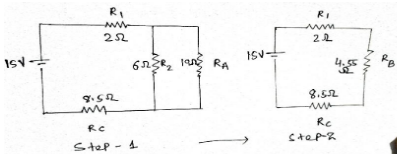
It's the simplified circuit for the above diagram in the question. Drawing a simplified circuit at each step makes the question more easy to solve and there is less chance for mistakes.
Now \[{R_1},{R_B},{R_c}\] are in series so the equivalent resistance across the battery is given by
\[{R_{eq}} = {R_1} + {R_B} + {R_c}\]
\[{R_{eq}} = 8.5 + 4.55 + 2 = 15.05 \simeq 15\Omega \]
Hence , the final circuit becomes,
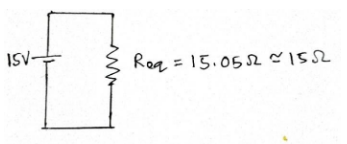
Hence the answer is option \[\left( D \right){\text{ }}15\Omega \]
Note:In series connection total voltage is equal to the sum of voltage consumed by each resistance while current remains same everywhere.In parallel connection voltage drop across each resistor is same while current is split up between different resistance.
\[{R_s} = {R_1} + {R_2} + ........... + {R_n}\]
When the resistances \[\left( {{R_1},{R_2}............{R_n}} \right)\]are connected in parallel the equivalent resistance is given by \[{R_p}\],
\[\dfrac{1}{{{R_p}}} = \dfrac{1}{{{R_1}}} + \dfrac{1}{{{R_2}}} + .......... + \dfrac{1}{{{R_n}}}\].
Complete step by step answer:
The total resistance of a series circuit is equal to the sum of individual resistances. It can be calculated from the formula
The total resistance for resistances in parallel in a circuit is equal to the sum of reciprocal individual resistances. It can be calculated from the formula
\[\dfrac{1}{{{R_p}}} = \dfrac{1}{{{R_1}}} + \dfrac{1}{{{R_2}}} + .......... + \dfrac{1}{{{R_n}}}\]
From the figure given in question we can see that,
Step. 1
\[{R_3},{R_4},{R_5}\] are connected in series hence \[{R_A} = {R_3} + {R_4} + {R_5}\],
\[ \Rightarrow {R_A} = 7 + 10 + 2 = 19\Omega \]
\[{R_6},{R_7}\] are also connected in series hence \[{R_C} = {R_6} + {R_7}\],
\[ \Rightarrow {R_C} = 8 + 0.5 = 8.5\Omega \]
Step. 2
then \[{R_A},{R_2}\] is in parallel hence, \[\dfrac{1}{{{R_B}}} = \dfrac{1}{{{R_A}}} + \dfrac{1}{{{R_2}}}\]
\[
\dfrac{1}{{{R_B}}} = \dfrac{1}{{19}} + \dfrac{1}{6} = \dfrac{{19 + 6}}{{19 \times 6}} \\
\Rightarrow {R_B} = \dfrac{{19 \times 6}}{{19 + 6}} \simeq 4.55 \\
\]
After that the equivalent circuit becomes.
It's the simplified circuit for the above diagram in the question. Drawing a simplified circuit at each step makes the question more easy to solve and there is less chance for mistakes.
Now \[{R_1},{R_B},{R_c}\] are in series so the equivalent resistance across the battery is given by
\[{R_{eq}} = {R_1} + {R_B} + {R_c}\]
\[{R_{eq}} = 8.5 + 4.55 + 2 = 15.05 \simeq 15\Omega \]
Hence , the final circuit becomes,
Hence the answer is option \[\left( D \right){\text{ }}15\Omega \]
Note:In series connection total voltage is equal to the sum of voltage consumed by each resistance while current remains same everywhere.In parallel connection voltage drop across each resistor is same while current is split up between different resistance.
Recently Updated Pages
Master Class 12 Business Studies: Engaging Questions & Answers for Success

Master Class 12 Chemistry: Engaging Questions & Answers for Success
Master Class 12 Biology: Engaging Questions & Answers for Success
Class 12 Question and Answer - Your Ultimate Solutions Guide
Master Class 11 Social Science: Engaging Questions & Answers for Success
Master Class 11 Chemistry: Engaging Questions & Answers for Success
Trending doubts
Which are the Top 10 Largest Countries of the World?
Draw a labelled sketch of the human eye class 12 physics CBSE
Name the crygenes that control cotton bollworm and class 12 biology CBSE
Differentiate between homogeneous and heterogeneous class 12 chemistry CBSE
Ribosomal RNA is actively synthesised in A Nucleoplasm class 12 biology CBSE
How many molecules of ATP and NADPH are required information class 12 biology CBSE