




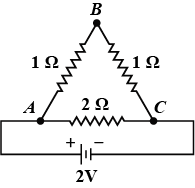
For the given circuit, calculate
(i) equivalent resistance between the points A and C.
(ii) current in the circuit
(iii) potential difference between A and B
Answer
 Verified
615k+ views
Hint:
(i) The resistance across AB and resistance across BC is in series and the equivalent resistance of these two will be parallel to the \[2\Omega \] resistance.
(ii) Find out the equivalent resistance of the circuit. Current across any resistance $R$ is given by $I = \dfrac{V}{R}$ where $V$ is the potential difference across the resistance.
(iii) Voltage or potential difference across resistors in parallel connection is same and current across resistors in series connection is same. Find the potential difference across AC and then current through ABC. Finally, the potential difference between A and B will be ${V_{AB}} = I{R_{AB}}$ .
Complete step by step answer:
(i) As clear from the figure that both the $1\Omega $ resistances are connected in series and we know that if two resistance are connected in series then their equivalent resistance is the algebraic sum of the two resistances. So, the equivalent resistance of the $1\Omega $ resistances will be ${R_1} = 1\Omega + 1\Omega = 2\Omega $ .
Now, ${R_1}$ will be parallel to the $2\Omega $ resistance. So, the equivalent resistance across AC will be
${R_{AC}} = \dfrac{{2 \times 2}}{{2 + 2}} = 1\Omega $
Hence, the equivalent resistance between the points A and C is $1\Omega $ .
(ii) To find the current in the circuit, we have to first calculate the equivalent resistance of the circuit.
The equivalent resistance of the circuit is $1\Omega $ .
We know that the current across any resistance $R$ is given by $I = \dfrac{V}{R}$ where $V$ is the potential difference across the resistance.
So, the current through the circuit
$I = \dfrac{2}{1} = 2A$ .
(iii) As clear from the figure that both the $1\Omega $ resistances are connected in series and they are parallel with the $2\Omega $ resistance. We know that the voltage or potential difference across resistors in parallel connection is the same and current across resistors in series connection is the same.
So, the potential difference across the equivalent resistance ${R_1} = 2\Omega $ is $V = 2V$ .
Therefore, current through ABC will be $I = \dfrac{2}{2} = 1\Omega $ .
Now, the potential difference between A and B will be ${V_{AB}} = I{R_{AB}}$
So, ${V_{AB}} = 1 \times 1 = 1V$
Hence, the potential difference between A and B is $1V$ .
Note: The relation between current and voltage is explained by the Ohm’s Law which states that the amount of electric current passing through a conductor in a circuit is directly proportional to the voltage or potential difference across it, at a fixed temperature and similar physical conditions.
(i) The resistance across AB and resistance across BC is in series and the equivalent resistance of these two will be parallel to the \[2\Omega \] resistance.
(ii) Find out the equivalent resistance of the circuit. Current across any resistance $R$ is given by $I = \dfrac{V}{R}$ where $V$ is the potential difference across the resistance.
(iii) Voltage or potential difference across resistors in parallel connection is same and current across resistors in series connection is same. Find the potential difference across AC and then current through ABC. Finally, the potential difference between A and B will be ${V_{AB}} = I{R_{AB}}$ .
Complete step by step answer:
(i) As clear from the figure that both the $1\Omega $ resistances are connected in series and we know that if two resistance are connected in series then their equivalent resistance is the algebraic sum of the two resistances. So, the equivalent resistance of the $1\Omega $ resistances will be ${R_1} = 1\Omega + 1\Omega = 2\Omega $ .
Now, ${R_1}$ will be parallel to the $2\Omega $ resistance. So, the equivalent resistance across AC will be
${R_{AC}} = \dfrac{{2 \times 2}}{{2 + 2}} = 1\Omega $
Hence, the equivalent resistance between the points A and C is $1\Omega $ .
(ii) To find the current in the circuit, we have to first calculate the equivalent resistance of the circuit.
The equivalent resistance of the circuit is $1\Omega $ .
We know that the current across any resistance $R$ is given by $I = \dfrac{V}{R}$ where $V$ is the potential difference across the resistance.
So, the current through the circuit
$I = \dfrac{2}{1} = 2A$ .
(iii) As clear from the figure that both the $1\Omega $ resistances are connected in series and they are parallel with the $2\Omega $ resistance. We know that the voltage or potential difference across resistors in parallel connection is the same and current across resistors in series connection is the same.
So, the potential difference across the equivalent resistance ${R_1} = 2\Omega $ is $V = 2V$ .
Therefore, current through ABC will be $I = \dfrac{2}{2} = 1\Omega $ .
Now, the potential difference between A and B will be ${V_{AB}} = I{R_{AB}}$
So, ${V_{AB}} = 1 \times 1 = 1V$
Hence, the potential difference between A and B is $1V$ .
Note: The relation between current and voltage is explained by the Ohm’s Law which states that the amount of electric current passing through a conductor in a circuit is directly proportional to the voltage or potential difference across it, at a fixed temperature and similar physical conditions.
Recently Updated Pages
Master Class 12 Business Studies: Engaging Questions & Answers for Success

Master Class 12 Biology: Engaging Questions & Answers for Success
Master Class 12 Chemistry: Engaging Questions & Answers for Success
Class 12 Question and Answer - Your Ultimate Solutions Guide
Master Class 11 English: Engaging Questions & Answers for Success
Master Class 11 Social Science: Engaging Questions & Answers for Success
Trending doubts
Which are the Top 10 Largest Countries of the World?
Draw a labelled sketch of the human eye class 12 physics CBSE
Differentiate between homogeneous and heterogeneous class 12 chemistry CBSE
Why is the cell called the structural and functional class 12 biology CBSE
Draw ray diagrams each showing i myopic eye and ii class 12 physics CBSE
Which is the correct genotypic ratio of mendel dihybrid class 12 biology CBSE