




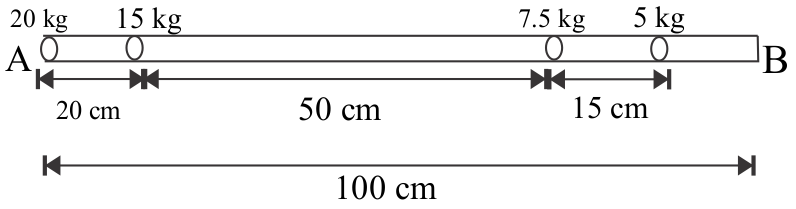
For the figure shows, a rod of mass 10kg (of length 100 cm) with some masses tied to it at different positions. Find the distance of the point (from A) at which if the rod is picked over a knife edge, it will be in equilibrium about that knife.
(A) 26.32 cm
(B) 28.72 cm
(C) 30.43 cm
(D) 32.50 cm
Answer
 Verified
583.5k+ views
Hint:-We know that about the equilibrium point, the torque will be balanced. So in order to solve this we will balance the torque about point A. We will find the torque produced due to each mass and then we will balance in the sense of rotation they produce the torque. By simplifying all these we can easily determine the equilibrium point from A.
Complete step-by-step solution:-
As we can see in the figure, the different point masses are attached to the rod at different positions. Now for the rod to be in equilibrium, the rod should be steady around the point. So, the forces i.e. rotational forces need to be equal on both sides.
Therefore, we compute the rotational force, Torque on both the sides of assumed equilibrium point and equalize them. Let us assume the equilibrium point be at x distance from point A,
The torque acting on point masses is force acting on mass into the perpendicular distance to that from the reference point.
$\tau = F \times r$
The force acting on masses is due to gravity downward, and the distance is along the rod, so on left hand side of equilibrium point, the torque is
$\tau = 20g(x) + 15g(20 - x)$
And on right hand side of rod, the torque is
$\tau = 5g(100 - x - 15) + 7.5g(100 - x - 30)$
Equalizing both gives,
$
20x + 15(x - 20) = 5(100 - x - 15) + 7.5(100 - x - 30) \\
20x + 15x - 300 = 500 - 5x - 75 + 750 - 7.5x - 225 \\
$
On simplifying we get
$
47.5x = 1250 \\
x = 26.32cm \\
$
Hence the distance of the point (from A) is 26.32 cm at which if the rod is picked over a knife edge, it will be in equilibrium about that knife.
The correct option is A.
Additional information:-
Torque is a measure of the force that can cause an object to rotate about an axis. Just as force is what causes an object to accelerate in linear kinematics, torque is what causes an object to acquire angular acceleration.
Torque is a vector quantity. The direction of the torque vector depends on the direction of the force on the axis.
The concept of rotational equilibrium is an equivalent to Newton’s 1ˢᵗ law for a rotational system. An object which is not rotating remains not rotating unless acted on by an external torque. Similarly, an object rotating at constant angular velocity remains rotating unless acted on by an external torque
Note:- The concept of rotational equilibrium is particularly useful in problems involving multiple torques acting on a rotatable object. In this case it is the net torque which is important. If the net torque on a rotatable object is zero then it will be in rotational equilibrium and not able to acquire angular acceleration.
Complete step-by-step solution:-
As we can see in the figure, the different point masses are attached to the rod at different positions. Now for the rod to be in equilibrium, the rod should be steady around the point. So, the forces i.e. rotational forces need to be equal on both sides.
Therefore, we compute the rotational force, Torque on both the sides of assumed equilibrium point and equalize them. Let us assume the equilibrium point be at x distance from point A,
The torque acting on point masses is force acting on mass into the perpendicular distance to that from the reference point.
$\tau = F \times r$
The force acting on masses is due to gravity downward, and the distance is along the rod, so on left hand side of equilibrium point, the torque is
$\tau = 20g(x) + 15g(20 - x)$
And on right hand side of rod, the torque is
$\tau = 5g(100 - x - 15) + 7.5g(100 - x - 30)$
Equalizing both gives,
$
20x + 15(x - 20) = 5(100 - x - 15) + 7.5(100 - x - 30) \\
20x + 15x - 300 = 500 - 5x - 75 + 750 - 7.5x - 225 \\
$
On simplifying we get
$
47.5x = 1250 \\
x = 26.32cm \\
$
Hence the distance of the point (from A) is 26.32 cm at which if the rod is picked over a knife edge, it will be in equilibrium about that knife.
The correct option is A.
Additional information:-
Torque is a measure of the force that can cause an object to rotate about an axis. Just as force is what causes an object to accelerate in linear kinematics, torque is what causes an object to acquire angular acceleration.
Torque is a vector quantity. The direction of the torque vector depends on the direction of the force on the axis.
The concept of rotational equilibrium is an equivalent to Newton’s 1ˢᵗ law for a rotational system. An object which is not rotating remains not rotating unless acted on by an external torque. Similarly, an object rotating at constant angular velocity remains rotating unless acted on by an external torque
Note:- The concept of rotational equilibrium is particularly useful in problems involving multiple torques acting on a rotatable object. In this case it is the net torque which is important. If the net torque on a rotatable object is zero then it will be in rotational equilibrium and not able to acquire angular acceleration.
Recently Updated Pages
Master Class 12 Economics: Engaging Questions & Answers for Success

Master Class 12 Physics: Engaging Questions & Answers for Success
Master Class 12 English: Engaging Questions & Answers for Success
Master Class 12 Social Science: Engaging Questions & Answers for Success
Master Class 12 Maths: Engaging Questions & Answers for Success
Master Class 12 Business Studies: Engaging Questions & Answers for Success
Trending doubts
Which are the Top 10 Largest Countries of the World?
What are the major means of transport Explain each class 12 social science CBSE
Draw a labelled sketch of the human eye class 12 physics CBSE
Why cannot DNA pass through cell membranes class 12 biology CBSE
Differentiate between insitu conservation and exsitu class 12 biology CBSE
Draw a neat and well labeled diagram of TS of ovary class 12 biology CBSE