




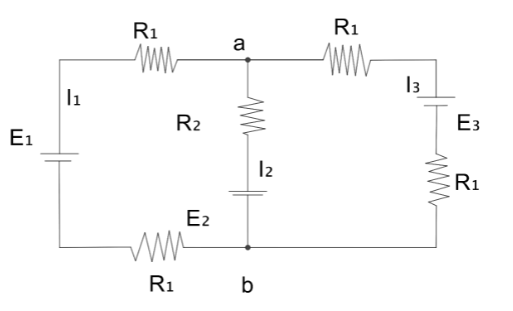
For the circuit shown, with ${R_1}{\text{ }} = {\text{ }}1{\text{ }}\Omega $, ${R_2}{\text{ }} = {\text{ }}2{\text{ }}\Omega $, ${E_1}{\text{ }} = {\text{ }}2{\text{ }}V$ and ${E_2}{\text{ }} = {\text{ }}{E_3}{\text{ }} = {\text{ }}4{\text{ }}V$, the potential difference between the points ‘$a$’ and ‘$b$’ is approximately (in $V$):
Answer
 Verified
527.1k+ views
Hint:We will use the basic equations of equivalent resistance and potential difference. Finally, we will substitute the values in their respective positions and then calculate the actual numerical value.
Formulae Used:
${R_{Series}}{\text{ }} = {\text{ }}{R_1}{\text{ }} + {\text{ }}{R_2}{\text{ }} + {\text{ }}...{\text{ }} + {\text{ }}{R_n}$
$\Rightarrow \dfrac{1}{{{R_{Parallel}}}}{\text{ }} = {\text{ }}\dfrac{1}{{{R_1}}}{\text{ }} + {\text{ }}\dfrac{1}{{{R_2}}}{\text{ }} + {\text{ }}...{\text{ }} + {\text{ }}\dfrac{1}{{{R_n}}}$
And,
$\Rightarrow I{\text{ }} = {\text{ }}\dfrac{V}{R}$
$\Rightarrow V{\text{ }} = {\text{ }}IR$
Complete step by step answer:
Here, we have to calculate the potential difference between $a$ and $b$. Thus, we will calculate the resistances for each cell. For cell ${E_1}$, the net resistance will be
${R_1}{\text{ }} + {\text{ }}{R_1} = 2{R_1}$
Again, for the cell ${E_2}$, the resistance is ${R_2}$
Also, for the cell ${E_3}$, the resistance is
${R_1}{\text{ }} + {\text{ }}{R_1}{\text{ }} = {\text{ }}2{R_1}$
Now, the current out of cell ${E_1}$ will be $\dfrac{{{E_1}}}{{2{R_1}}}$.
Through ${E_2}$ is $\dfrac{{{E_2}}}{{{R_2}}}$
And, through ${E_3}$ is $\dfrac{{{E_3}}}{{2{R_1}}}$
Thus, total current through the circuit where $a$ and $b$ are the endpoints:
${I_{ab}}{\text{ }} = {\text{ }}\dfrac{{{E_1}}}{{2{R_1}}}{\text{ }} + {\text{ }}\dfrac{{{E_2}}}{{{R_2}}}{\text{ }} + {\text{ }}\dfrac{{{E_3}}}{{2{R_1}}}$
Now, if we consider the points $a$ and $b$ as the end points. All the individual cell circuits will be in parallel with each other. Thus, the net resistance will be
$\dfrac{1}{{{R_{ab}}}}{\text{ }} = {\text{ }}\dfrac{1}{{2{R_1}}}{\text{ }} + {\text{ }}\dfrac{1}{{{R_2}}}{\text{ }} + {\text{ }}\dfrac{1}{{2{R_1}}}$
Thus, the potential difference between $a$ and $b$ will be
${V_{ab}}{\text{ }} = {\text{ }}{I_{ab}}{\text{ }}{R_{ab}}$
This equation can also be written as
${V_{ab}}{\text{ }} = {\text{ }}\dfrac{{{I_{ab}}}}{{\dfrac{1}{{{R_{ab}}}}}}$
Now,
Substituting the values, we get
${V_{ab}}\, = {\text{ }}\dfrac{{\dfrac{{{E_1}}}{{2{R_1}}}{\text{ }} + {\text{ }}\dfrac{{{E_2}}}{{{R_2}}}{\text{ }} + {\text{ }}\dfrac{{{E_3}}}{{2{R_1}}}}}{{\dfrac{1}{{2{R_1}}}{\text{ }} + {\text{ }}\dfrac{1}{{{R_2}}}{\text{ }} + {\text{ }}\dfrac{1}{{2{R_1}}}}}$
Further, we get
${V_{ab}}{\text{ }} = {\text{ }}\dfrac{{2{E_1}{R_1}{R_2}{\text{ }} + {\text{ }}4{E_2}{R_1}^2{\text{ }} + {\text{ }}2{E_3}{R_1}{R_2}}}{{2{R_1}{R_2}{\text{ }} + {\text{ }}4{R_1}^2{\text{ }} + {\text{ }}2{R_1}{R_2}}}$
Taking $2{R_1}$ common from the numerator and the denominator and cancelling, we get
${V_{ab}}{\text{ }} = {\text{ }}\dfrac{{{E_1}{R_2}{\text{ }} + {\text{ }}2{E_2}{R_1}{\text{ }} + {\text{ }}{E_3}{R_2}}}{{2{R_2}\; + {\text{ }}2{R_1}}}$
Then, we get
${V_{ab}}{\text{ }} = {\text{ }}\dfrac{{({E_1}{\text{ }} + {\text{ }}{E_3}){R_2}{\text{ }} + {\text{ }}2{E_2}{R_1}}}{{2({R_1}{\text{ }} + {R_2})}}$
Now, substituting the given values in this equation, we get
${V_{ab}}{\text{ }} = {\text{ }}\dfrac{{(2{\text{ }} + {\text{ }}4){\text{ }} \times {\text{ }}2{\text{ }} + {\text{ }}2{\text{ }} \times {\text{ }}4{\text{ }} \times {\text{ }}1}}{{2{\text{ }} \times {\text{ }}(1{\text{ }} + {\text{ }}3)}}$
After further evaluation, we get
${V_{ab}}{\text{ }} = {\text{ }}\dfrac{{12{\text{ }} + {\text{ }}4}}{8}$
Then, we get
${V_{ab}}{\text{ }} = {\text{ }}\dfrac{{16}}{8}$
Thus, we get
$\therefore {V_{ab}}{\text{ }} = {\text{ }}2{\text{ }}V$
Hence, the potential difference between the points ‘$a$’ and ‘$b$’ is 2 V.
Note: Students often commit errors in considering the type of circuit it will form when we take some other point within the given circuit as end points. This would lead them applying the wrong formula and eventually reaching an incorrect answer. If students are confused with what the new circuit will be, it is always a safe method to redraw the circuit taking the new endpoints. This would reduce the possibility of committing a mistake.
Formulae Used:
${R_{Series}}{\text{ }} = {\text{ }}{R_1}{\text{ }} + {\text{ }}{R_2}{\text{ }} + {\text{ }}...{\text{ }} + {\text{ }}{R_n}$
$\Rightarrow \dfrac{1}{{{R_{Parallel}}}}{\text{ }} = {\text{ }}\dfrac{1}{{{R_1}}}{\text{ }} + {\text{ }}\dfrac{1}{{{R_2}}}{\text{ }} + {\text{ }}...{\text{ }} + {\text{ }}\dfrac{1}{{{R_n}}}$
And,
$\Rightarrow I{\text{ }} = {\text{ }}\dfrac{V}{R}$
$\Rightarrow V{\text{ }} = {\text{ }}IR$
Complete step by step answer:
Here, we have to calculate the potential difference between $a$ and $b$. Thus, we will calculate the resistances for each cell. For cell ${E_1}$, the net resistance will be
${R_1}{\text{ }} + {\text{ }}{R_1} = 2{R_1}$
Again, for the cell ${E_2}$, the resistance is ${R_2}$
Also, for the cell ${E_3}$, the resistance is
${R_1}{\text{ }} + {\text{ }}{R_1}{\text{ }} = {\text{ }}2{R_1}$
Now, the current out of cell ${E_1}$ will be $\dfrac{{{E_1}}}{{2{R_1}}}$.
Through ${E_2}$ is $\dfrac{{{E_2}}}{{{R_2}}}$
And, through ${E_3}$ is $\dfrac{{{E_3}}}{{2{R_1}}}$
Thus, total current through the circuit where $a$ and $b$ are the endpoints:
${I_{ab}}{\text{ }} = {\text{ }}\dfrac{{{E_1}}}{{2{R_1}}}{\text{ }} + {\text{ }}\dfrac{{{E_2}}}{{{R_2}}}{\text{ }} + {\text{ }}\dfrac{{{E_3}}}{{2{R_1}}}$
Now, if we consider the points $a$ and $b$ as the end points. All the individual cell circuits will be in parallel with each other. Thus, the net resistance will be
$\dfrac{1}{{{R_{ab}}}}{\text{ }} = {\text{ }}\dfrac{1}{{2{R_1}}}{\text{ }} + {\text{ }}\dfrac{1}{{{R_2}}}{\text{ }} + {\text{ }}\dfrac{1}{{2{R_1}}}$
Thus, the potential difference between $a$ and $b$ will be
${V_{ab}}{\text{ }} = {\text{ }}{I_{ab}}{\text{ }}{R_{ab}}$
This equation can also be written as
${V_{ab}}{\text{ }} = {\text{ }}\dfrac{{{I_{ab}}}}{{\dfrac{1}{{{R_{ab}}}}}}$
Now,
Substituting the values, we get
${V_{ab}}\, = {\text{ }}\dfrac{{\dfrac{{{E_1}}}{{2{R_1}}}{\text{ }} + {\text{ }}\dfrac{{{E_2}}}{{{R_2}}}{\text{ }} + {\text{ }}\dfrac{{{E_3}}}{{2{R_1}}}}}{{\dfrac{1}{{2{R_1}}}{\text{ }} + {\text{ }}\dfrac{1}{{{R_2}}}{\text{ }} + {\text{ }}\dfrac{1}{{2{R_1}}}}}$
Further, we get
${V_{ab}}{\text{ }} = {\text{ }}\dfrac{{2{E_1}{R_1}{R_2}{\text{ }} + {\text{ }}4{E_2}{R_1}^2{\text{ }} + {\text{ }}2{E_3}{R_1}{R_2}}}{{2{R_1}{R_2}{\text{ }} + {\text{ }}4{R_1}^2{\text{ }} + {\text{ }}2{R_1}{R_2}}}$
Taking $2{R_1}$ common from the numerator and the denominator and cancelling, we get
${V_{ab}}{\text{ }} = {\text{ }}\dfrac{{{E_1}{R_2}{\text{ }} + {\text{ }}2{E_2}{R_1}{\text{ }} + {\text{ }}{E_3}{R_2}}}{{2{R_2}\; + {\text{ }}2{R_1}}}$
Then, we get
${V_{ab}}{\text{ }} = {\text{ }}\dfrac{{({E_1}{\text{ }} + {\text{ }}{E_3}){R_2}{\text{ }} + {\text{ }}2{E_2}{R_1}}}{{2({R_1}{\text{ }} + {R_2})}}$
Now, substituting the given values in this equation, we get
${V_{ab}}{\text{ }} = {\text{ }}\dfrac{{(2{\text{ }} + {\text{ }}4){\text{ }} \times {\text{ }}2{\text{ }} + {\text{ }}2{\text{ }} \times {\text{ }}4{\text{ }} \times {\text{ }}1}}{{2{\text{ }} \times {\text{ }}(1{\text{ }} + {\text{ }}3)}}$
After further evaluation, we get
${V_{ab}}{\text{ }} = {\text{ }}\dfrac{{12{\text{ }} + {\text{ }}4}}{8}$
Then, we get
${V_{ab}}{\text{ }} = {\text{ }}\dfrac{{16}}{8}$
Thus, we get
$\therefore {V_{ab}}{\text{ }} = {\text{ }}2{\text{ }}V$
Hence, the potential difference between the points ‘$a$’ and ‘$b$’ is 2 V.
Note: Students often commit errors in considering the type of circuit it will form when we take some other point within the given circuit as end points. This would lead them applying the wrong formula and eventually reaching an incorrect answer. If students are confused with what the new circuit will be, it is always a safe method to redraw the circuit taking the new endpoints. This would reduce the possibility of committing a mistake.
Recently Updated Pages
Master Class 12 Social Science: Engaging Questions & Answers for Success

Master Class 12 Physics: Engaging Questions & Answers for Success
Master Class 12 Maths: Engaging Questions & Answers for Success
Master Class 12 Economics: Engaging Questions & Answers for Success
Master Class 12 Chemistry: Engaging Questions & Answers for Success
Master Class 12 Business Studies: Engaging Questions & Answers for Success
Trending doubts
Which are the Top 10 Largest Countries of the World?
Draw a labelled sketch of the human eye class 12 physics CBSE
Explain the structure of megasporangium class 12 biology CBSE
What are the major means of transport Explain each class 12 social science CBSE
How many chromosomes are found in human ovum a 46 b class 12 biology CBSE
The diagram of the section of a maize grain is given class 12 biology CBSE