




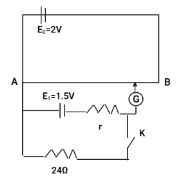
For the arrangement of the potentiometer shown in the figure, the balance point is obtained at a distance $ 75cm $ from A when the key $ k $ is open. The second balance point is obtained at $ 60cm $ from $ A $ when the key $ k $ is closed. Find the internal resistance $ (in\Omega ) $ of the battery $ {E_1} $ .
Answer
 Verified
533.1k+ views
Hint :Potentiometer working principle is that the potential drop in the wire which is carrying uniform current is directly proportional to its length. It is a device which is used to measure the internal resistance. The formula used is as follows:
$ r = \left( {\dfrac{{{l_1} - {l_2}}}{{{l_2}}}} \right) \times R $
Where $ {l_1} $ and $ {l_2} $ are the balancing point when the key is open and the key is closed respectively. $ R $ is the shunt resistance connected parallel to the battery.
Complete Step By Step Answer:
Let us consider the balance point obtained when the key is open as $ {l_1} $
$ {l_1} = 75cm = 0.75m $
Now, let us consider the balance point obtained when the key is closed as $ {l_2} $
When the key is closed, it produces a shunt and the balance point changes to $ 60 $ . So,
$ {l_2} = 60cm = 0.60m $
Let the shunt resistance be $ R $
$ R = 6\Omega $
Now, we know that the formula to calculate the internal resistance is:
$ r = \left( {\dfrac{{{l_1} - {l_2}}}{{{l_2}}}} \right) \times R $
Where, $ r $ is the internal resistance.
So, substituting the values we will get,
$ r = \left( {\dfrac{{0.75 - 0.60}}{{0.60}}} \right) \times 6 \\
r = \left( {\dfrac{{0.15}}{{0.60}}} \right) \times 6 \\
r = \dfrac{6}{4} \\
r = 1.5\Omega \\ $
Hence, the internal resistance of the battery $ {E_1} $ is $ 1.5\Omega $ .
Note :
It’s important to carry out necessary precautions while doing the experiment, to ensure that the calculated value is equal to the experimental value. The connections should be tight. The current should be uniform and it should not flow for a long time or else it heats up the wire. The cross sectional area of the wire should also be uniform.
$ r = \left( {\dfrac{{{l_1} - {l_2}}}{{{l_2}}}} \right) \times R $
Where $ {l_1} $ and $ {l_2} $ are the balancing point when the key is open and the key is closed respectively. $ R $ is the shunt resistance connected parallel to the battery.
Complete Step By Step Answer:
Let us consider the balance point obtained when the key is open as $ {l_1} $
$ {l_1} = 75cm = 0.75m $
Now, let us consider the balance point obtained when the key is closed as $ {l_2} $
When the key is closed, it produces a shunt and the balance point changes to $ 60 $ . So,
$ {l_2} = 60cm = 0.60m $
Let the shunt resistance be $ R $
$ R = 6\Omega $
Now, we know that the formula to calculate the internal resistance is:
$ r = \left( {\dfrac{{{l_1} - {l_2}}}{{{l_2}}}} \right) \times R $
Where, $ r $ is the internal resistance.
So, substituting the values we will get,
$ r = \left( {\dfrac{{0.75 - 0.60}}{{0.60}}} \right) \times 6 \\
r = \left( {\dfrac{{0.15}}{{0.60}}} \right) \times 6 \\
r = \dfrac{6}{4} \\
r = 1.5\Omega \\ $
Hence, the internal resistance of the battery $ {E_1} $ is $ 1.5\Omega $ .
Note :
It’s important to carry out necessary precautions while doing the experiment, to ensure that the calculated value is equal to the experimental value. The connections should be tight. The current should be uniform and it should not flow for a long time or else it heats up the wire. The cross sectional area of the wire should also be uniform.
Recently Updated Pages
Master Class 12 Economics: Engaging Questions & Answers for Success

Master Class 12 Physics: Engaging Questions & Answers for Success
Master Class 12 English: Engaging Questions & Answers for Success
Master Class 12 Social Science: Engaging Questions & Answers for Success
Master Class 12 Maths: Engaging Questions & Answers for Success
Master Class 12 Business Studies: Engaging Questions & Answers for Success
Trending doubts
Which are the Top 10 Largest Countries of the World?
What are the major means of transport Explain each class 12 social science CBSE
Draw a labelled sketch of the human eye class 12 physics CBSE
Why cannot DNA pass through cell membranes class 12 biology CBSE
Differentiate between insitu conservation and exsitu class 12 biology CBSE
Draw a neat and well labeled diagram of TS of ovary class 12 biology CBSE