




For paraxial rays, show that the focal length of a spherical mirror is one-half of its radius of curvature.
Answer
 Verified
625.2k+ views
Hint: A curved mirror is a mirror with the curved reflecting surfaces. If the inner side of the spherical mirror is reflecting then it is called a concave mirror and if the outer side of the spherical mirror is reflecting, it is called a convex mirror. To show that the focal length of a spherical mirror is one-half of its radius of curvature we can firstly make the ray diagram for both the mirrors and then apply congruence in triangles to reach the answer.
Complete step-by-step answer:
We will now prove the given formula for both the types of mirrors.
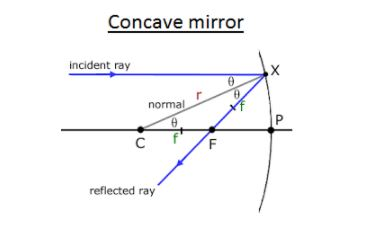
(a) Concave mirror
In the given figure P is the pole, F is the principal focus and C is the centre of curvature of a concave mirror of small aperture. Now, let us assume that a light ray AB be incident on the mirror in a direction parallel to the principal axis of the mirror. It gets reflected along BF. Join CB which is normal to mirror at B.
\[\angle ABC=i\], angle of incidence
\[\angle CBF=r\], angle of reflection
Now, \[\angle ABC=\angle BCF=i\] (alternate angles)
In \[\Delta CBF\] as i=r (law of reflection)
CF = FB
But as FB=FP because aperture is small
CF = FP
That is, F is the centre of PC
Hence, PF = \[\dfrac{1}{2}\]PC
Therefore, we get,
\[f=\dfrac{R}{2}\]
(b) Convex mirror
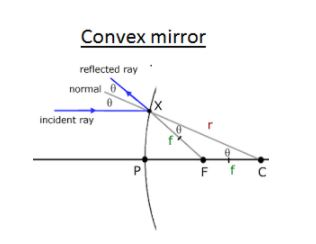
In the given figure P is the pole, F is the principal focus and C is the centre of curvature of a concave mirror of small aperture. Now, let us assume that a light ray AB be incident on the mirror in a direction parallel to the principal axis of the mirror. It gets reflected along BD and on producing back we see that it appears to come from principal focus F of the mirror. Join CB and produce it to N which is normal to mirror at B.
\[\angle ABN=i\], angle of incidence
\[\angle DBN=r\], angle of reflection
Now, \[\angle FBC=\angle DBN=r\] (opposite angles)
\[\angle BCF=\angle NBA=i\] (corresponding angles)
In \[\Delta CBF\] as i=r (law of reflection)
CF = FB
But as FB=FP because aperture is small
CF = FP
That is, F is the centre of PC
Hence, PF = \[\dfrac{1}{2}\]PC
Therefore, we get,
\[f=\dfrac{R}{2}\]
Note: The paraxial approximation which we have used in this derivation is a small-angle approximation used in Gaussian optics and ray tracing of light through an optical system. A paraxial ray is a ray which makes a small angle to the optical axis of the system and thus always lies close to the axis throughout the system.
Complete step-by-step answer:
We will now prove the given formula for both the types of mirrors.
(a) Concave mirror
In the given figure P is the pole, F is the principal focus and C is the centre of curvature of a concave mirror of small aperture. Now, let us assume that a light ray AB be incident on the mirror in a direction parallel to the principal axis of the mirror. It gets reflected along BF. Join CB which is normal to mirror at B.
\[\angle ABC=i\], angle of incidence
\[\angle CBF=r\], angle of reflection
Now, \[\angle ABC=\angle BCF=i\] (alternate angles)
In \[\Delta CBF\] as i=r (law of reflection)
CF = FB
But as FB=FP because aperture is small
CF = FP
That is, F is the centre of PC
Hence, PF = \[\dfrac{1}{2}\]PC
Therefore, we get,
\[f=\dfrac{R}{2}\]
(b) Convex mirror
In the given figure P is the pole, F is the principal focus and C is the centre of curvature of a concave mirror of small aperture. Now, let us assume that a light ray AB be incident on the mirror in a direction parallel to the principal axis of the mirror. It gets reflected along BD and on producing back we see that it appears to come from principal focus F of the mirror. Join CB and produce it to N which is normal to mirror at B.
\[\angle ABN=i\], angle of incidence
\[\angle DBN=r\], angle of reflection
Now, \[\angle FBC=\angle DBN=r\] (opposite angles)
\[\angle BCF=\angle NBA=i\] (corresponding angles)
In \[\Delta CBF\] as i=r (law of reflection)
CF = FB
But as FB=FP because aperture is small
CF = FP
That is, F is the centre of PC
Hence, PF = \[\dfrac{1}{2}\]PC
Therefore, we get,
\[f=\dfrac{R}{2}\]
Note: The paraxial approximation which we have used in this derivation is a small-angle approximation used in Gaussian optics and ray tracing of light through an optical system. A paraxial ray is a ray which makes a small angle to the optical axis of the system and thus always lies close to the axis throughout the system.
Recently Updated Pages
Master Class 12 Economics: Engaging Questions & Answers for Success

Master Class 12 English: Engaging Questions & Answers for Success
Master Class 12 Social Science: Engaging Questions & Answers for Success
Master Class 12 Maths: Engaging Questions & Answers for Success
Master Class 12 Physics: Engaging Questions & Answers for Success
Master Class 9 General Knowledge: Engaging Questions & Answers for Success
Trending doubts
Which are the Top 10 Largest Countries of the World?
Draw a labelled sketch of the human eye class 12 physics CBSE
Differentiate between homogeneous and heterogeneous class 12 chemistry CBSE
Sulphuric acid is known as the king of acids State class 12 chemistry CBSE
Why is the cell called the structural and functional class 12 biology CBSE
Draw ray diagrams each showing i myopic eye and ii class 12 physics CBSE