




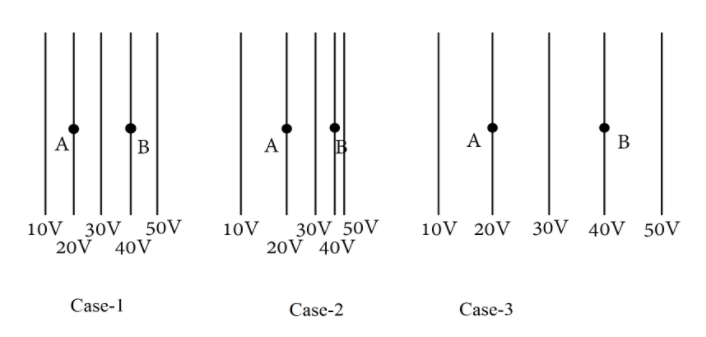
For case III what is the direction of the electric force exerted by the field on the \[ + 1\mu C\] charged object when at A and when at B?
A. Left at A and left at B.
B. Right at A and right at B.
C. Left at A and right at B.
D. Right at A and left at B.
Answer
 Verified
476.4k+ views
Hint: Potential energy of a system of two charges in free space is simply the potential energy of one charge because of the other. Note that positive and negative charges have a natural attraction in between them. Therefore, the amount of work required would be less.
Complete step by step answer:
Given that the charged particle of charge \[ + 1\mu C\] is moved from point \[A\] to \[B\] as shown within the figure. We have to identify the direction of the electric force exerted by the field on \[ + 1\mu C\] charge. Since positive charge moves from high potential to low potential. So, force on the positive charge at \[A\] and \[B\] is towards lower potential i.e, towards left of \[A\] as well as left off \[B\].
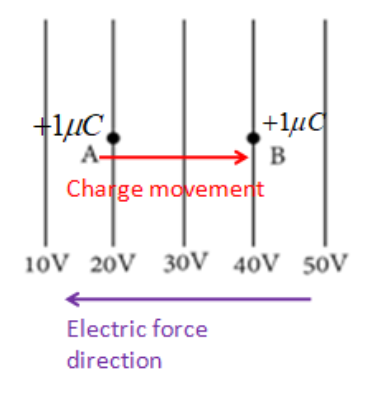
Hence, option A is correct.
Additional information: Electric current flows from higher electric potential to lower potential. If we put metal in an electrical circuit. As we all know that current flows from positive terminal to negative terminal. Then a positive terminal flows within the current direction. If electrons are present in metal then they flow opposite to the applied current which suggests current flows within the direction of the electric field.
The positive terminal is taken as high potential and the negative charge is taken as low potential. The direction of motion of the positive charge is often high potential to low potential but the direction of motion of the negative charge is often from low potential to high potential.
Note: The negative sign within potential energy is always an indicator of attractive forces. This means that we need not do any work, but instead, it might give us energy if taken slowly there. If we could take it there through an apparatus that might convert this released energy into useful forms, we might get energy.
Complete step by step answer:
Given that the charged particle of charge \[ + 1\mu C\] is moved from point \[A\] to \[B\] as shown within the figure. We have to identify the direction of the electric force exerted by the field on \[ + 1\mu C\] charge. Since positive charge moves from high potential to low potential. So, force on the positive charge at \[A\] and \[B\] is towards lower potential i.e, towards left of \[A\] as well as left off \[B\].
Hence, option A is correct.
Additional information: Electric current flows from higher electric potential to lower potential. If we put metal in an electrical circuit. As we all know that current flows from positive terminal to negative terminal. Then a positive terminal flows within the current direction. If electrons are present in metal then they flow opposite to the applied current which suggests current flows within the direction of the electric field.
The positive terminal is taken as high potential and the negative charge is taken as low potential. The direction of motion of the positive charge is often high potential to low potential but the direction of motion of the negative charge is often from low potential to high potential.
Note: The negative sign within potential energy is always an indicator of attractive forces. This means that we need not do any work, but instead, it might give us energy if taken slowly there. If we could take it there through an apparatus that might convert this released energy into useful forms, we might get energy.
Recently Updated Pages
Master Class 12 Economics: Engaging Questions & Answers for Success

Master Class 12 Physics: Engaging Questions & Answers for Success
Master Class 12 English: Engaging Questions & Answers for Success
Master Class 12 Social Science: Engaging Questions & Answers for Success
Master Class 12 Maths: Engaging Questions & Answers for Success
Master Class 12 Business Studies: Engaging Questions & Answers for Success
Trending doubts
Which are the Top 10 Largest Countries of the World?
What are the major means of transport Explain each class 12 social science CBSE
Draw a labelled sketch of the human eye class 12 physics CBSE
Why cannot DNA pass through cell membranes class 12 biology CBSE
Differentiate between insitu conservation and exsitu class 12 biology CBSE
Draw a neat and well labeled diagram of TS of ovary class 12 biology CBSE