




For a parallel beam of monochromatic light of wavelength $ '\lambda ' $, diffraction is produced by a single slit whose width $ 'a' $ is of the order of the wavelength of the light. If $ 'D' $ is the distance of the screen from the slit, the width of the central maxima will be
$ A.\dfrac{Da}{\lambda } $
$ B.\dfrac{2Da}{\lambda } $
$ C.\dfrac{2D\lambda }{a} $
$ D.\dfrac{D\lambda }{a} $
Answer
 Verified
571.8k+ views
Hint: We have to use the concept of Diffraction in the process of solving the problem. The central maxima lie between the minima. The width of the central maxima is given as the distance between the first order minima from the screen’s centre on both sides. Light of a single wavelength is called monochromatic light.
Formula used:
We are going to use the following formula to get the required result:-
$ \vartriangle y=2\Theta D $.
Complete step-by-step answer:
We will draw the following diagram to solve this particular problem:-
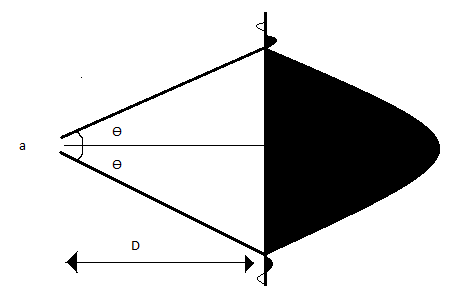
To find the width of the central maxima we will use the following relation:-
$ \vartriangle y=2\Theta D $ ………… $ (i) $
Where, $ \vartriangle y $ represents width of the central maxima, $ D $ represents distance of the screen from the slit and $ \Theta $ is angle relative to the original direction of the light.
We also know that $ \Theta =\dfrac{\lambda }{a} $ …………. $ (ii) $
Where, $ \lambda $ is the wavelength of the monochromatic light and $ a $ is the width of the single slit.
Putting equation $ (ii) $ in $ (i) $ we get,
$ \vartriangle y=\dfrac{2D\lambda }{a} $.
Hence, option $ (C) $ is correct.
So, the correct answer is “Option C”.
Additional Information: The bending of light around the corners such that it spreads out and illuminates areas where the shadow is expected to form is called diffraction. Diffraction is due to the superposition of two secondary wavelets originating from different points of the same wave front. The widths of the fringes are not equal in diffraction.
Note: We should not be confused between diffraction and interference. One should know that the bright fringes are of varying intensity in diffraction pattern unlike in interference pattern. Central maxima are the regions where one gets the maximum intensity. Bands are also few in numbers as compared to interference.
Formula used:
We are going to use the following formula to get the required result:-
$ \vartriangle y=2\Theta D $.
Complete step-by-step answer:
We will draw the following diagram to solve this particular problem:-
To find the width of the central maxima we will use the following relation:-
$ \vartriangle y=2\Theta D $ ………… $ (i) $
Where, $ \vartriangle y $ represents width of the central maxima, $ D $ represents distance of the screen from the slit and $ \Theta $ is angle relative to the original direction of the light.
We also know that $ \Theta =\dfrac{\lambda }{a} $ …………. $ (ii) $
Where, $ \lambda $ is the wavelength of the monochromatic light and $ a $ is the width of the single slit.
Putting equation $ (ii) $ in $ (i) $ we get,
$ \vartriangle y=\dfrac{2D\lambda }{a} $.
Hence, option $ (C) $ is correct.
So, the correct answer is “Option C”.
Additional Information: The bending of light around the corners such that it spreads out and illuminates areas where the shadow is expected to form is called diffraction. Diffraction is due to the superposition of two secondary wavelets originating from different points of the same wave front. The widths of the fringes are not equal in diffraction.
Note: We should not be confused between diffraction and interference. One should know that the bright fringes are of varying intensity in diffraction pattern unlike in interference pattern. Central maxima are the regions where one gets the maximum intensity. Bands are also few in numbers as compared to interference.
Recently Updated Pages
Master Class 12 Economics: Engaging Questions & Answers for Success

Master Class 12 Physics: Engaging Questions & Answers for Success
Master Class 12 English: Engaging Questions & Answers for Success
Master Class 12 Social Science: Engaging Questions & Answers for Success
Master Class 12 Maths: Engaging Questions & Answers for Success
Master Class 12 Business Studies: Engaging Questions & Answers for Success
Trending doubts
Which are the Top 10 Largest Countries of the World?
What are the major means of transport Explain each class 12 social science CBSE
Draw a labelled sketch of the human eye class 12 physics CBSE
Why cannot DNA pass through cell membranes class 12 biology CBSE
Differentiate between insitu conservation and exsitu class 12 biology CBSE
Draw a neat and well labeled diagram of TS of ovary class 12 biology CBSE