



For a linear plot of \[\log (x/m)\] versus \[\log p\] in a Freundlich adsorption isotherm, which of the following statements is correct ? (\[k\]and \[n\] are constants)
A. \[\dfrac{1}{n}\] appears as the intercept.
B. Only \[\dfrac{1}{n}\] appears as the slope.
C. log\[\dfrac{1}{n}\] appears as the intercept.
D. Both \[k\] and \[\dfrac{1}{n}\] appear in the slope term
Answer
 Verified
598.2k+ views
Hint: An adsorption isotherm is a curve relating the equilibrium concentration of a solute on the surface of an adsorbent. The adsorption isotherm is also an equation relating the amount of solute adsorbed onto the solid.
Complete step by step answer:
Freundlich Adsorption Isotherm gives the variation in the quantity of gas adsorbed by a unit mass of solid adsorbent with the change in pressure of the system for a given temperature. The expression for the Freundlich isotherm can be represented by the following equation;
\[\Rightarrow \dfrac{x}{m}=k{{P}^{\dfrac{1}{n}}}\]
Where \[x\] is the mass of the gas adsorbed, \[m\]is the mass of the adsorbent, \[P\] is the pressure and \[n\] is a constant which depends upon the nature of adsorbent and the gas at a given temperature. Taking the logarithm on both the sides of the equation, we get;
\[\Rightarrow \log \dfrac{x}{m}=\log k+\dfrac{1}{n}\log {{P}^{{}}}\]
On comparing this equation with the equation of straight line(\[y=mx+c\]). The plot of this equation is a straight line as represented by the following curve.
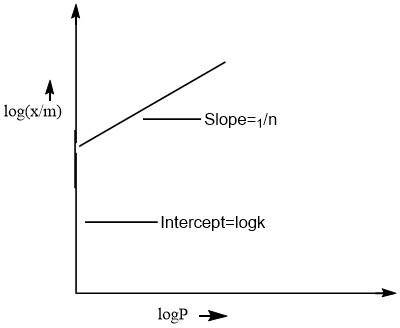
From the graph, it is very clear that only \[1/n\] appears as the slope.
So, the correct answer is Option B.
Note: The Freundlich adsorption isotherm is followed by another two isotherms, Langmuir adsorption isotherms and BET theory. The Langmuir adsorption isotherms predict linear adsorption at low adsorption densities and a maximum surface coverage at higher solute metal concentrations.
Complete step by step answer:
Freundlich Adsorption Isotherm gives the variation in the quantity of gas adsorbed by a unit mass of solid adsorbent with the change in pressure of the system for a given temperature. The expression for the Freundlich isotherm can be represented by the following equation;
\[\Rightarrow \dfrac{x}{m}=k{{P}^{\dfrac{1}{n}}}\]
Where \[x\] is the mass of the gas adsorbed, \[m\]is the mass of the adsorbent, \[P\] is the pressure and \[n\] is a constant which depends upon the nature of adsorbent and the gas at a given temperature. Taking the logarithm on both the sides of the equation, we get;
\[\Rightarrow \log \dfrac{x}{m}=\log k+\dfrac{1}{n}\log {{P}^{{}}}\]
On comparing this equation with the equation of straight line(\[y=mx+c\]). The plot of this equation is a straight line as represented by the following curve.
From the graph, it is very clear that only \[1/n\] appears as the slope.
So, the correct answer is Option B.
Note: The Freundlich adsorption isotherm is followed by another two isotherms, Langmuir adsorption isotherms and BET theory. The Langmuir adsorption isotherms predict linear adsorption at low adsorption densities and a maximum surface coverage at higher solute metal concentrations.
Recently Updated Pages
Master Class 10 Computer Science: Engaging Questions & Answers for Success

Master Class 10 General Knowledge: Engaging Questions & Answers for Success
Master Class 10 English: Engaging Questions & Answers for Success
Master Class 10 Social Science: Engaging Questions & Answers for Success
Master Class 10 Maths: Engaging Questions & Answers for Success
Master Class 10 Science: Engaging Questions & Answers for Success
Trending doubts
Which is more stable and why class 12 chemistry CBSE
Which are the Top 10 Largest Countries of the World?
Draw a labelled sketch of the human eye class 12 physics CBSE
Differentiate between homogeneous and heterogeneous class 12 chemistry CBSE
What are the major means of transport Explain each class 12 social science CBSE
Sulphuric acid is known as the king of acids State class 12 chemistry CBSE