




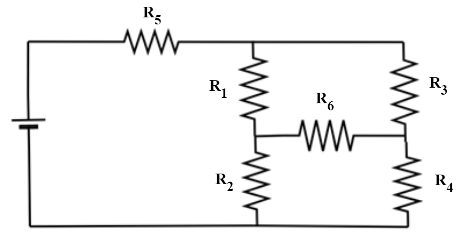
For a given circuit it is observed that the current $I$ is independent of the value of the resistance ${R_6}$ . The resistance values must satisfy:
A. ${R_2}{R_3} = {R_1}{R_4}$
B. ${R_3}{R_4}{R_6} = {R_2}{R_1}{R_5}$
C. $\dfrac{1}{{{R_3} + {R_4}}} = \dfrac{1}{{{R_5} + {R_6}}} = \dfrac{1}{{{R_1} + {R_2}}}$
D. \[{R_3}{R_1} = {R_2}{R_4} = {R_5}{R_6}\]
Answer
 Verified
508.2k+ views
Hint: To find the condition that satisfy the circuit in which the current $I$ is independent of the value of the resistance ${R_6}$ , i.e. no current should be flowing through ${R_6}$ , we analyze the junctions of the same potential. We use the concept of Wheatstone’s meter bridge to find the condition.
Complete step by step answer:
We know that, current $I$ is independent of the value of the resistance ${R_6}$ , no current is flowing through the ${R_6}$. This requires that the junction of ${R_1}\& {R_2}$ must be at the same potential as the junction of ${R_3}\& {R_4}$. This must satisfy the Wheatstone’s meter bridge balancing condition i.e. ${R_2}{R_3} = {R_1}{R_4}$.
Hence, option A is correct.
Note:The Wheatstone’s meter bridge is an arrangement of four resistances used to measure one of them in terms of the three. We should note that, on changing the position of the cell and resistances, the balancing condition is not changed. Resistance ${R_5}$ is in series with ${R_1}$, so it will not produce any effect in the balancing condition.
Complete step by step answer:
We know that, current $I$ is independent of the value of the resistance ${R_6}$ , no current is flowing through the ${R_6}$. This requires that the junction of ${R_1}\& {R_2}$ must be at the same potential as the junction of ${R_3}\& {R_4}$. This must satisfy the Wheatstone’s meter bridge balancing condition i.e. ${R_2}{R_3} = {R_1}{R_4}$.
Hence, option A is correct.
Note:The Wheatstone’s meter bridge is an arrangement of four resistances used to measure one of them in terms of the three. We should note that, on changing the position of the cell and resistances, the balancing condition is not changed. Resistance ${R_5}$ is in series with ${R_1}$, so it will not produce any effect in the balancing condition.
Recently Updated Pages
Master Class 12 Economics: Engaging Questions & Answers for Success

Master Class 12 Physics: Engaging Questions & Answers for Success
Master Class 12 English: Engaging Questions & Answers for Success
Master Class 12 Social Science: Engaging Questions & Answers for Success
Master Class 12 Maths: Engaging Questions & Answers for Success
Master Class 12 Business Studies: Engaging Questions & Answers for Success
Trending doubts
Which are the Top 10 Largest Countries of the World?
What are the major means of transport Explain each class 12 social science CBSE
Draw a labelled sketch of the human eye class 12 physics CBSE
Why cannot DNA pass through cell membranes class 12 biology CBSE
Differentiate between insitu conservation and exsitu class 12 biology CBSE
Draw a neat and well labeled diagram of TS of ovary class 12 biology CBSE