




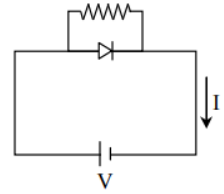
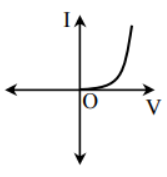
For a diode connected in parallel with a resistor, which is the most likely current (I) – voltage (V) characteristic?
A.
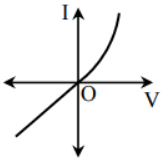
B.
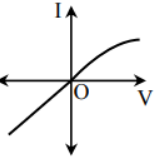
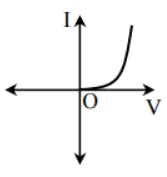
C.
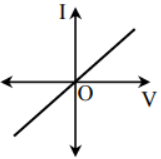
D.
Answer
 Verified
615.6k+ views
Hint: The current always follows the path where resistance is minimum. The diode only conducts forward biasing. The diode doesn’t work in reverse bias.
Complete step by step answer:
You have to find the I – V characteristic of the given circuit.
Notice the question, the resistance is connected in parallel with the diode. So, when the diode is forward biased, the current (I) – voltage (V) characteristic of the diode dominant. Or when the diode in reverse bias then, current passes through the resistance then, the current (I) is directly proportional to the voltage (V).
The current (I) – voltage (V) characteristic in option A fits the most.
So, option A is the correct answer.
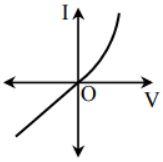
Option B is incorrect because on the positive side the current (I) – voltage (V) characteristic of the diode is wrong.
Option C is incorrect because on the positive side the current (I) – voltage (V) characteristic of the diode is wrong.
Option D is incorrect because when the diode is reverse biased then the current is directly proportional to the voltage. This part of the graph had not been drawn.
So, the correct answer is “Option A”.
Additional Information:
For the diode in forward bias, the current increases exponentially with the voltage, and in reverse bias, the ideal diode does not conduct any current through the diode.
The current (I) – voltage (V) characteristic of the diode is.
The current (I) – voltage (V) characteristic of the resistor is
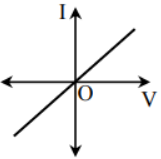
The current is directly proportional to the voltage for the resistor.
Note:
Try to remember the current (I) – voltage (V) characteristic of the diode. In forward bias, the current increases exponentially with the voltage. And in reverse bias the ideal diode does not conduct any current through the diode.
Complete step by step answer:
You have to find the I – V characteristic of the given circuit.
Notice the question, the resistance is connected in parallel with the diode. So, when the diode is forward biased, the current (I) – voltage (V) characteristic of the diode dominant. Or when the diode in reverse bias then, current passes through the resistance then, the current (I) is directly proportional to the voltage (V).
The current (I) – voltage (V) characteristic in option A fits the most.
So, option A is the correct answer.
Option B is incorrect because on the positive side the current (I) – voltage (V) characteristic of the diode is wrong.
Option C is incorrect because on the positive side the current (I) – voltage (V) characteristic of the diode is wrong.
Option D is incorrect because when the diode is reverse biased then the current is directly proportional to the voltage. This part of the graph had not been drawn.
So, the correct answer is “Option A”.
Additional Information:
For the diode in forward bias, the current increases exponentially with the voltage, and in reverse bias, the ideal diode does not conduct any current through the diode.
The current (I) – voltage (V) characteristic of the diode is.
The current (I) – voltage (V) characteristic of the resistor is
The current is directly proportional to the voltage for the resistor.
Note:
Try to remember the current (I) – voltage (V) characteristic of the diode. In forward bias, the current increases exponentially with the voltage. And in reverse bias the ideal diode does not conduct any current through the diode.
Recently Updated Pages
Master Class 12 Business Studies: Engaging Questions & Answers for Success

Master Class 12 Biology: Engaging Questions & Answers for Success
Master Class 12 Chemistry: Engaging Questions & Answers for Success
Class 12 Question and Answer - Your Ultimate Solutions Guide
Master Class 11 English: Engaging Questions & Answers for Success
Master Class 11 Social Science: Engaging Questions & Answers for Success
Trending doubts
Which are the Top 10 Largest Countries of the World?
Draw a labelled sketch of the human eye class 12 physics CBSE
Differentiate between homogeneous and heterogeneous class 12 chemistry CBSE
Why is the cell called the structural and functional class 12 biology CBSE
Draw ray diagrams each showing i myopic eye and ii class 12 physics CBSE
Which is the correct genotypic ratio of mendel dihybrid class 12 biology CBSE