




For a CE transistor amplifier, the audio signal voltage across the collector resistance of $\text{2k }\Omega$ is 2V. Suppose the current amplification factor of the transistor is 100. What should be the value of ${{\text{R}}_{\text{B}}}$ in series with ${{\text{V}}_{\text{BB}}}$ supply of 2V if the dc base current has to be 10 times the signal current. Also calculate the dc drop across the collector resistance. Take ${{\text{V}}_{\text{BE}}}$ = 0.6V.
Answer
 Verified
672.6k+ views
Hint: To solve this question, we should be having an idea about the formulas including collector current, current gain, base input and lastly the dc drop across the collector current. To solve the numerical, we should be beginning with the value of current gain.
Complete step-by-step solution:
We should know that in case of a transistor, on the input side apart from that of the audio signal voltage, there would also be a dc supply. For the transistor to operate in its active region, there is the absence of the signal, but there should be the base current. This is known as the bias current which helps in keeping the transistor active. The signal current is the AC current in the base emitter junction due to the audio signal voltage. From the question, we can draw,
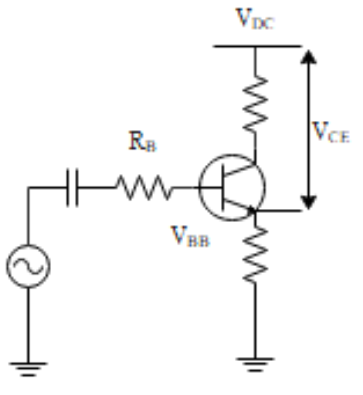
It is given in the question that,
${{\text{R}}_{\text{C}}}\text{ = 2k }\Omega$
${{\text{R}}_{\text{C}}}\text{ = 2 }\!\!\times\!\!\text{ 1}{{\text{0}}^{\text{3}}}\text{ }\!\!\Omega\!\!\text{ }$
Here the ${{\text{R}}_{\text{C}}}$ stands for Collector resistance.
It is also given that ${{\text{V}}_{\text{C}}}$ is equal to 2 volts.
The current amplification factor or $\text{ }\!\!\beta\!\!\text{ }$ is given as 100.
The ${{\text{V}}_{\text{BB}}}$ is given as 2 volts.
Now let us see that,
The current at the collector due to the audio signal will be $\text{= }\dfrac{\text{2}}{\text{2 }\!\!\times\!\!\text{ 10}{{\text{ }}^{\text{3}}}}\text{ = }\dfrac{\text{1}}{\text{1000}}\text{ = 1 mA}$
It is given that,
Current Gain = $\beta$= 100
The value of Current Gain is given as $\dfrac{\text{Current at collector}}{\text{signal current at base}}$.
Hence, the signal current at the base input will be : $\dfrac{\text{Current at collector}}{\text{ }\!\!\beta\!\!\text{ }}$
The value of the signal current at the base input will be $\dfrac{\text{1}{{\text{0}}^{-\text{3}}}}{\text{100}}\text{ = 1}{{\text{0}}^{-\text{5}}}\text{A = 10 }\!\!\mu\!\!\text{ A}$
Now let us find the value of ${{\text{R}}_{\text{B}}}$.
If the base current is 10 times that of the signal current, then it means $\text{signal current at base input }\!\!\times\!\!\text{ 10}$.
This also means that $\text{10 }\!\!\mu\!\!\text{ A }\!\!\times\!\!\text{ 10 = 100 }\!\!\mu\!\!\text{ A}$
Now the value of ${{\text{V}}_{\text{BE}}}$ = 0.6 volts.
Therefore, the value of ${{\text{R}}_{\text{B}}}$is $\dfrac{\text{0.6}}{\text{100}\mu\text{A}}$ which is equal to $\text{6k }\Omega$.
Now we have to find the value of DC drop at the collector resistance.
It is given that the DC current at the collector is 100 times the 100 micro ampere, which is equal to 10 milliampere.
Therefore, the drop across the $\text{2k }\Omega \text{ V}$which is equal to IR, which gives us $\text{10 }\!\!\times\!\!\text{ 1}{{\text{0}}^{-\text{3}}}\text{ }\!\!\times\!\!\text{ 2 }\!\!\times\!\!\text{ 1}{{\text{0}}^{\text{3}}}$.
The result of which is 20 volts or 20 V.
Note: We should be having an idea about the CE amplifier transistor. The CE amplifier transistor is known as a three basic single stage bipolar junction transistor. It can also be used as a voltage amplifier. The input of this transistor is taken from the base terminal and the output of this collected from the collector terminal and the emitter terminal is common for both of the terminals.
Complete step-by-step solution:
We should know that in case of a transistor, on the input side apart from that of the audio signal voltage, there would also be a dc supply. For the transistor to operate in its active region, there is the absence of the signal, but there should be the base current. This is known as the bias current which helps in keeping the transistor active. The signal current is the AC current in the base emitter junction due to the audio signal voltage. From the question, we can draw,
It is given in the question that,
${{\text{R}}_{\text{C}}}\text{ = 2k }\Omega$
${{\text{R}}_{\text{C}}}\text{ = 2 }\!\!\times\!\!\text{ 1}{{\text{0}}^{\text{3}}}\text{ }\!\!\Omega\!\!\text{ }$
Here the ${{\text{R}}_{\text{C}}}$ stands for Collector resistance.
It is also given that ${{\text{V}}_{\text{C}}}$ is equal to 2 volts.
The current amplification factor or $\text{ }\!\!\beta\!\!\text{ }$ is given as 100.
The ${{\text{V}}_{\text{BB}}}$ is given as 2 volts.
Now let us see that,
The current at the collector due to the audio signal will be $\text{= }\dfrac{\text{2}}{\text{2 }\!\!\times\!\!\text{ 10}{{\text{ }}^{\text{3}}}}\text{ = }\dfrac{\text{1}}{\text{1000}}\text{ = 1 mA}$
It is given that,
Current Gain = $\beta$= 100
The value of Current Gain is given as $\dfrac{\text{Current at collector}}{\text{signal current at base}}$.
Hence, the signal current at the base input will be : $\dfrac{\text{Current at collector}}{\text{ }\!\!\beta\!\!\text{ }}$
The value of the signal current at the base input will be $\dfrac{\text{1}{{\text{0}}^{-\text{3}}}}{\text{100}}\text{ = 1}{{\text{0}}^{-\text{5}}}\text{A = 10 }\!\!\mu\!\!\text{ A}$
Now let us find the value of ${{\text{R}}_{\text{B}}}$.
If the base current is 10 times that of the signal current, then it means $\text{signal current at base input }\!\!\times\!\!\text{ 10}$.
This also means that $\text{10 }\!\!\mu\!\!\text{ A }\!\!\times\!\!\text{ 10 = 100 }\!\!\mu\!\!\text{ A}$
Now the value of ${{\text{V}}_{\text{BE}}}$ = 0.6 volts.
Therefore, the value of ${{\text{R}}_{\text{B}}}$is $\dfrac{\text{0.6}}{\text{100}\mu\text{A}}$ which is equal to $\text{6k }\Omega$.
Now we have to find the value of DC drop at the collector resistance.
It is given that the DC current at the collector is 100 times the 100 micro ampere, which is equal to 10 milliampere.
Therefore, the drop across the $\text{2k }\Omega \text{ V}$which is equal to IR, which gives us $\text{10 }\!\!\times\!\!\text{ 1}{{\text{0}}^{-\text{3}}}\text{ }\!\!\times\!\!\text{ 2 }\!\!\times\!\!\text{ 1}{{\text{0}}^{\text{3}}}$.
The result of which is 20 volts or 20 V.
Note: We should be having an idea about the CE amplifier transistor. The CE amplifier transistor is known as a three basic single stage bipolar junction transistor. It can also be used as a voltage amplifier. The input of this transistor is taken from the base terminal and the output of this collected from the collector terminal and the emitter terminal is common for both of the terminals.
Recently Updated Pages
Master Class 12 Physics: Engaging Questions & Answers for Success

Master Class 12 Social Science: Engaging Questions & Answers for Success
Master Class 12 English: Engaging Questions & Answers for Success
Master Class 12 Maths: Engaging Questions & Answers for Success
Master Class 12 Business Studies: Engaging Questions & Answers for Success
Master Class 12 Chemistry: Engaging Questions & Answers for Success
Trending doubts
Draw a labelled sketch of the human eye class 12 physics CBSE
Which are the Top 10 Largest Countries of the World?
Draw ray diagrams each showing i myopic eye and ii class 12 physics CBSE
One megawatt is equal to how many units of electri class 12 physics CBSE
Which is the correct genotypic ratio of mendel dihybrid class 12 biology CBSE
Give 10 examples of unisexual and bisexual flowers