




Following diagrams were drawn by different students on having seen prepared slides of budding in yeast.
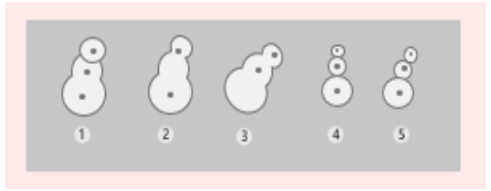
Correct diagrams are
(a)I, II, III
(b)II, III, IV
(c)III, IV, V
(d)I, IV, V
Answer
 Verified
597.3k+ views
Hint: A type of asexual reproduction found in the members of the phylum coelenterate. The offspring develops through the repeated mitotic division as the new cell grows out of the parental cell. The new cell can now grow on their own into a new hydra.
Complete answer:
Budding is the mode of asexual reproduction wherein an outgrowth of part of a cell/body develops into progeny and either get separated or remain attached to the parent to form a new colony. Options II and III are incorrect as the nucleus should be present in all buds. Option I show bud formation and nuclear division. Options IV and V show the chain of cells produced by budding.
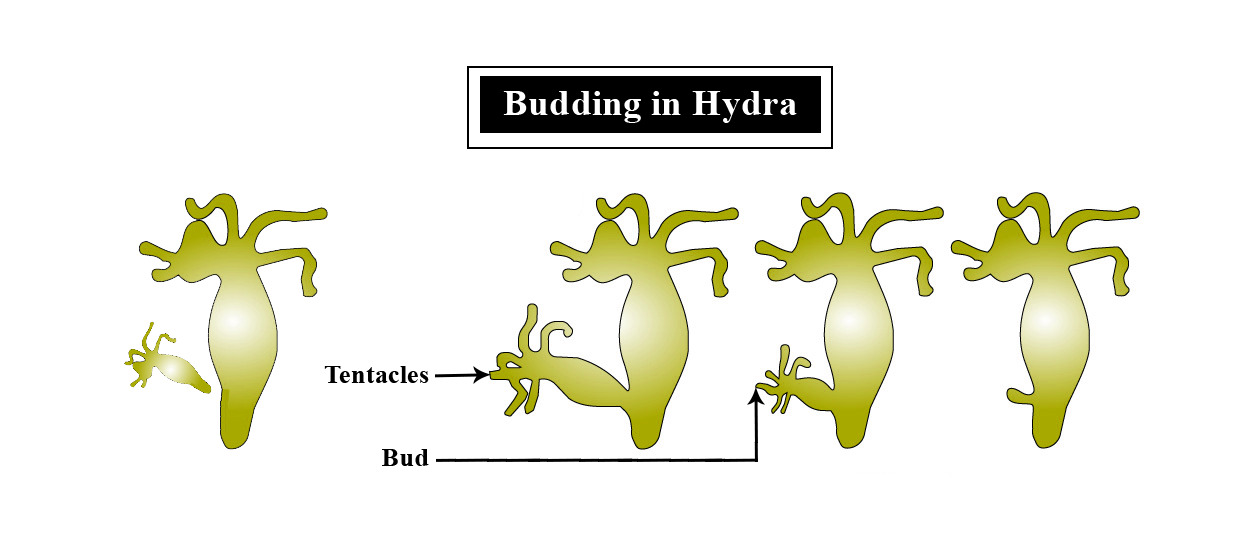
Additional Information: -Budding occurs in Hydra. In this process, the parent cell remains (or not destroyed) and a new daughter cell is formed. The hydra uses the regenerative cells to produce in this manner. The new hydra grows in the form of a bud and stays attached to the parental body while it grows. In Hydra, the budding occurs at a specific point only. The small bud then receives its nutrition from the parent hydra, which helps it to grow. Development begins with the advancement of little appendages and the mouth until the recently delivered hydra gets isolated from its parent hydra and turns into a free creature. Since it is an asexual type of reproduction, the new organism is genetically similar to the parent hydra.
So, the correct answer is,’I, IV, V.’
Note: -Budding is most commonly associated with both multicellular and unicellular organisms. Some animal species that reproduce by the process of budding are bacteria, yeast, Jellyfish, corals, flatworms, and sea anemones.
-Budding is also common in sponges.
- In many species, the buds can emerge at any point from the body, while in some it is restricted to a specialized area.
-In many species, the new individual separates to exist separately from the parent, and in some the buds may remain attached, forming aggregates or colonies.
-Coelenterates exhibit asexual reproduction by budding and sexual reproduction by medusa.
Complete answer:
Budding is the mode of asexual reproduction wherein an outgrowth of part of a cell/body develops into progeny and either get separated or remain attached to the parent to form a new colony. Options II and III are incorrect as the nucleus should be present in all buds. Option I show bud formation and nuclear division. Options IV and V show the chain of cells produced by budding.
Additional Information: -Budding occurs in Hydra. In this process, the parent cell remains (or not destroyed) and a new daughter cell is formed. The hydra uses the regenerative cells to produce in this manner. The new hydra grows in the form of a bud and stays attached to the parental body while it grows. In Hydra, the budding occurs at a specific point only. The small bud then receives its nutrition from the parent hydra, which helps it to grow. Development begins with the advancement of little appendages and the mouth until the recently delivered hydra gets isolated from its parent hydra and turns into a free creature. Since it is an asexual type of reproduction, the new organism is genetically similar to the parent hydra.
So, the correct answer is,’I, IV, V.’
Note: -Budding is most commonly associated with both multicellular and unicellular organisms. Some animal species that reproduce by the process of budding are bacteria, yeast, Jellyfish, corals, flatworms, and sea anemones.
-Budding is also common in sponges.
- In many species, the buds can emerge at any point from the body, while in some it is restricted to a specialized area.
-In many species, the new individual separates to exist separately from the parent, and in some the buds may remain attached, forming aggregates or colonies.
-Coelenterates exhibit asexual reproduction by budding and sexual reproduction by medusa.
Recently Updated Pages
Three beakers labelled as A B and C each containing 25 mL of water were taken A small amount of NaOH anhydrous CuSO4 and NaCl were added to the beakers A B and C respectively It was observed that there was an increase in the temperature of the solutions contained in beakers A and B whereas in case of beaker C the temperature of the solution falls Which one of the following statements isarecorrect i In beakers A and B exothermic process has occurred ii In beakers A and B endothermic process has occurred iii In beaker C exothermic process has occurred iv In beaker C endothermic process has occurred

Master Class 12 Social Science: Engaging Questions & Answers for Success
Master Class 12 Physics: Engaging Questions & Answers for Success
Master Class 12 Maths: Engaging Questions & Answers for Success
Master Class 12 Economics: Engaging Questions & Answers for Success
Master Class 12 Chemistry: Engaging Questions & Answers for Success
Three beakers labelled as A B and C each containing 25 mL of water were taken A small amount of NaOH anhydrous CuSO4 and NaCl were added to the beakers A B and C respectively It was observed that there was an increase in the temperature of the solutions contained in beakers A and B whereas in case of beaker C the temperature of the solution falls Which one of the following statements isarecorrect i In beakers A and B exothermic process has occurred ii In beakers A and B endothermic process has occurred iii In beaker C exothermic process has occurred iv In beaker C endothermic process has occurred
Master Class 12 Social Science: Engaging Questions & Answers for Success
Master Class 12 Physics: Engaging Questions & Answers for Success
Trending doubts
Which are the Top 10 Largest Countries of the World?
Draw a labelled sketch of the human eye class 12 physics CBSE
Explain the structure of megasporangium class 12 biology CBSE
What are the major means of transport Explain each class 12 social science CBSE
Differentiate between homogeneous and heterogeneous class 12 chemistry CBSE
Sulphuric acid is known as the king of acids State class 12 chemistry CBSE