




Focal length of the convex lens is \[3cm\] . Find the image distance if an object of height \[2cm\] is placed at \[7cm\] from the lens?
Answer
 Verified
489.6k+ views
Hint: In order to answer the given question where we are asked to find out the image distance we will use the lens formula. The lens formula is a relationship between a lens' focal length and the distance between an object in front of it and the image created by that object.
Formula used:
$\dfrac{1}{f} = \dfrac{1}{v} - \dfrac{1}{u}$
Where,
$v - $ is the image distance
$u - $ is the object distance
$f - $ is the focal length
Complete step by step solution:
The Lens formula describes the relationship between the distance of an image \[\left( v \right)\] , the distance of an object \[\left( u \right)\] , and the focal length \[\left( f \right)\] of the lens in optics. The lens formula works for both convex and concave lenses. The thickness of these lenses is minimal. The following is the formula: $\dfrac{1}{f} = \dfrac{1}{v} - \dfrac{1}{u}$
To determine the desired answer to our supplied question, we will use the formula above.
The focal length as $(3cm)$ and the object distance as $\left( { - 7cm} \right)$ is given to us in the question hence, we need to find out the image distance. So,
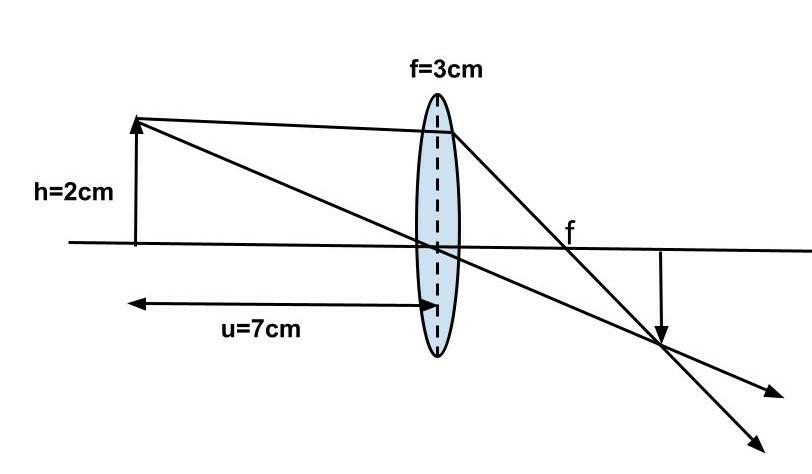
The ray diagram of image formation is given by
$\dfrac{1}{f} = \dfrac{1}{v} - \dfrac{1}{u}$
Where, $\left( {u = - 7\,,\,f = 3cm} \right)$
Now, arranging the equation in manner
$\dfrac{1}{f} + \dfrac{1}{u} = \dfrac{1}{v}$
Now, putting all the known terms
$\dfrac{1}{3} - \dfrac{1}{7} = \dfrac{1}{v}$
Now, taking LCM
$
\dfrac{{7 - 3}}{{21}} = \dfrac{1}{v} \\
\dfrac{4}{{21}} = \dfrac{1}{v} \\
\therefore v = \dfrac{{21}}{4} = 5.25cm \\
$
Therefore the image distance will be $5.25cm$ .
Note:
The lens formula is applicable to both convex and concave lenses. It can also be used to figure out how far real and virtual images are apart. If the equation yields a negative image distance, the resulting picture is virtual and on the same side as the item. If the equation yields a negative focal length, the lens is diverging rather than converging.
Formula used:
$\dfrac{1}{f} = \dfrac{1}{v} - \dfrac{1}{u}$
Where,
$v - $ is the image distance
$u - $ is the object distance
$f - $ is the focal length
Complete step by step solution:
The Lens formula describes the relationship between the distance of an image \[\left( v \right)\] , the distance of an object \[\left( u \right)\] , and the focal length \[\left( f \right)\] of the lens in optics. The lens formula works for both convex and concave lenses. The thickness of these lenses is minimal. The following is the formula: $\dfrac{1}{f} = \dfrac{1}{v} - \dfrac{1}{u}$
To determine the desired answer to our supplied question, we will use the formula above.
The focal length as $(3cm)$ and the object distance as $\left( { - 7cm} \right)$ is given to us in the question hence, we need to find out the image distance. So,
The ray diagram of image formation is given by
$\dfrac{1}{f} = \dfrac{1}{v} - \dfrac{1}{u}$
Where, $\left( {u = - 7\,,\,f = 3cm} \right)$
Now, arranging the equation in manner
$\dfrac{1}{f} + \dfrac{1}{u} = \dfrac{1}{v}$
Now, putting all the known terms
$\dfrac{1}{3} - \dfrac{1}{7} = \dfrac{1}{v}$
Now, taking LCM
$
\dfrac{{7 - 3}}{{21}} = \dfrac{1}{v} \\
\dfrac{4}{{21}} = \dfrac{1}{v} \\
\therefore v = \dfrac{{21}}{4} = 5.25cm \\
$
Therefore the image distance will be $5.25cm$ .
Note:
The lens formula is applicable to both convex and concave lenses. It can also be used to figure out how far real and virtual images are apart. If the equation yields a negative image distance, the resulting picture is virtual and on the same side as the item. If the equation yields a negative focal length, the lens is diverging rather than converging.
Recently Updated Pages
Master Class 12 Economics: Engaging Questions & Answers for Success

Master Class 12 Physics: Engaging Questions & Answers for Success
Master Class 12 English: Engaging Questions & Answers for Success
Master Class 12 Social Science: Engaging Questions & Answers for Success
Master Class 12 Maths: Engaging Questions & Answers for Success
Master Class 12 Business Studies: Engaging Questions & Answers for Success
Trending doubts
Which are the Top 10 Largest Countries of the World?
What are the major means of transport Explain each class 12 social science CBSE
Draw a labelled sketch of the human eye class 12 physics CBSE
Why cannot DNA pass through cell membranes class 12 biology CBSE
Differentiate between insitu conservation and exsitu class 12 biology CBSE
Draw a neat and well labeled diagram of TS of ovary class 12 biology CBSE