




Flowers are monochlamydeous in
A. Malvaceae
B. Fabaceae
C. Liliaceae
D. Polygonaceae
Answer
 Verified
587.1k+ views
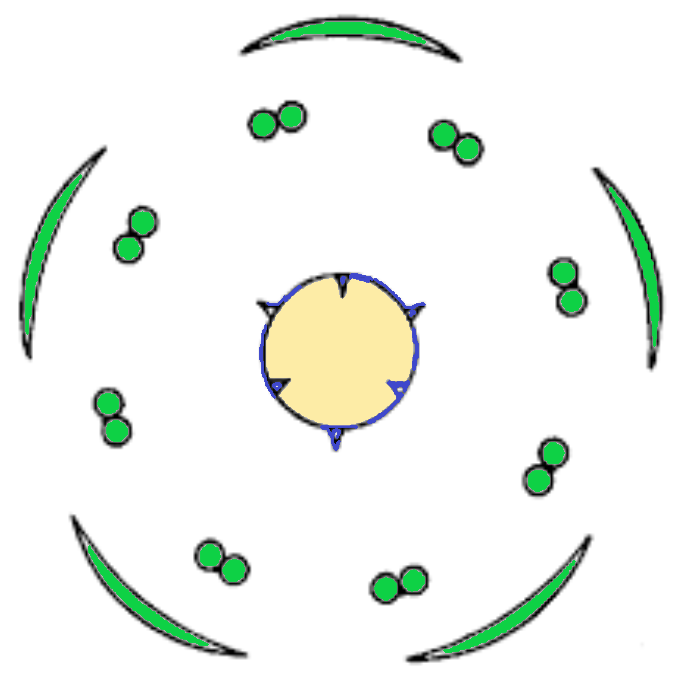
Hint: The term 'mono' means 'one' and 'chlamydeous' means 'floral structure'. Therefore, as the name describes a monochlamydeous flower has only one of the members of perianth or floral structure, that is, either calyx or corolla.
Complete answer:
Amongst the options given above, Polygonaceae is the monochlamydeous flower. It has 3 - 6 sepals of calyx but has no petals of corolla, thus, having only one member of perianth. It is a bisexual flower therefore, absence of petals (the attractive part of flowers which is very important for pollination) does not affect pollination.
Therefore, option d, is the correct answer.
Additional information
Following are a few characteristics of a monochlamydeous flowering plants:
Vegetative Characters:
Root: This family has a tap root system.
Stem: Stem is generally herbaceous having swollen nodes, surrounded by a stipular sheath.
Leaves: They have simple leaves having alternate phyllotaxy.
Floral Characters:
Inflorescence: The inflorescence is generally variable ranging from racemose to cymose. It is often present as umbellate clusters.
Flower: They have small, bisexual flowers that are usually trimerous rarely dimerous, having radial symmetry (actinomorphic).
Androecium: Stamens are usually 6 to 9, arranged in two whorls having the six outer ones often introrse and the three inner extrorse.
Gynoecium: The gynoecium is generally tricarpellary, syncarpous, ovary superior, and unilocular with basal placentation. The ovary has a characteristic nectariferous disc having as many as 8 lobes.
Fruit: The fruit is a dry nut having a single seed that may be three-sided or biconvex having lateral wings, or an achene with wings which may be furnished in bristles or hooks.
Seed: Seeds are copious.
Note:
Calyx is nothing but the green leafy envelope (sepals) at the top of the stalk that holds petals of flowers whereas corolla is another term used to collectively refer to petals. In perianth, sometimes the inner sepals are enlarged resulting in membranous wings known as Rumex or rarely the outer ones can enlarge known as Triplaris. These might get modified as hooks, spines, or bristles and aids in the distribution of the fruit.
Complete answer:
Amongst the options given above, Polygonaceae is the monochlamydeous flower. It has 3 - 6 sepals of calyx but has no petals of corolla, thus, having only one member of perianth. It is a bisexual flower therefore, absence of petals (the attractive part of flowers which is very important for pollination) does not affect pollination.
Therefore, option d, is the correct answer.
Additional information
Following are a few characteristics of a monochlamydeous flowering plants:
Vegetative Characters:
Root: This family has a tap root system.
Stem: Stem is generally herbaceous having swollen nodes, surrounded by a stipular sheath.
Leaves: They have simple leaves having alternate phyllotaxy.
Floral Characters:
Inflorescence: The inflorescence is generally variable ranging from racemose to cymose. It is often present as umbellate clusters.
Flower: They have small, bisexual flowers that are usually trimerous rarely dimerous, having radial symmetry (actinomorphic).
Androecium: Stamens are usually 6 to 9, arranged in two whorls having the six outer ones often introrse and the three inner extrorse.
Gynoecium: The gynoecium is generally tricarpellary, syncarpous, ovary superior, and unilocular with basal placentation. The ovary has a characteristic nectariferous disc having as many as 8 lobes.
Fruit: The fruit is a dry nut having a single seed that may be three-sided or biconvex having lateral wings, or an achene with wings which may be furnished in bristles or hooks.
Seed: Seeds are copious.
Note:
Calyx is nothing but the green leafy envelope (sepals) at the top of the stalk that holds petals of flowers whereas corolla is another term used to collectively refer to petals. In perianth, sometimes the inner sepals are enlarged resulting in membranous wings known as Rumex or rarely the outer ones can enlarge known as Triplaris. These might get modified as hooks, spines, or bristles and aids in the distribution of the fruit.
Recently Updated Pages
Which will be the least stable resonating structure class 11 chemistry CBSE

How many 5 digit telephone numbers can be construc-class-11-maths-CBSE
How do you find the angle of the resultant vector class 11 physics CBSE
Draw labelled diagram of the following i Gram seed class 11 biology CBSE
1 Quintal is equal to a 110 kg b 10 kg c 100kg d 1000 class 11 physics CBSE
What is the need and importance of classification class 11 biology CBSE
Trending doubts
Find the value of the expression given below sin 30circ class 11 maths CBSE
One Metric ton is equal to kg A 10000 B 1000 C 100 class 11 physics CBSE
10 examples of friction in our daily life
Draw a diagram of a plant cell and label at least eight class 11 biology CBSE
Difference between physical and chemical change class 11 chemistry CBSE
Proton was discovered by A Thomson B Rutherford C Chadwick class 11 chemistry CBSE