




Five persons A, B, C, D and E are seated in circular arrangements. If each of them is given a hat of one of the three colors red, blue and green, then the number of ways of distributing the hats such that the person seated in adjacent seats can get different colored hats is?
Answer
 Verified
664.2k+ views
Hint: In this particular question use the concept that to select r object out of n we use combination rule which is given as, ${}^n{C_r}$ and as there are only three hats available and use the concept that there are only 2 number of ways to distribute a hat adjacent to a particular person so they can get different color hats.
Complete step-by-step answer:
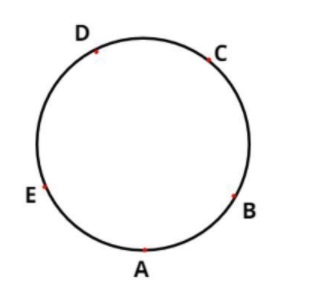
Five persons A, B, C, D and E are seated in a circular arrangement as shown in the above figure.
Given data:
There are 3 colors of hat available:
Red, blue, and green.
Now we have to find the number of ways of distributing the hats such that the person seated in adjacent seats gets different colored hats.
Now to distribute these 3 hats first we have to select a person according to the combination rule (i.e. to select r object out of n is, ${}^n{C_r}$), so to select 1 person out of 5, the number of ways = ${}^5{C_1}$
Now there are three hats available so the number of ways by which a hat is given to a person which is selected earlier = ${}^3{C_1}$ (select one hat out of three).
Now as we see from the figure that there are only two people who can be adjacent to a particular person.
Let us suppose that person A is chosen and a red color hat is given to him so the remaining color hat is blue and green, so the person adjacent to him (B and E) can only get either green color hat or blue color hat according to the question.
So the number of ways of distributing the hat adjacent to person A = 2.
So the total number of ways of distributing the hats such that the person seated in adjacent seats can get different colored hats, N = ${}^5{C_1} \times {}^3{C_1} \times 2$
Now as we know that ${}^n{C_r} = \dfrac{{n!}}{{r!\left( {n - r} \right)!}}$ so use this property we have,
$ \Rightarrow N = \dfrac{{5!}}{{1!\left( {5 - 1} \right)!}} \times \dfrac{{3!}}{{1!\left( {3 - 1} \right)!}} \times 2$
Now simplify this we have,
$ \Rightarrow N = \dfrac{{5.4!}}{{1!\left( 4 \right)!}} \times \dfrac{{3.2!}}{{1!\left( 2 \right)!}} \times 2 = 5 \times 3 \times 2 = 30$
So there are 30 such possible ways.
So this is the required answer.
Note:Whenever we face such types of question the key concept we have to remember is that always recall the formula of the combination which is stated above, then first calculate the number of ways of to select a particular person then calculate the number of ways to select a hat which is given to him then calculate the number of ways of distributing the hat adjacent to a particular person according to given condition then multiply all these values we will get the required answer.
Complete step-by-step answer:
Five persons A, B, C, D and E are seated in a circular arrangement as shown in the above figure.
Given data:
There are 3 colors of hat available:
Red, blue, and green.
Now we have to find the number of ways of distributing the hats such that the person seated in adjacent seats gets different colored hats.
Now to distribute these 3 hats first we have to select a person according to the combination rule (i.e. to select r object out of n is, ${}^n{C_r}$), so to select 1 person out of 5, the number of ways = ${}^5{C_1}$
Now there are three hats available so the number of ways by which a hat is given to a person which is selected earlier = ${}^3{C_1}$ (select one hat out of three).
Now as we see from the figure that there are only two people who can be adjacent to a particular person.
Let us suppose that person A is chosen and a red color hat is given to him so the remaining color hat is blue and green, so the person adjacent to him (B and E) can only get either green color hat or blue color hat according to the question.
So the number of ways of distributing the hat adjacent to person A = 2.
So the total number of ways of distributing the hats such that the person seated in adjacent seats can get different colored hats, N = ${}^5{C_1} \times {}^3{C_1} \times 2$
Now as we know that ${}^n{C_r} = \dfrac{{n!}}{{r!\left( {n - r} \right)!}}$ so use this property we have,
$ \Rightarrow N = \dfrac{{5!}}{{1!\left( {5 - 1} \right)!}} \times \dfrac{{3!}}{{1!\left( {3 - 1} \right)!}} \times 2$
Now simplify this we have,
$ \Rightarrow N = \dfrac{{5.4!}}{{1!\left( 4 \right)!}} \times \dfrac{{3.2!}}{{1!\left( 2 \right)!}} \times 2 = 5 \times 3 \times 2 = 30$
So there are 30 such possible ways.
So this is the required answer.
Note:Whenever we face such types of question the key concept we have to remember is that always recall the formula of the combination which is stated above, then first calculate the number of ways of to select a particular person then calculate the number of ways to select a hat which is given to him then calculate the number of ways of distributing the hat adjacent to a particular person according to given condition then multiply all these values we will get the required answer.
Recently Updated Pages
Which of the following graphs shows the variation of class 12 physics CBSE

Draw a labelled diagram of the human male reproductive class 12 biology CBSE
Describe the experiment to compare the emf of two cells class 12 physics CBSE
What is standard hydrogen electrode
What is conventional current and electric current class 12 physics CBSE
2Bromopentane is treated with an alcoholic KOH solution class 12 chemistry CBSE
Trending doubts
Draw a labelled sketch of the human eye class 12 physics CBSE
Which are the Top 10 Largest Countries of the World?
Differentiate between homogeneous and heterogeneous class 12 chemistry CBSE
Draw ray diagrams each showing i myopic eye and ii class 12 physics CBSE
Which is the correct genotypic ratio of mendel dihybrid class 12 biology CBSE
What is the Full Form of PVC, PET, HDPE, LDPE, PP and PS ?