




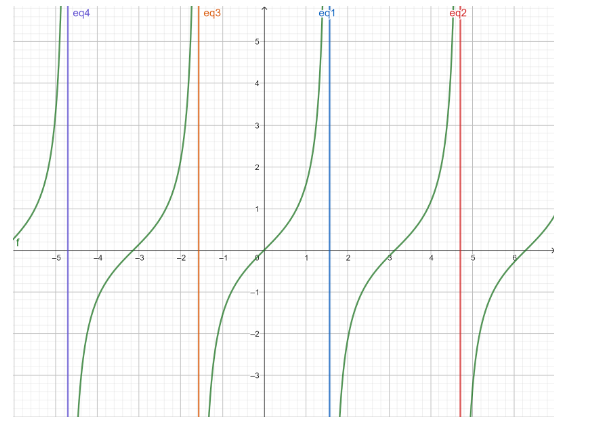
How do you find vertical asymptote of tangent function ?
Answer
 Verified
583.5k+ views
Hint: In the given question, we are required to find out the vertical asymptotes of the tangent function. Asymptote is a straight line that continually approaches a given curve but does not meet it at any finite distance. So to find vertical asymptotes for tangent function, we have to calculate the derivative of the function and see the nature of the curve at different points. Then, we equate the derivative of the function to infinity so as to find the points where the vertical asymptotes for the tangent function exists.
Complete step by step solution:
To solve the given question and find the vertical asymptote of tangent function, we first find out the derivative of the function.
So, $ f\left( x \right) = \tan \left( x \right) $
Hence, $ f'\left( x \right) = {\sec ^2}\left( x \right) $
Now, equating the derivative to infinity since the slope of the function has to be infinity so as to have a vertical asymptote.
So, for $ f'\left( x \right) = {\sec ^2}x = \dfrac{1}{{{{\cos }^2}\left( x \right)}} $ to be infinity, the denominator must be zero.
Hence, we get, $ {\cos ^2}\left( x \right) = 0 $
$ \Rightarrow \cos \left( x \right) = 0 $
$ \Rightarrow x = \left( {\dfrac{{n\pi }}{2}} \right) $ where n is any integer.
So, the tangent function has a vertical asymptote for every integral multiple of $ \left( {\dfrac{\pi }{2}} \right) $ .
Note: One should have thorough knowledge of differentiation and applications of derivatives in order to solve such questions. We should also know the definition of an asymptote. Algebraic rules like transposition must also be practiced as they are used often in mathematical equations.
Complete step by step solution:
To solve the given question and find the vertical asymptote of tangent function, we first find out the derivative of the function.
So, $ f\left( x \right) = \tan \left( x \right) $
Hence, $ f'\left( x \right) = {\sec ^2}\left( x \right) $
Now, equating the derivative to infinity since the slope of the function has to be infinity so as to have a vertical asymptote.
So, for $ f'\left( x \right) = {\sec ^2}x = \dfrac{1}{{{{\cos }^2}\left( x \right)}} $ to be infinity, the denominator must be zero.
Hence, we get, $ {\cos ^2}\left( x \right) = 0 $
$ \Rightarrow \cos \left( x \right) = 0 $
$ \Rightarrow x = \left( {\dfrac{{n\pi }}{2}} \right) $ where n is any integer.
So, the tangent function has a vertical asymptote for every integral multiple of $ \left( {\dfrac{\pi }{2}} \right) $ .
Note: One should have thorough knowledge of differentiation and applications of derivatives in order to solve such questions. We should also know the definition of an asymptote. Algebraic rules like transposition must also be practiced as they are used often in mathematical equations.
Recently Updated Pages
Master Class 12 Business Studies: Engaging Questions & Answers for Success

Master Class 12 Chemistry: Engaging Questions & Answers for Success
Master Class 12 Biology: Engaging Questions & Answers for Success
Class 12 Question and Answer - Your Ultimate Solutions Guide
Master Class 11 English: Engaging Questions & Answers for Success
Master Class 11 Social Science: Engaging Questions & Answers for Success
Trending doubts
Which are the Top 10 Largest Countries of the World?
Draw a labelled sketch of the human eye class 12 physics CBSE
Differentiate between homogeneous and heterogeneous class 12 chemistry CBSE
Why is the cell called the structural and functional class 12 biology CBSE
When was the first election held in India a 194748 class 12 sst CBSE
Draw ray diagrams each showing i myopic eye and ii class 12 physics CBSE