




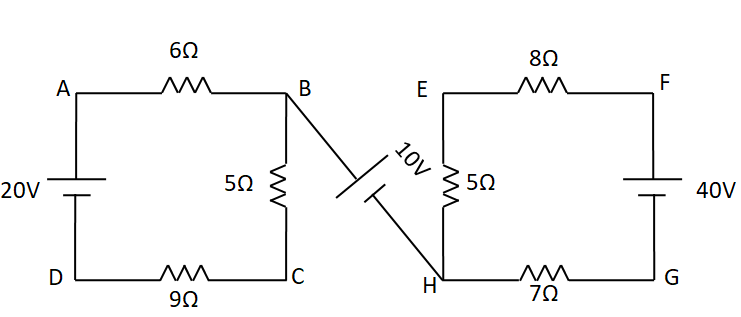
Find ${V_{CE}}$ and ${V_{AG}}$
Answer
 Verified
602.7k+ views
Hint
To find this question, we need to use the KVL to find the currents in the given two meshes. Then, for finding the required potential difference, start from the initial point and choose any path to reach to the final path, while writing the potential gains or drops whichever comes in between.
Complete step by step answer
Let the currents in the two meshes be ${I_1}$ and ${I_2}$ respectively, as shown in the below circuit diagram.
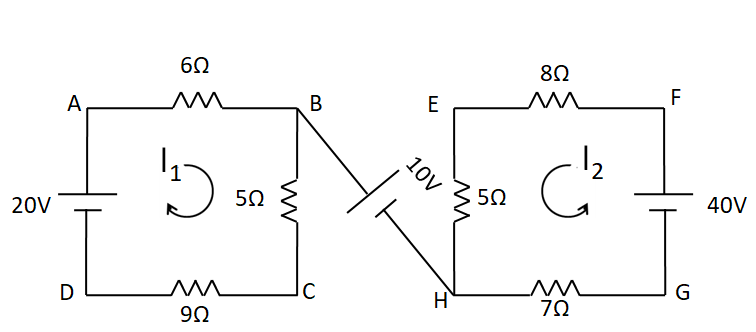
Applying KVL in the first loop ABCD, we have
$\Rightarrow 6{I_1} + 5{I_1} + 9{I_1} - 20 = 0$
$\Rightarrow 20{I_1} = 20$
Dividing both sides by $20$, we get
$\Rightarrow {I_1} = 1{\text{A}}$
Now, applying KVL in the second loop EFGH, we have
$\Rightarrow 8{I_2} + 5{I_2} + 7{I_2} - 40 = 0$
$\Rightarrow 20{I_2} = 40$
Dividing both sides by $20$, we get
$\Rightarrow {I_2} = 2{\text{A}}$
For ${V_{CE}}$, we travel along the path CBHE to get
$\Rightarrow {V_C} + 5{I_1} - 10 + 5{I_2} = {V_E}$
$\Rightarrow {V_C} + 5(1) - 10 + 5(2) = {V_E}$
On rearranging, we get
$\Rightarrow {V_C} - {V_E} = - 5{\text{V}}$
Or ${V_{CE}} = - 5{\text{V}}$
For ${V_{AG}}$, we travel along the path ABHG to get
$\Rightarrow {V_A} - 6{I_1} - 10 - 7{I_2} = {V_G}$
$\Rightarrow {V_A} - 6(1) - 10 - 7(2) = {V_G}$
On rearranging, we get
$\Rightarrow {V_A} - {V_G} = 30{\text{V}}$
Or ${V_{AG}} = 30{\text{V}}$
Hence, we have ${V_{CE}} = - 5{\text{V}}$ and ${V_{AG}} = 30{\text{V}}$.
Note
Before using the KVL, fix a sign convention of your choice. Do not confuse between the two sign conventions possible. We can use any sign convention of our choice. The choice of the sign convention does not affect the final answer.
-But while finding the potential difference between two points, there is no sign convention. As all the values of the currents are already found before this method is applied, so there is no need to think about any sign convention.
-We can choose any path between the initial point and the final point to find the potential difference. The potential difference between any two points in a circuit is not path dependent.
To find this question, we need to use the KVL to find the currents in the given two meshes. Then, for finding the required potential difference, start from the initial point and choose any path to reach to the final path, while writing the potential gains or drops whichever comes in between.
Complete step by step answer
Let the currents in the two meshes be ${I_1}$ and ${I_2}$ respectively, as shown in the below circuit diagram.
Applying KVL in the first loop ABCD, we have
$\Rightarrow 6{I_1} + 5{I_1} + 9{I_1} - 20 = 0$
$\Rightarrow 20{I_1} = 20$
Dividing both sides by $20$, we get
$\Rightarrow {I_1} = 1{\text{A}}$
Now, applying KVL in the second loop EFGH, we have
$\Rightarrow 8{I_2} + 5{I_2} + 7{I_2} - 40 = 0$
$\Rightarrow 20{I_2} = 40$
Dividing both sides by $20$, we get
$\Rightarrow {I_2} = 2{\text{A}}$
For ${V_{CE}}$, we travel along the path CBHE to get
$\Rightarrow {V_C} + 5{I_1} - 10 + 5{I_2} = {V_E}$
$\Rightarrow {V_C} + 5(1) - 10 + 5(2) = {V_E}$
On rearranging, we get
$\Rightarrow {V_C} - {V_E} = - 5{\text{V}}$
Or ${V_{CE}} = - 5{\text{V}}$
For ${V_{AG}}$, we travel along the path ABHG to get
$\Rightarrow {V_A} - 6{I_1} - 10 - 7{I_2} = {V_G}$
$\Rightarrow {V_A} - 6(1) - 10 - 7(2) = {V_G}$
On rearranging, we get
$\Rightarrow {V_A} - {V_G} = 30{\text{V}}$
Or ${V_{AG}} = 30{\text{V}}$
Hence, we have ${V_{CE}} = - 5{\text{V}}$ and ${V_{AG}} = 30{\text{V}}$.
Note
Before using the KVL, fix a sign convention of your choice. Do not confuse between the two sign conventions possible. We can use any sign convention of our choice. The choice of the sign convention does not affect the final answer.
-But while finding the potential difference between two points, there is no sign convention. As all the values of the currents are already found before this method is applied, so there is no need to think about any sign convention.
-We can choose any path between the initial point and the final point to find the potential difference. The potential difference between any two points in a circuit is not path dependent.
Recently Updated Pages
Master Class 12 Economics: Engaging Questions & Answers for Success

Master Class 12 English: Engaging Questions & Answers for Success
Master Class 12 Social Science: Engaging Questions & Answers for Success
Master Class 12 Maths: Engaging Questions & Answers for Success
Master Class 12 Physics: Engaging Questions & Answers for Success
Master Class 12 Business Studies: Engaging Questions & Answers for Success
Trending doubts
The ratio of E to B in electromagnetic waves is equal class 12 physics CBSE
Which of the following is referred to as the Evil Quartet class 12 biology CBSE
What causes instant death by hanging class 12 biology CBSE
Percentage of photosynthetically active radiation PAR class 12 biology CBSE
The electric field due to a uniformly charged nonconducting class 12 physics CBSE
One megawatt is equal to how many units of electri class 12 physics CBSE