




How do you find trigonometric ratios of 30, 45, and 60 degrees?
Answer
 Verified
602.1k+ views
Hint: Right-angled triangle in an equilateral triangle (which is formed by dropping altitude from any vertex to its opposite side) and isosceles right-angled triangle are considered to be special right triangles. From these triangles, we can find the trigonometric ratios of basic angles. Trigonometric ratios are the ratios of the sides of some standard triangles like a special right triangle. In a triangle, according to the Pythagorean theorem, the sum of squares of the length of two adjacent sides is equal to the square of the length of the opposite side.
Complete step-by-step solution:
As per the given question, we have trigonometric ratios of 30, 45, and 60 degrees. Both \[30{}^\circ \] and \[60{}^\circ \] are based on an equilateral triangle with sides of length 2 and one of the angles bisected.
The \[45{}^\circ \] angle is based on an isosceles triangle with the equal sides having a length of 1.
Now, let’s consider the equilateral triangle which is shown below:
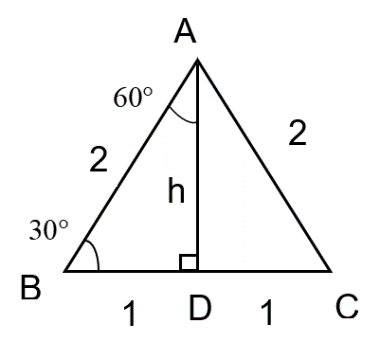
Using Pythagorean theorem, \[{{2}^{2}}={{1}^{2}}+{{h}^{2}}\Rightarrow h=\sqrt{{{2}^{2}}-{{1}^{2}}}\Rightarrow h=\sqrt{3}\]. We know that,
\[\begin{align}
& \sin =\dfrac{opposite(side)}{hypotenuse} \\
& \cos =\dfrac{adjacent(side)}{hypotenuse} \\
& \tan =\dfrac{opposite(side)}{adjacent(side)} \\
& \sec =\dfrac{1}{\cos } \\
& \cot =\dfrac{1}{\tan } \\
\end{align}\]
cosec \[=\dfrac{1}{\sin }\]
Therefore, the trigonometric ratios of \[30{}^\circ \] and \[60{}^\circ \]are
\[\begin{align}
& \Rightarrow \sin (30{}^\circ )=\dfrac{1}{2},\sin (60{}^\circ )=\dfrac{\sqrt{3}}{2} \\
& \Rightarrow \cos (30{}^\circ )=\dfrac{\sqrt{3}}{2},\cos (30{}^\circ )=\dfrac{1}{2} \\
& \Rightarrow \tan (30{}^\circ )=\dfrac{1}{\sqrt{3}},\tan (60{}^\circ )=\dfrac{\sqrt{3}}{1}=\sqrt{3} \\
& \Rightarrow \sec (30{}^\circ )=\dfrac{1}{\cos (30{}^\circ )}=\dfrac{1}{\dfrac{\sqrt{3}}{2}}=\dfrac{2}{\sqrt{3}},\sec (60{}^\circ )=\dfrac{1}{\cos (60{}^\circ )}=\dfrac{1}{\dfrac{1}{2}}=2 \\
& \Rightarrow \cot (30{}^\circ )=\dfrac{1}{\tan 30{}^\circ }=\dfrac{1}{\dfrac{1}{\sqrt{3}}}=\sqrt{3},\cot (60{}^\circ )=\dfrac{1}{\tan (60{}^\circ )}=\dfrac{1}{\sqrt{3}} \\
& \\
\end{align}\]
\[\Rightarrow \]cosec (\[30{}^\circ \])\[=\dfrac{1}{\sin (30{}^\circ )}=\dfrac{1}{\dfrac{1}{2}}=2,\]
\[\Rightarrow \]cosec (\[60{}^\circ \])\[=\dfrac{1}{\sin (60{}^\circ )}=\dfrac{1}{\dfrac{\sqrt{3}}{2}}=\dfrac{2}{\sqrt{3}}\].
Now, let’s consider the isosceles right triangle to find trigonometric ratios of \[45{}^\circ \]as shown below:
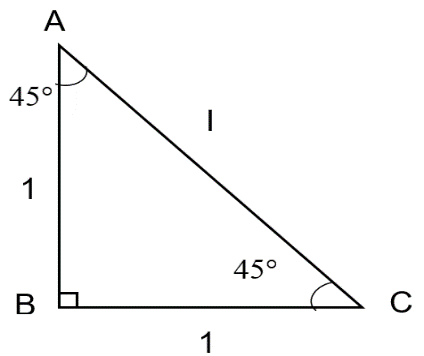
Using Pythagorean theorem, length \[l=\sqrt{{{1}^{2}}+{{1}^{2}}}=\sqrt{2}\].
Therefore, the trigonometric ratios of \[45{}^\circ \]are
\[\begin{align}
& \Rightarrow \sin (45{}^\circ )=\dfrac{1}{\sqrt{2}} \\
& \Rightarrow \cos (45{}^\circ )=\dfrac{1}{\sqrt{2}} \\
& \Rightarrow \tan (45{}^\circ )=\dfrac{1}{1}=1 \\
& \Rightarrow \sec (45{}^\circ )=\dfrac{1}{\cos (45{}^\circ )}=\dfrac{1}{\dfrac{1}{\sqrt{2}}}=\sqrt{2} \\
& \Rightarrow \cot (45{}^\circ )=\dfrac{1}{\tan (45{}^\circ )}=\dfrac{1}{1}=1 \\
\end{align}\]
\[\Rightarrow \]cosec (\[45{}^\circ \])\[=\dfrac{1}{\sin (45{}^\circ )}=\dfrac{1}{\dfrac{1}{\sqrt{2}}}=\sqrt{2}\].
Note: While finding the trigonometric ratios of a triangle, if we have sine, cosine, and tangent values, then we can calculate the cosecant, secant, and cotangent of the triangle. And we know that for \[sin(n\times 90{}^\circ -\theta )\], it is equal to \[\pm \]\[\sin \theta \] if n is even and it is equal to \[\pm \cos \theta \] as cosine is the complement of sine function. So, if we have a sine value of 30 degrees then we find a cosine value of 60 degrees.
Complete step-by-step solution:
As per the given question, we have trigonometric ratios of 30, 45, and 60 degrees. Both \[30{}^\circ \] and \[60{}^\circ \] are based on an equilateral triangle with sides of length 2 and one of the angles bisected.
The \[45{}^\circ \] angle is based on an isosceles triangle with the equal sides having a length of 1.
Now, let’s consider the equilateral triangle which is shown below:
Using Pythagorean theorem, \[{{2}^{2}}={{1}^{2}}+{{h}^{2}}\Rightarrow h=\sqrt{{{2}^{2}}-{{1}^{2}}}\Rightarrow h=\sqrt{3}\]. We know that,
\[\begin{align}
& \sin =\dfrac{opposite(side)}{hypotenuse} \\
& \cos =\dfrac{adjacent(side)}{hypotenuse} \\
& \tan =\dfrac{opposite(side)}{adjacent(side)} \\
& \sec =\dfrac{1}{\cos } \\
& \cot =\dfrac{1}{\tan } \\
\end{align}\]
cosec \[=\dfrac{1}{\sin }\]
Therefore, the trigonometric ratios of \[30{}^\circ \] and \[60{}^\circ \]are
\[\begin{align}
& \Rightarrow \sin (30{}^\circ )=\dfrac{1}{2},\sin (60{}^\circ )=\dfrac{\sqrt{3}}{2} \\
& \Rightarrow \cos (30{}^\circ )=\dfrac{\sqrt{3}}{2},\cos (30{}^\circ )=\dfrac{1}{2} \\
& \Rightarrow \tan (30{}^\circ )=\dfrac{1}{\sqrt{3}},\tan (60{}^\circ )=\dfrac{\sqrt{3}}{1}=\sqrt{3} \\
& \Rightarrow \sec (30{}^\circ )=\dfrac{1}{\cos (30{}^\circ )}=\dfrac{1}{\dfrac{\sqrt{3}}{2}}=\dfrac{2}{\sqrt{3}},\sec (60{}^\circ )=\dfrac{1}{\cos (60{}^\circ )}=\dfrac{1}{\dfrac{1}{2}}=2 \\
& \Rightarrow \cot (30{}^\circ )=\dfrac{1}{\tan 30{}^\circ }=\dfrac{1}{\dfrac{1}{\sqrt{3}}}=\sqrt{3},\cot (60{}^\circ )=\dfrac{1}{\tan (60{}^\circ )}=\dfrac{1}{\sqrt{3}} \\
& \\
\end{align}\]
\[\Rightarrow \]cosec (\[30{}^\circ \])\[=\dfrac{1}{\sin (30{}^\circ )}=\dfrac{1}{\dfrac{1}{2}}=2,\]
\[\Rightarrow \]cosec (\[60{}^\circ \])\[=\dfrac{1}{\sin (60{}^\circ )}=\dfrac{1}{\dfrac{\sqrt{3}}{2}}=\dfrac{2}{\sqrt{3}}\].
Now, let’s consider the isosceles right triangle to find trigonometric ratios of \[45{}^\circ \]as shown below:
Using Pythagorean theorem, length \[l=\sqrt{{{1}^{2}}+{{1}^{2}}}=\sqrt{2}\].
Therefore, the trigonometric ratios of \[45{}^\circ \]are
\[\begin{align}
& \Rightarrow \sin (45{}^\circ )=\dfrac{1}{\sqrt{2}} \\
& \Rightarrow \cos (45{}^\circ )=\dfrac{1}{\sqrt{2}} \\
& \Rightarrow \tan (45{}^\circ )=\dfrac{1}{1}=1 \\
& \Rightarrow \sec (45{}^\circ )=\dfrac{1}{\cos (45{}^\circ )}=\dfrac{1}{\dfrac{1}{\sqrt{2}}}=\sqrt{2} \\
& \Rightarrow \cot (45{}^\circ )=\dfrac{1}{\tan (45{}^\circ )}=\dfrac{1}{1}=1 \\
\end{align}\]
\[\Rightarrow \]cosec (\[45{}^\circ \])\[=\dfrac{1}{\sin (45{}^\circ )}=\dfrac{1}{\dfrac{1}{\sqrt{2}}}=\sqrt{2}\].
Note: While finding the trigonometric ratios of a triangle, if we have sine, cosine, and tangent values, then we can calculate the cosecant, secant, and cotangent of the triangle. And we know that for \[sin(n\times 90{}^\circ -\theta )\], it is equal to \[\pm \]\[\sin \theta \] if n is even and it is equal to \[\pm \cos \theta \] as cosine is the complement of sine function. So, if we have a sine value of 30 degrees then we find a cosine value of 60 degrees.
Recently Updated Pages
Master Class 11 English: Engaging Questions & Answers for Success

Master Class 11 Social Science: Engaging Questions & Answers for Success
Master Class 11 Maths: Engaging Questions & Answers for Success
Master Class 11 Biology: Engaging Questions & Answers for Success
Master Class 11 Physics: Engaging Questions & Answers for Success
Master Class 11 Chemistry: Engaging Questions & Answers for Success
Trending doubts
Explain the Treaty of Vienna of 1815 class 10 social science CBSE
What is the full form of POSCO class 10 social science CBSE
Define Potential, Developed, Stock and Reserved resources
The diagonals of a rhombus are 10cm and 24cm Find the class 10 maths CBSE
Fill the blanks with proper collective nouns 1 A of class 10 english CBSE
One number is chosen from numbers 1 to 200 Find the class 10 maths CBSE