




Find the volume of the solid obtained by revolving the loop of the curve $2a{{y}^{2}}=x{{\left( x-a \right)}^{2}}$ about the x-axis.
Answer
 Verified
574.2k+ views
Hint: Here we have to find the volume of the solid which we will obtain after revolving the loop of the given curve $2a{{y}^{2}}=x{{\left( x-a \right)}^{2}}$. For that, we will plot the graph and we will find the range of $x$ by putting $y=0$. Then we will find the volume using integration with proper limits of $x$. The value which we will obtain after integration will be the required volume of the solid generated.
Complete step-by-step answer:
The given curve is $2a{{y}^{2}}=x{{\left( x-a \right)}^{2}}$
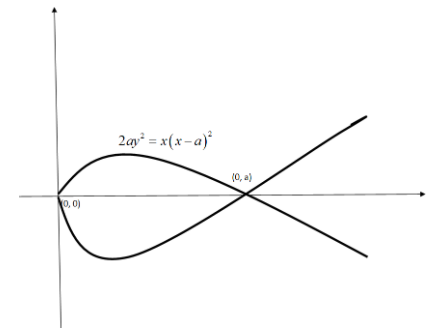
We will find the value of $x$ for which $y=0$. For that, we will put $y=0$ in the equation of the curve.
Putting value $y=0$ in the equation, we get
$\Rightarrow 2a{{0}^{2}}=x{{\left( x-a \right)}^{2}}$
On simplifying the terms, we get
$x=0$ and $x=a$
Now, we will draw the graph of the curve.
Now, we will find the volume of solid obtained by the revolving the loop of this curve.
Therefore,
$\Rightarrow volume=\pi \int\limits_{0}^{a}{{{y}^{2}}dx}$
We will put the value of ${{y}^{2}}$here.
$\Rightarrow volume=\pi \int\limits_{0}^{a}{\dfrac{x{{\left( x-a \right)}^{2}}}{2a}dx}$
We will take constants out of integration and we will expand the terms.
$\Rightarrow volume=\dfrac{\pi }{2a}\int\limits_{0}^{a}{x\left( {{x}^{2}}+{{a}^{2}}-2ax \right)dx}$
Multiplying the terms, we get
$\Rightarrow volume=\dfrac{\pi }{2a}\int\limits_{0}^{a}{\left( {{x}^{3}}+{{a}^{2}}{{x}}-2a{{x}^{2}} \right)dx}$
Integrating the terms, we get
$\Rightarrow volume=\dfrac{\pi }{2a}\left[ \dfrac{{{x}^{4}}}{4}+\dfrac{{{a}^{2}}{{x}^{2}}}{2}-\dfrac{2a{{x}^{3}}}{3} \right]_{0}^{a}$
On further simplification, we get
$\Rightarrow volume=\dfrac{\pi }{2a}\left[ \dfrac{3{{a}^{4}}+6{{a}^{4}}-8{{a}^{4}}}{12} \right]$
$\Rightarrow volume=\dfrac{\pi {{a}^{3}}}{24}$
Hence, the required volume of the solid obtained by revolving the loop of this curve is $\dfrac{\pi {{a}^{3}}}{24}$ cubic units.
Note: This curve is symmetric about the x-axis. A curve is said to be symmetric about the x axis if whenever a point $\left( a,b \right)$ lies on the curve then point $\left( a,-b \right)$ also lies on the curve i.e. both of them will satisfy the equation of the curve. Here x-axis is called the axis of symmetry of the given curve. The shape of the curve is the same on both sides of the axis of symmetry.
Complete step-by-step answer:
The given curve is $2a{{y}^{2}}=x{{\left( x-a \right)}^{2}}$
We will find the value of $x$ for which $y=0$. For that, we will put $y=0$ in the equation of the curve.
Putting value $y=0$ in the equation, we get
$\Rightarrow 2a{{0}^{2}}=x{{\left( x-a \right)}^{2}}$
On simplifying the terms, we get
$x=0$ and $x=a$
Now, we will draw the graph of the curve.
Now, we will find the volume of solid obtained by the revolving the loop of this curve.
Therefore,
$\Rightarrow volume=\pi \int\limits_{0}^{a}{{{y}^{2}}dx}$
We will put the value of ${{y}^{2}}$here.
$\Rightarrow volume=\pi \int\limits_{0}^{a}{\dfrac{x{{\left( x-a \right)}^{2}}}{2a}dx}$
We will take constants out of integration and we will expand the terms.
$\Rightarrow volume=\dfrac{\pi }{2a}\int\limits_{0}^{a}{x\left( {{x}^{2}}+{{a}^{2}}-2ax \right)dx}$
Multiplying the terms, we get
$\Rightarrow volume=\dfrac{\pi }{2a}\int\limits_{0}^{a}{\left( {{x}^{3}}+{{a}^{2}}{{x}}-2a{{x}^{2}} \right)dx}$
Integrating the terms, we get
$\Rightarrow volume=\dfrac{\pi }{2a}\left[ \dfrac{{{x}^{4}}}{4}+\dfrac{{{a}^{2}}{{x}^{2}}}{2}-\dfrac{2a{{x}^{3}}}{3} \right]_{0}^{a}$
On further simplification, we get
$\Rightarrow volume=\dfrac{\pi }{2a}\left[ \dfrac{3{{a}^{4}}+6{{a}^{4}}-8{{a}^{4}}}{12} \right]$
$\Rightarrow volume=\dfrac{\pi {{a}^{3}}}{24}$
Hence, the required volume of the solid obtained by revolving the loop of this curve is $\dfrac{\pi {{a}^{3}}}{24}$ cubic units.
Note: This curve is symmetric about the x-axis. A curve is said to be symmetric about the x axis if whenever a point $\left( a,b \right)$ lies on the curve then point $\left( a,-b \right)$ also lies on the curve i.e. both of them will satisfy the equation of the curve. Here x-axis is called the axis of symmetry of the given curve. The shape of the curve is the same on both sides of the axis of symmetry.
Recently Updated Pages
Master Class 12 Economics: Engaging Questions & Answers for Success

Master Class 12 Physics: Engaging Questions & Answers for Success
Master Class 12 English: Engaging Questions & Answers for Success
Master Class 12 Social Science: Engaging Questions & Answers for Success
Master Class 12 Maths: Engaging Questions & Answers for Success
Master Class 12 Business Studies: Engaging Questions & Answers for Success
Trending doubts
Which are the Top 10 Largest Countries of the World?
What are the major means of transport Explain each class 12 social science CBSE
Draw a labelled sketch of the human eye class 12 physics CBSE
Why cannot DNA pass through cell membranes class 12 biology CBSE
Differentiate between insitu conservation and exsitu class 12 biology CBSE
Draw a neat and well labeled diagram of TS of ovary class 12 biology CBSE