



How do you find the volume of the solid generated by revolving the region bounded by $y={{x}^{2}},y=0,x=2$
(i) about the X-axis
(ii) about the Y-axis
Answer
 Verified
580.2k+ views
Hint: We first find the area region bounded by the curves and lines $y={{x}^{2}},y=0,x=2$. Then we use the rotation and the volume formulas to find the integration and the solution of the problem.
Complete step by step solution:
We have to find the volume of the solid generated by revolving the region bounded by $y={{x}^{2}},y=0,x=2$
Then we need to do it revolving twice, once about the X-axis and then about the Y-axis.
We first try to find the area bounded by the region bounded by $y={{x}^{2}},y=0,x=2$.
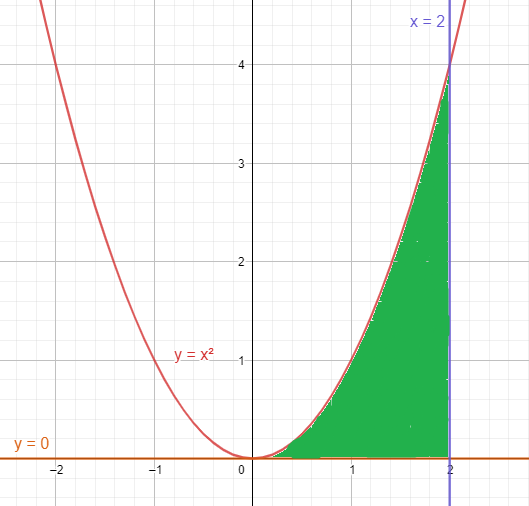
The shaded area is the bounded area which will be rotated.
We first rotate it about the X-axis.
The region will be covering the whole area in a circle-based form where we have to find the volume with respect the y intersects.
To get a solid of revolution we start out with a function, $y=f\left( x \right)f\left( x \right)$, on an interval $\left[ a,b \right]$. We then rotate this curve about a given axis to get the surface of the solid of revolution.
Therefore, we are trying to form the integration for the volume along the y intersects.
The lines $y=0,x=2$ gives the boundary.
We now integrate $y={{x}^{2}}$ with the volume formula where $V=\pi \int\limits_{a}^{b}{{{y}^{2}}dx}$.
Putting the values, we get $V=\pi \int\limits_{0}^{2}{{{y}^{2}}dx}$. We have the equation $y={{x}^{2}}$.
So, $V=\pi \int\limits_{0}^{2}{{{x}^{4}}dx}=\pi \left[ \dfrac{{{x}^{5}}}{5} \right]_{0}^{2}$. Putting the values, we get $V=\pi \left[ \dfrac{{{x}^{5}}}{5} \right]_{0}^{2}=\dfrac{32\pi }{5}$ cubic unit.
Now for rotation about Y-axis, we integrate $x=\sqrt{y}$ with the volume formula where $V=\pi \int\limits_{a}^{b}{\left[ {{x}_{2}}^{2}-{{x}_{1}}^{2} \right]dx}$.
So, $V=\pi \int\limits_{0}^{4}{\left[ {{2}^{2}}-y \right]dy}=\pi \left[ 4y-\dfrac{{{y}^{2}}}{2} \right]_{0}^{4}=\pi \left[ 16-8 \right]=8\pi $ cubic unit.
Therefore, the volumes are $\dfrac{32\pi }{5},8\pi $ cubic units respectively.
Note: Consider the same function with $f\left( x \right)=1$. When rotated, it will look similar to our previous rotation but with a cylinder removed in the middle. To find the volume, we simply take the difference of our original area and the area of the space in the centre.
Complete step by step solution:
We have to find the volume of the solid generated by revolving the region bounded by $y={{x}^{2}},y=0,x=2$
Then we need to do it revolving twice, once about the X-axis and then about the Y-axis.
We first try to find the area bounded by the region bounded by $y={{x}^{2}},y=0,x=2$.
The shaded area is the bounded area which will be rotated.
We first rotate it about the X-axis.
The region will be covering the whole area in a circle-based form where we have to find the volume with respect the y intersects.
To get a solid of revolution we start out with a function, $y=f\left( x \right)f\left( x \right)$, on an interval $\left[ a,b \right]$. We then rotate this curve about a given axis to get the surface of the solid of revolution.
Therefore, we are trying to form the integration for the volume along the y intersects.
The lines $y=0,x=2$ gives the boundary.
We now integrate $y={{x}^{2}}$ with the volume formula where $V=\pi \int\limits_{a}^{b}{{{y}^{2}}dx}$.
Putting the values, we get $V=\pi \int\limits_{0}^{2}{{{y}^{2}}dx}$. We have the equation $y={{x}^{2}}$.
So, $V=\pi \int\limits_{0}^{2}{{{x}^{4}}dx}=\pi \left[ \dfrac{{{x}^{5}}}{5} \right]_{0}^{2}$. Putting the values, we get $V=\pi \left[ \dfrac{{{x}^{5}}}{5} \right]_{0}^{2}=\dfrac{32\pi }{5}$ cubic unit.
Now for rotation about Y-axis, we integrate $x=\sqrt{y}$ with the volume formula where $V=\pi \int\limits_{a}^{b}{\left[ {{x}_{2}}^{2}-{{x}_{1}}^{2} \right]dx}$.
So, $V=\pi \int\limits_{0}^{4}{\left[ {{2}^{2}}-y \right]dy}=\pi \left[ 4y-\dfrac{{{y}^{2}}}{2} \right]_{0}^{4}=\pi \left[ 16-8 \right]=8\pi $ cubic unit.
Therefore, the volumes are $\dfrac{32\pi }{5},8\pi $ cubic units respectively.
Note: Consider the same function with $f\left( x \right)=1$. When rotated, it will look similar to our previous rotation but with a cylinder removed in the middle. To find the volume, we simply take the difference of our original area and the area of the space in the centre.
Recently Updated Pages
Master Class 12 Economics: Engaging Questions & Answers for Success

Master Class 12 English: Engaging Questions & Answers for Success
Master Class 12 Social Science: Engaging Questions & Answers for Success
Master Class 12 Maths: Engaging Questions & Answers for Success
Master Class 12 Physics: Engaging Questions & Answers for Success
Master Class 9 General Knowledge: Engaging Questions & Answers for Success
Trending doubts
Which are the Top 10 Largest Countries of the World?
Draw a labelled sketch of the human eye class 12 physics CBSE
Differentiate between homogeneous and heterogeneous class 12 chemistry CBSE
Why is the cell called the structural and functional class 12 biology CBSE
Draw ray diagrams each showing i myopic eye and ii class 12 physics CBSE
Which is the correct genotypic ratio of mendel dihybrid class 12 biology CBSE