




Find the volume of the parallelepiped whose co terminal edges are \[4\hat{i}+3\hat{j}+\hat{k},5\hat{i}+9\hat{j}+19\hat{k}\text{ }and\text{ }8\hat{i}+6\hat{j}+5\hat{k}\].
Answer
 Verified
596.4k+ views
Hint: The volume of the parallelepiped is given by, $\vec{a}.\left( \vec{b}\times \vec{c} \right)$ where $\vec{a},\vec{b},\vec{c}$ are the coterminal edges of the parallelepiped. We have already been given the co terminal edges, so we will put $\vec{a}=4\hat{i}+3\hat{j}+\hat{k},\vec{b}=5\hat{i}+9\hat{j}+19\hat{k},\vec{c}=8\hat{i}+6\hat{j}+5\hat{k}$ and find the volume of the parallelepiped.
Complete step-by-step answer:
It is given in the question that we have to find the volume of the parallelepiped whose co terminal edges are \[4\hat{i}+3\hat{j}+\hat{k},5\hat{i}+9\hat{j}+19\hat{k}\text{ }and\text{ }8\hat{i}+6\hat{j}+5\hat{k}\]. So, before we solve the question, let us understand what a parallelepiped is. It is a solid 3D shape in which all the faces are parallelograms and the opposite faces are of the same dimension. A parallelepiped can be shown as below.
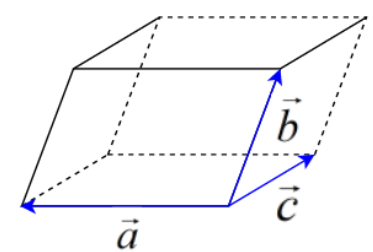
Let us assume that $\vec{a}=4\hat{i}+3\hat{j}+\hat{k},\vec{b}=5\hat{i}+9\hat{j}+19\hat{k},\vec{c}=8\hat{i}+6\hat{j}+5\hat{k}$. Then, we know that the volume of a parallelepiped is given by, $\vec{a}.\left( \vec{b}\times \vec{c} \right)$ where $\vec{a},\vec{b},\vec{c}$ are the coterminal edges of the parallelepiped.
So, first, we will find the cross product of $\vec{b}\text{ }and\text{ }\vec{c}$. In order to find the cross product, we will take determinant of the given vectors. For example, let $\vec{p}=a\hat{i}+b\hat{j}+c\hat{k}\text{ }and\text{ }\vec{q}=d\hat{i}+e\hat{j}+f\hat{k}$, then their cross product will be, $\vec{p}\times \vec{q}=\left| \begin{matrix}
{\hat{i}} & {\hat{j}} & {\hat{k}} \\
a & b & c \\
d & e & f \\
\end{matrix} \right|$.
And, the determinant will be, $\hat{i}\left( bf-ec \right)-\hat{j}\left( af-dc \right)+\hat{k}\left( ae-db \right)$.
So, here, we have to find the cross product of $\vec{b}\text{ }and\text{ }\vec{c}$, where $\vec{b}=5\hat{i}+9\hat{j}+19\hat{k},\vec{c}=8\hat{i}+6\hat{j}+5\hat{k}$. So, we will get,
$\vec{b}\times \vec{c}=\left| \begin{matrix}
{\hat{i}} & {\hat{j}} & {\hat{k}} \\
5 & 9 & 19 \\
8 & 6 & 5 \\
\end{matrix} \right|$
So, on taking the determinant, we get,
\[\begin{align}
& \hat{i}\left[ \left( 9\times 5 \right)-\left( 6\times 19 \right) \right]-\hat{j}\left[ \left( 5\times 5 \right)-\left( 8\times 19 \right) \right]+\hat{k}\left[ \left( 5\times 6 \right)-\left( 8\times 9 \right) \right] \\
& \hat{i}\left[ 45-114 \right]-\hat{j}\left[ 25-152 \right]+\hat{k}\left[ 30-72 \right] \\
& -69\hat{i}+127\hat{j}-42\hat{k} \\
\end{align}\]
So, we get the cross product of $\vec{b}\text{ }and\text{ }\vec{c}$ as \[-69\hat{i}+127\hat{j}-42\hat{k}\].
Now, we will find the dot product of $\vec{a}$ with $\vec{b}\times \vec{c}$.
If we consider the vectors, $\vec{p}=a\hat{i}+b\hat{j}+c\hat{k}\text{ }and\text{ }\vec{q}=d\hat{i}+e\hat{j}+f\hat{k}$, then their dot product will be $\vec{p}.\vec{q}=\left( a\times d \right)+\left( b\times e \right)+\left( c\times f \right)$.
So, here we have to find the dot product of $\vec{a}$ with $\vec{b}\times \vec{c}$, where $\vec{a}=4\hat{i}+3\hat{j}+\hat{k}$ and \[\vec{b}\times \vec{c}=-69\hat{i}+127\hat{j}-42\hat{k}\]. So, we will get,
\[\begin{align}
& \vec{a}.\left( \vec{b}\times \vec{c} \right)=\left( 4\hat{i}+3\hat{j}+\hat{k} \right)\left( -69\hat{i}+127\hat{j}-42\hat{k} \right) \\
& =\left( 4\times -69 \right)+\left( 3\times 127 \right)+\left( 1\times -42 \right) \\
& =-276+381-42 \\
& =381-18 \\
& =63\text{ }cubic\text{ }units \\
\end{align}\]
Therefore, the volume of the parallelepiped is 63 cubic units.
Note: The most common mistake that students make while solving this question is that, while taking the determinant, most of the students put + sign instead of – sign before $\hat{j}$ and as a result, they will get the cross product of $\vec{b}\text{ }and\text{ }\vec{c}$ as \[\vec{b}\times \vec{c}=-69\hat{i}-127\hat{j}-42\hat{k}\], which is wrong, hence the final answer also will become wrong. So, the students are supposed to do all the calculations step by step in order to avoid any mistakes.
Complete step-by-step answer:
It is given in the question that we have to find the volume of the parallelepiped whose co terminal edges are \[4\hat{i}+3\hat{j}+\hat{k},5\hat{i}+9\hat{j}+19\hat{k}\text{ }and\text{ }8\hat{i}+6\hat{j}+5\hat{k}\]. So, before we solve the question, let us understand what a parallelepiped is. It is a solid 3D shape in which all the faces are parallelograms and the opposite faces are of the same dimension. A parallelepiped can be shown as below.
Let us assume that $\vec{a}=4\hat{i}+3\hat{j}+\hat{k},\vec{b}=5\hat{i}+9\hat{j}+19\hat{k},\vec{c}=8\hat{i}+6\hat{j}+5\hat{k}$. Then, we know that the volume of a parallelepiped is given by, $\vec{a}.\left( \vec{b}\times \vec{c} \right)$ where $\vec{a},\vec{b},\vec{c}$ are the coterminal edges of the parallelepiped.
So, first, we will find the cross product of $\vec{b}\text{ }and\text{ }\vec{c}$. In order to find the cross product, we will take determinant of the given vectors. For example, let $\vec{p}=a\hat{i}+b\hat{j}+c\hat{k}\text{ }and\text{ }\vec{q}=d\hat{i}+e\hat{j}+f\hat{k}$, then their cross product will be, $\vec{p}\times \vec{q}=\left| \begin{matrix}
{\hat{i}} & {\hat{j}} & {\hat{k}} \\
a & b & c \\
d & e & f \\
\end{matrix} \right|$.
And, the determinant will be, $\hat{i}\left( bf-ec \right)-\hat{j}\left( af-dc \right)+\hat{k}\left( ae-db \right)$.
So, here, we have to find the cross product of $\vec{b}\text{ }and\text{ }\vec{c}$, where $\vec{b}=5\hat{i}+9\hat{j}+19\hat{k},\vec{c}=8\hat{i}+6\hat{j}+5\hat{k}$. So, we will get,
$\vec{b}\times \vec{c}=\left| \begin{matrix}
{\hat{i}} & {\hat{j}} & {\hat{k}} \\
5 & 9 & 19 \\
8 & 6 & 5 \\
\end{matrix} \right|$
So, on taking the determinant, we get,
\[\begin{align}
& \hat{i}\left[ \left( 9\times 5 \right)-\left( 6\times 19 \right) \right]-\hat{j}\left[ \left( 5\times 5 \right)-\left( 8\times 19 \right) \right]+\hat{k}\left[ \left( 5\times 6 \right)-\left( 8\times 9 \right) \right] \\
& \hat{i}\left[ 45-114 \right]-\hat{j}\left[ 25-152 \right]+\hat{k}\left[ 30-72 \right] \\
& -69\hat{i}+127\hat{j}-42\hat{k} \\
\end{align}\]
So, we get the cross product of $\vec{b}\text{ }and\text{ }\vec{c}$ as \[-69\hat{i}+127\hat{j}-42\hat{k}\].
Now, we will find the dot product of $\vec{a}$ with $\vec{b}\times \vec{c}$.
If we consider the vectors, $\vec{p}=a\hat{i}+b\hat{j}+c\hat{k}\text{ }and\text{ }\vec{q}=d\hat{i}+e\hat{j}+f\hat{k}$, then their dot product will be $\vec{p}.\vec{q}=\left( a\times d \right)+\left( b\times e \right)+\left( c\times f \right)$.
So, here we have to find the dot product of $\vec{a}$ with $\vec{b}\times \vec{c}$, where $\vec{a}=4\hat{i}+3\hat{j}+\hat{k}$ and \[\vec{b}\times \vec{c}=-69\hat{i}+127\hat{j}-42\hat{k}\]. So, we will get,
\[\begin{align}
& \vec{a}.\left( \vec{b}\times \vec{c} \right)=\left( 4\hat{i}+3\hat{j}+\hat{k} \right)\left( -69\hat{i}+127\hat{j}-42\hat{k} \right) \\
& =\left( 4\times -69 \right)+\left( 3\times 127 \right)+\left( 1\times -42 \right) \\
& =-276+381-42 \\
& =381-18 \\
& =63\text{ }cubic\text{ }units \\
\end{align}\]
Therefore, the volume of the parallelepiped is 63 cubic units.
Note: The most common mistake that students make while solving this question is that, while taking the determinant, most of the students put + sign instead of – sign before $\hat{j}$ and as a result, they will get the cross product of $\vec{b}\text{ }and\text{ }\vec{c}$ as \[\vec{b}\times \vec{c}=-69\hat{i}-127\hat{j}-42\hat{k}\], which is wrong, hence the final answer also will become wrong. So, the students are supposed to do all the calculations step by step in order to avoid any mistakes.
Recently Updated Pages
Master Class 12 Economics: Engaging Questions & Answers for Success

Master Class 12 Physics: Engaging Questions & Answers for Success
Master Class 12 English: Engaging Questions & Answers for Success
Master Class 12 Social Science: Engaging Questions & Answers for Success
Master Class 12 Maths: Engaging Questions & Answers for Success
Master Class 12 Business Studies: Engaging Questions & Answers for Success
Trending doubts
Which are the Top 10 Largest Countries of the World?
What are the major means of transport Explain each class 12 social science CBSE
Draw a labelled sketch of the human eye class 12 physics CBSE
Why cannot DNA pass through cell membranes class 12 biology CBSE
Differentiate between insitu conservation and exsitu class 12 biology CBSE
Draw a neat and well labeled diagram of TS of ovary class 12 biology CBSE