




How do you find the volume bounded by \[x = 8 - {y^2}\] and \[x = {y^2}\] revolved about the \[y - axis\] ?
Answer
 Verified
595.2k+ views
Hint: To find the volume bounded by \[x = 8 - {y^2}\] and \[x = {y^2}\] on the \[y - axis\] . To plot a graph with respect to given equations. By using Pappu’s second theorem, the volume, \[V\] of a solid of revolution generated by the revolution of a lamina about an external axis is equal to the product of the area \[A\] of the lamina and the distance travelled by the lamina’s geometric centroid,
\[V = A \times \] Distance
The centroid will travel a distance of \[2\pi x\]
Complete step-by-step answer:
The volume bounded region by the given equations are revolved around \[y - axis\] ,
\[x = 8 - {y^2}\] ……… \[(1)\]
\[x = {y^2}\] …….. \[(2)\]
We need the point where the two parabolas equations are intersect \[8 - {y^2}\] and \[{y^2}\] , we get
\[8 - {y^2} = {y^2}\]
To simplify it,
\[
{y^2} + {y^2} = 8 \\
2{y^2} = 8 \;
\]
Now, we get
\[
{y^2} = \dfrac{8}{2} = 4 \\
{y^2} = {2^2} \;
\]
By taking square root on both sides, we get
Therefore,
\[y = \pm 2\] , by substitute the value in equation \[(2)\] to find \[x\] , we have
\[(2) \Rightarrow x = {2^2} = 4\]
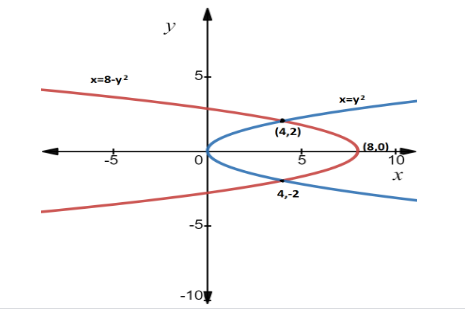
Here, we have the point \[(x,y)\] is \[(4, \pm 2)\] \[\]
By the two parabolas and the points \[(4, - 2),(4,2)\] , we have to plot a graph is mentioned below
By using Pappus second theorem,
The volume \[V\] of a solid of revolution generated by the revolution of a lamina about an external axis is equal to the product of the area \[A\] of the lamina and the distance travelled by the lamina’s geometric centroid.
\[V = A \times \] Distance
For one revolution about the \[y\] -axis,
Due to symmetric, the geometric centroid is at the point \[(4,0)\]
The centroid will travel a distance of \[2\pi x = 2\pi \cdot 4\]
Distance \[ = 8\pi \]
The total area \[A\] is the four times of the area of one revolution (which is quarter of the area) about \[y - axis\] .
The curve represents \[x = {y^2}\] which implies \[y = \sqrt x \]
Total area, \[A = 4\int\limits_0^4 {ydx} \]
By substitute the value \[y\] ,
\[A = 4\int\limits_0^4 {\sqrt x dx} \]
By integrating the above with respect to \[x\] , we get
\[ = 4\left[ {\dfrac{{{x^{\dfrac{1}{2} + 1}}}}{{\dfrac{1}{2} + 1}}} \right] _0^4\]
To simplify, we get
\[ = 4\left[ {\dfrac{{{x^{\dfrac{1}{2}}} \cdot {x^1}}}{{\dfrac{3}{2}}}} \right] _0^4\]
Now, we get
\[ = 4 \cdot \dfrac{2}{3}\left[ {x \cdot {x^{\dfrac{1}{2}}}} \right] _0^4\]
By applying upper limit and lower limit for \[x\] , we get
\[ = 4 \cdot \dfrac{2}{3}\left[ {4 \cdot {4^{\dfrac{1}{2}}}} \right] \]
By simplify the multiplication, then we get
\[ = \dfrac{8}{3}\left[ 8 \right] \]
Total area, \[A\] \[ = \dfrac{{64}}{3}\]
Hence, the volume \[V = A \times \] distance
\[V = \dfrac{{64}}{3} \times 8\pi \]
So, the correct answer is “ \[V = \dfrac{{64}}{3} \times 8\pi \] ”.
Note: We need to find the volume bounded with the points found from the two parabola equations, we should remind the volume formula to solve the problem and to find the total area by means of the formula.
\[V = A \times \] Distance
The centroid will travel a distance of \[2\pi x\]
Complete step-by-step answer:
The volume bounded region by the given equations are revolved around \[y - axis\] ,
\[x = 8 - {y^2}\] ……… \[(1)\]
\[x = {y^2}\] …….. \[(2)\]
We need the point where the two parabolas equations are intersect \[8 - {y^2}\] and \[{y^2}\] , we get
\[8 - {y^2} = {y^2}\]
To simplify it,
\[
{y^2} + {y^2} = 8 \\
2{y^2} = 8 \;
\]
Now, we get
\[
{y^2} = \dfrac{8}{2} = 4 \\
{y^2} = {2^2} \;
\]
By taking square root on both sides, we get
Therefore,
\[y = \pm 2\] , by substitute the value in equation \[(2)\] to find \[x\] , we have
\[(2) \Rightarrow x = {2^2} = 4\]
Here, we have the point \[(x,y)\] is \[(4, \pm 2)\] \[\]
By the two parabolas and the points \[(4, - 2),(4,2)\] , we have to plot a graph is mentioned below
By using Pappus second theorem,
The volume \[V\] of a solid of revolution generated by the revolution of a lamina about an external axis is equal to the product of the area \[A\] of the lamina and the distance travelled by the lamina’s geometric centroid.
\[V = A \times \] Distance
For one revolution about the \[y\] -axis,
Due to symmetric, the geometric centroid is at the point \[(4,0)\]
The centroid will travel a distance of \[2\pi x = 2\pi \cdot 4\]
Distance \[ = 8\pi \]
The total area \[A\] is the four times of the area of one revolution (which is quarter of the area) about \[y - axis\] .
The curve represents \[x = {y^2}\] which implies \[y = \sqrt x \]
Total area, \[A = 4\int\limits_0^4 {ydx} \]
By substitute the value \[y\] ,
\[A = 4\int\limits_0^4 {\sqrt x dx} \]
By integrating the above with respect to \[x\] , we get
\[ = 4\left[ {\dfrac{{{x^{\dfrac{1}{2} + 1}}}}{{\dfrac{1}{2} + 1}}} \right] _0^4\]
To simplify, we get
\[ = 4\left[ {\dfrac{{{x^{\dfrac{1}{2}}} \cdot {x^1}}}{{\dfrac{3}{2}}}} \right] _0^4\]
Now, we get
\[ = 4 \cdot \dfrac{2}{3}\left[ {x \cdot {x^{\dfrac{1}{2}}}} \right] _0^4\]
By applying upper limit and lower limit for \[x\] , we get
\[ = 4 \cdot \dfrac{2}{3}\left[ {4 \cdot {4^{\dfrac{1}{2}}}} \right] \]
By simplify the multiplication, then we get
\[ = \dfrac{8}{3}\left[ 8 \right] \]
Total area, \[A\] \[ = \dfrac{{64}}{3}\]
Hence, the volume \[V = A \times \] distance
\[V = \dfrac{{64}}{3} \times 8\pi \]
So, the correct answer is “ \[V = \dfrac{{64}}{3} \times 8\pi \] ”.
Note: We need to find the volume bounded with the points found from the two parabola equations, we should remind the volume formula to solve the problem and to find the total area by means of the formula.
Recently Updated Pages
Explain the structure of megasporangium class 12 biology CBSE

Why is chloroform kept in dark coloured bottles class 12 chemistry CBSE
Derive the balancing condition of a Wheatstone bri class 12 physics CBSE
Draw VI characteristics of a pn junction diode Explain class 12 physics CBSE
Is it possible to carry pride in ones language too class 12 english CBSE
In a population at Hardy Weinberg equilibrium the allele class 12 biology CBSE
Trending doubts
Draw a labelled sketch of the human eye class 12 physics CBSE
Which are the Top 10 Largest Countries of the World?
Draw ray diagrams each showing i myopic eye and ii class 12 physics CBSE
Which is the correct genotypic ratio of mendel dihybrid class 12 biology CBSE
Differentiate between homogeneous and heterogeneous class 12 chemistry CBSE
Which animal never drinks water in its entire life class 12 biology CBSE