




Find the values of ‘a’ and ‘b’ of the parallelogram PQRS. Given that: vertices of the parallelogram PQRS contains$P \equiv (1,2)$, $Q \equiv (4,6)$,$R \equiv (5,7)$and $S \equiv (a,b)$ respectively.
(a) $a = 3$,$b = 3$
(b) $a = 3$,$b = 2$
(c) Cannot be determined
(d) $a = 2$,$b = 3$
Answer
 Verified
528.3k+ views
Hint: We will use the most eccentric concept of vectors. Consider the midpoint of the polygon, say, parallelogram between the diagonals which intersect at one point. Then, using the midpoint formula, substituting the given vertices in the formula, the required values are obtained.
Complete step-by-step answer:
Since, we have given that
The parallelogram PQRS has the vertices ‘P’ , ‘Q’ , ‘R’ and ‘S’ respectively
Vertices are as follows,
$P = (1,2)$,
$Q = (4,6)$,
$R = (5,7)$ and
$S = (a,b)$
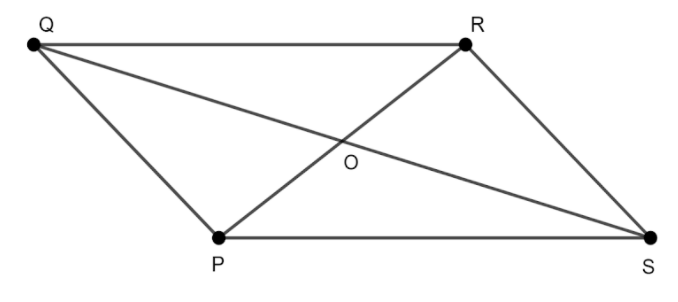
From figure, it seems that
Diagonals ‘PR’ and ‘QS’ meets at one point ‘O’ intersects at only and only one point respectively,
As a result by midpoint formula that is $x = \dfrac{{a + b}}{2}$ and $y = \dfrac{{c + d}}{2}$, we get
Hence, here we can write
\[\dfrac{{\overrightarrow {PR} }}{2} = \dfrac{{\overrightarrow {QS} }}{2}\]
Using midpoint formula, we get
Since, considering x-intercept
\[\dfrac{{\overrightarrow p + \overrightarrow r }}{2} = \dfrac{{\overrightarrow q + \overrightarrow s }}{2}\]
Substituting the given vertices in above equation, we get
\[
\dfrac{{1 + 5}}{2} = \dfrac{{4 + a}}{2} \\
\dfrac{6}{2} = \dfrac{{4 + a}}{2} = 3 \\
\]
Solve the equation mathematically, we get
\[
6 = 4 + a \\
\therefore a = 6 - 4 = 2 \\
\]
Similarly,
Using midpoint formula, we get
Since, considering y-intercept
\[\dfrac{{\overrightarrow p + \overrightarrow r }}{2} = \dfrac{{\overrightarrow q + \overrightarrow s }}{2}\]
Substituting the given vertices in above equation, we get
\[
\dfrac{{2 + 7}}{2} = \dfrac{{6 + b}}{2} \\
\dfrac{9}{2} = \dfrac{{6 + b}}{2} \\
\]
Solve the equation mathematically, we get
\[
9 = 6 + b \\
\therefore b = 9 - 6 = 3 \\
\]
So, the correct answer is “Option d”.
Note: One must remember the concept of vector quantity that revolves in magnitude as well as direction of the quantities or applications of the respective parameters. Should clarify how to calculate the required values of the vertices of the required polygon – using the midpoint formula (after joining diagonals of the polygon, say, parallelogram). Algebraic identities play a significant role in solving this problem so as for the ease of such problems.
Complete step-by-step answer:
Since, we have given that
The parallelogram PQRS has the vertices ‘P’ , ‘Q’ , ‘R’ and ‘S’ respectively
Vertices are as follows,
$P = (1,2)$,
$Q = (4,6)$,
$R = (5,7)$ and
$S = (a,b)$
From figure, it seems that
Diagonals ‘PR’ and ‘QS’ meets at one point ‘O’ intersects at only and only one point respectively,
As a result by midpoint formula that is $x = \dfrac{{a + b}}{2}$ and $y = \dfrac{{c + d}}{2}$, we get
Hence, here we can write
\[\dfrac{{\overrightarrow {PR} }}{2} = \dfrac{{\overrightarrow {QS} }}{2}\]
Using midpoint formula, we get
Since, considering x-intercept
\[\dfrac{{\overrightarrow p + \overrightarrow r }}{2} = \dfrac{{\overrightarrow q + \overrightarrow s }}{2}\]
Substituting the given vertices in above equation, we get
\[
\dfrac{{1 + 5}}{2} = \dfrac{{4 + a}}{2} \\
\dfrac{6}{2} = \dfrac{{4 + a}}{2} = 3 \\
\]
Solve the equation mathematically, we get
\[
6 = 4 + a \\
\therefore a = 6 - 4 = 2 \\
\]
Similarly,
Using midpoint formula, we get
Since, considering y-intercept
\[\dfrac{{\overrightarrow p + \overrightarrow r }}{2} = \dfrac{{\overrightarrow q + \overrightarrow s }}{2}\]
Substituting the given vertices in above equation, we get
\[
\dfrac{{2 + 7}}{2} = \dfrac{{6 + b}}{2} \\
\dfrac{9}{2} = \dfrac{{6 + b}}{2} \\
\]
Solve the equation mathematically, we get
\[
9 = 6 + b \\
\therefore b = 9 - 6 = 3 \\
\]
So, the correct answer is “Option d”.
Note: One must remember the concept of vector quantity that revolves in magnitude as well as direction of the quantities or applications of the respective parameters. Should clarify how to calculate the required values of the vertices of the required polygon – using the midpoint formula (after joining diagonals of the polygon, say, parallelogram). Algebraic identities play a significant role in solving this problem so as for the ease of such problems.
Recently Updated Pages
Master Class 12 Business Studies: Engaging Questions & Answers for Success

Master Class 12 Biology: Engaging Questions & Answers for Success
Master Class 12 Chemistry: Engaging Questions & Answers for Success
Class 12 Question and Answer - Your Ultimate Solutions Guide
Master Class 11 Social Science: Engaging Questions & Answers for Success
Master Class 11 English: Engaging Questions & Answers for Success
Trending doubts
Which is more stable and why class 12 chemistry CBSE
Which are the Top 10 Largest Countries of the World?
Draw a labelled sketch of the human eye class 12 physics CBSE
Differentiate between homogeneous and heterogeneous class 12 chemistry CBSE
What are the major means of transport Explain each class 12 social science CBSE
Sulphuric acid is known as the king of acids State class 12 chemistry CBSE