




Find the value of Trigonometric expression $\cos \left( -1125{}^\circ \right)$ .
Answer
 Verified
639.9k+ views
Hint: Use the trigonometric identity $\cos \left( -\theta \right)=\cos \theta $ to get a familiar relation. Now, cos function is positive in 1st and (iv)th quadrant and negative in 2nd and 3rd quadrant. And if the angle inside the trigonometric function is of type $\dfrac{n\pi }{2}\pm \theta $ (where n is an odd), then change cos to sin, otherwise, if angle of type $n\pi \pm \theta $ , then do not change the trigonometric function, use these rules to solve the given problem. Use the value of $\cos \left( \dfrac{\pi }{4} \right)=\left( \dfrac{1}{\sqrt{2}} \right)$.
Complete step-by-step answer:
Here, we have to determine the value of the trigonometric term $\cos \left( -1125{}^\circ \right)$.
So, let us suppose the value of the given trigonometric expression in the problem be ‘A’.
Hence, we can write equation as –
$A=\cos \left( -1125{}^\circ \right)$ …………………….. (i)
Now, as the angle inside the expression is negative. So, we need to use the following trigonometric identity of cosine functions, given as –
$\cos \left( -\theta \right)=\cos \theta $……………………… (ii)
So, using the above expression, we can re-write the equation (i) as –
$A=\cos \left( -1125{}^\circ \right)=\cos 1125{}^\circ $
Or $A=\cos 1125{}^\circ $ ……………………….. (iii)
Now, we can observe that the angle involved in the above expression is not lying in $0{}^\circ $ to ${{90}^{\circ }}$. It means we have to convert the given angle to acute angle form with the help of some trigonometric identities.
Hence, Let us divide the given expression by ${{180}^{\circ }}$ . So, that we can write the given angle in form of sum of angle which is multiple of ${{180}^{\circ }}$in following way:-
So, let us divide \[{{1125}^{\circ }}\] by \[{{180}^{\circ }}\] as,
\[180\overset{6}{\overline{\left){\begin{align}
& 1125 \\
& \underline{1080} \\
& \underline{ 45} \\
\end{align}}\right.}}\]
So, we can write the angle ${{1125}^{\circ }}$ as ${{1125}^{\circ }}={{180}^{\circ }}\times 6+45{}^\circ $ ………………………….(iv)
Now, as we know the radian representation of $180{}^\circ $ is given as –
$\pi $ radian $=180{}^\circ $ …………………….. (v)
And with the help of above relation, we can re-write the angle ${{45}^{\circ }}$ in radian form as well, given as –
${{45}^{\circ }}=\dfrac{\pi }{4}radian$ …………… (vi)
Hence, we can re-write the expression (iv) with the help of equations (v) and (vi).
${{1125}^{\circ }}=6\pi +\dfrac{\pi }{4}$ …………………………. (vii)
Now, we can put the angle ${{1125}^{\circ }}$ as $6\pi +\dfrac{\pi }{4}$ to the equation (iii). So, we get –
$A=\cos \left( 6\pi +\dfrac{\pi }{4} \right)$ ……………….. (viii)
Now, as we know the quadrant angles are defined as
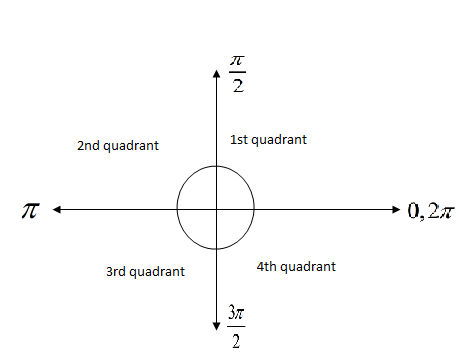
Now, we can apply the trigonometric rules for conversion of trigonometric expressions by changing it’s angle. We can observe the equation (viii) and the given quadrants and hence, get that the angle $6\pi $ will lie at the same position where ${{0}^{\circ }}$ or $2\pi $is lying in the third rotation of ${{360}^{\circ }}$ or $2\pi $angle around the quadrant $\left( 6\pi =2\pi \times 3 \right)$ . Hence, the angle $\left( 6\pi +\dfrac{\pi }{4} \right)$ will lie in the 1st quadrant. As we know all the trigonometric functions are positive in the first quadrant and as the angle $\left( 6\pi +\dfrac{\pi }{4} \right)$ involved angle $6\pi $ which is multiple of $\pi $ , so trigonometric function will not change as per the rules of conversion of trigonometric functions.
So, we can give relation as –
$\begin{align}
& \cos \left( 2\pi +\theta \right)=\cos \theta \\
& \cos \left( 4\pi +\theta \right)=\cos \theta \\
& \cos \left( 6\pi +\theta \right)=\cos \theta \\
\end{align}$
Or $\cos \left( n\pi +\theta \right)=\cos \theta $………………………………. (ix)
Where n is an even integer.
Hence, we get the equation (viii) from the result (ix) as –
$A=\cos \left( 6\pi +\dfrac{\pi }{4} \right)=\cos \dfrac{\pi }{4}$ ……………………………. (x)
Now, we know the value of cos$\dfrac{\pi }{4}$ or $\cos {{45}^{\circ }}$ is given as $\dfrac{1}{\sqrt{2}}$ . Hence, the equation (x) can be given as $A=\cos \dfrac{\pi }{4}=\dfrac{1}{\sqrt{2}}$ .
So, $\dfrac{1}{\sqrt{2}}$is the answer to the problem.
Note: One may get confuse the identity $\cos \left( -\theta \right)=\cos \theta $ by the other relations for other trigonometric functions. For future reference, other trigonometric relations are given as –
$\begin{align}
& \sin \left( -x \right)=-\sin x,\tan \left( -x \right)=-\tan x \\
& \cos ec\left( -x \right)=-\cos ecx,\sec \left( -x \right)=-\sec x \\
& \cot \left( -x \right)=-\cot x \\
\end{align}$
One may not be able to find the direct value of $\cos \left( -1125{}^\circ \right)$ or not be able to convert $-1125{}^\circ $as done with $1125{}^\circ $ . So, we need to use $\cos \left( -\theta \right)=\cos \theta $ to get the familiar form of trigonometric function. So, don’t confuse with the negative sign inside the trigonometric function.
Complete step-by-step answer:
Here, we have to determine the value of the trigonometric term $\cos \left( -1125{}^\circ \right)$.
So, let us suppose the value of the given trigonometric expression in the problem be ‘A’.
Hence, we can write equation as –
$A=\cos \left( -1125{}^\circ \right)$ …………………….. (i)
Now, as the angle inside the expression is negative. So, we need to use the following trigonometric identity of cosine functions, given as –
$\cos \left( -\theta \right)=\cos \theta $……………………… (ii)
So, using the above expression, we can re-write the equation (i) as –
$A=\cos \left( -1125{}^\circ \right)=\cos 1125{}^\circ $
Or $A=\cos 1125{}^\circ $ ……………………….. (iii)
Now, we can observe that the angle involved in the above expression is not lying in $0{}^\circ $ to ${{90}^{\circ }}$. It means we have to convert the given angle to acute angle form with the help of some trigonometric identities.
Hence, Let us divide the given expression by ${{180}^{\circ }}$ . So, that we can write the given angle in form of sum of angle which is multiple of ${{180}^{\circ }}$in following way:-
So, let us divide \[{{1125}^{\circ }}\] by \[{{180}^{\circ }}\] as,
\[180\overset{6}{\overline{\left){\begin{align}
& 1125 \\
& \underline{1080} \\
& \underline{ 45} \\
\end{align}}\right.}}\]
So, we can write the angle ${{1125}^{\circ }}$ as ${{1125}^{\circ }}={{180}^{\circ }}\times 6+45{}^\circ $ ………………………….(iv)
Now, as we know the radian representation of $180{}^\circ $ is given as –
$\pi $ radian $=180{}^\circ $ …………………….. (v)
And with the help of above relation, we can re-write the angle ${{45}^{\circ }}$ in radian form as well, given as –
${{45}^{\circ }}=\dfrac{\pi }{4}radian$ …………… (vi)
Hence, we can re-write the expression (iv) with the help of equations (v) and (vi).
${{1125}^{\circ }}=6\pi +\dfrac{\pi }{4}$ …………………………. (vii)
Now, we can put the angle ${{1125}^{\circ }}$ as $6\pi +\dfrac{\pi }{4}$ to the equation (iii). So, we get –
$A=\cos \left( 6\pi +\dfrac{\pi }{4} \right)$ ……………….. (viii)
Now, as we know the quadrant angles are defined as
Now, we can apply the trigonometric rules for conversion of trigonometric expressions by changing it’s angle. We can observe the equation (viii) and the given quadrants and hence, get that the angle $6\pi $ will lie at the same position where ${{0}^{\circ }}$ or $2\pi $is lying in the third rotation of ${{360}^{\circ }}$ or $2\pi $angle around the quadrant $\left( 6\pi =2\pi \times 3 \right)$ . Hence, the angle $\left( 6\pi +\dfrac{\pi }{4} \right)$ will lie in the 1st quadrant. As we know all the trigonometric functions are positive in the first quadrant and as the angle $\left( 6\pi +\dfrac{\pi }{4} \right)$ involved angle $6\pi $ which is multiple of $\pi $ , so trigonometric function will not change as per the rules of conversion of trigonometric functions.
So, we can give relation as –
$\begin{align}
& \cos \left( 2\pi +\theta \right)=\cos \theta \\
& \cos \left( 4\pi +\theta \right)=\cos \theta \\
& \cos \left( 6\pi +\theta \right)=\cos \theta \\
\end{align}$
Or $\cos \left( n\pi +\theta \right)=\cos \theta $………………………………. (ix)
Where n is an even integer.
Hence, we get the equation (viii) from the result (ix) as –
$A=\cos \left( 6\pi +\dfrac{\pi }{4} \right)=\cos \dfrac{\pi }{4}$ ……………………………. (x)
Now, we know the value of cos$\dfrac{\pi }{4}$ or $\cos {{45}^{\circ }}$ is given as $\dfrac{1}{\sqrt{2}}$ . Hence, the equation (x) can be given as $A=\cos \dfrac{\pi }{4}=\dfrac{1}{\sqrt{2}}$ .
So, $\dfrac{1}{\sqrt{2}}$is the answer to the problem.
Note: One may get confuse the identity $\cos \left( -\theta \right)=\cos \theta $ by the other relations for other trigonometric functions. For future reference, other trigonometric relations are given as –
$\begin{align}
& \sin \left( -x \right)=-\sin x,\tan \left( -x \right)=-\tan x \\
& \cos ec\left( -x \right)=-\cos ecx,\sec \left( -x \right)=-\sec x \\
& \cot \left( -x \right)=-\cot x \\
\end{align}$
One may not be able to find the direct value of $\cos \left( -1125{}^\circ \right)$ or not be able to convert $-1125{}^\circ $as done with $1125{}^\circ $ . So, we need to use $\cos \left( -\theta \right)=\cos \theta $ to get the familiar form of trigonometric function. So, don’t confuse with the negative sign inside the trigonometric function.
Recently Updated Pages
Master Class 12 Business Studies: Engaging Questions & Answers for Success

Master Class 12 Chemistry: Engaging Questions & Answers for Success
Master Class 12 Biology: Engaging Questions & Answers for Success
Class 12 Question and Answer - Your Ultimate Solutions Guide
Master Class 9 General Knowledge: Engaging Questions & Answers for Success
Master Class 9 Maths: Engaging Questions & Answers for Success
Trending doubts
Which are the Top 10 Largest Countries of the World?
Draw a labelled sketch of the human eye class 12 physics CBSE
Differentiate between homogeneous and heterogeneous class 12 chemistry CBSE
Sulphuric acid is known as the king of acids State class 12 chemistry CBSE
Why is the cell called the structural and functional class 12 biology CBSE
A dentist uses a small mirror that gives a magnification class 12 physics CBSE