




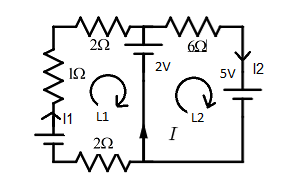
Find the value of $I$ ?
A.\[\text{-1}\text{.4 A}\]
B.\[\text{-2}\text{.1 A}\]
C.\[\text{2A}\]
D.\[\text{-4}\text{.2 A}\]
Answer
 Verified
666.6k+ views
Hint: The value of $I$ can be found using Kirchhoff’s laws. Assume the directions of current and solve the Kirchhoff equations. Negative sign in the current implies the current flows in the opposite direction.
Formula used: \[V=IR\] (Ohm's law).
Complete solution Step-by-Step:
Kirchhoff’s Current Law or Kirchhoff’s First Law or Kirchhoff’s Junction Rule, states that in a circuit, the total of the currents in a junction is equal to the sum of currents outside the junction.
Kirchhoff’s Voltage Law or Kirchhoff’s Second Law or Kirchhoff’s Loop Rule. According to the loop rule, the sum of the voltages around the closed loop is equal to null.
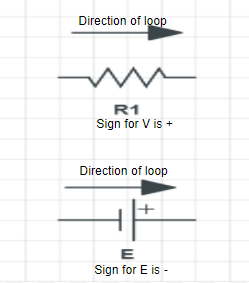
Defining the conventions:
According to Kirchhoff’s Current Law :\[{{I}_{1}}+I={{I}_{2}}\];\[{{I}_{2}}-{{I}_{1}}=I\]
According to Kirchhoff’s Voltage Law:
Sum of voltages is zero, from Ohm’s law \[V=IR\], hence
In \[{{L}_{1}}\]: \[10-{{I}_{1}}-2{{I}_{1}}-2-2{{I}_{1}}=0\]
\[8-5{{I}_{1}}=0\]
\[8=5{{I}_{1}}\]
\[{{I}_{1}}=1.6\]
In \[{{L}_{2}}\]:\[-6{{I}_{2}}-5+2=0\]
\[-6{{I}_{2}}-3=0\]
\[-6{{I}_{2}}=3\]
\[{{I}_{2}}=-0.5\]
Hence $I$ in the circuit is given by
\[{{I}_{2}}-{{I}_{1}}=I\] using Kirchhoff’s Current Law
\[-0.5-1.6=I\]
\[-2.1=I\] in ampere
Hence B.\[\text{-2}\text{.1 A}\] is the answer.
Additional Information: In 1845, a German physicist, Gustav Kirchhoff developed a pair of laws that deal with the conservation of current and energy within electrical circuits. These two laws are commonly known as Kirchhoff’s Voltage and Current Law. The advantages of the laws are:
(I) It makes the calculation of unknown voltages and currents easy.
(II) The analysis and simplification of complex closed-loop circuits becomes manageable.
Note: Assume the directions of current and solve the Kirchhoff equations.Negative sign in the current implies the current flows in the opposite direction. Also take care of the sign convention. Loops can be clockwise or anticlockwise. Use \[V=IR\]Ohm's law.
Formula used: \[V=IR\] (Ohm's law).
Complete solution Step-by-Step:
Kirchhoff’s Current Law or Kirchhoff’s First Law or Kirchhoff’s Junction Rule, states that in a circuit, the total of the currents in a junction is equal to the sum of currents outside the junction.
Kirchhoff’s Voltage Law or Kirchhoff’s Second Law or Kirchhoff’s Loop Rule. According to the loop rule, the sum of the voltages around the closed loop is equal to null.
Defining the conventions:
According to Kirchhoff’s Current Law :\[{{I}_{1}}+I={{I}_{2}}\];\[{{I}_{2}}-{{I}_{1}}=I\]
According to Kirchhoff’s Voltage Law:
Sum of voltages is zero, from Ohm’s law \[V=IR\], hence
In \[{{L}_{1}}\]: \[10-{{I}_{1}}-2{{I}_{1}}-2-2{{I}_{1}}=0\]
\[8-5{{I}_{1}}=0\]
\[8=5{{I}_{1}}\]
\[{{I}_{1}}=1.6\]
In \[{{L}_{2}}\]:\[-6{{I}_{2}}-5+2=0\]
\[-6{{I}_{2}}-3=0\]
\[-6{{I}_{2}}=3\]
\[{{I}_{2}}=-0.5\]
Hence $I$ in the circuit is given by
\[{{I}_{2}}-{{I}_{1}}=I\] using Kirchhoff’s Current Law
\[-0.5-1.6=I\]
\[-2.1=I\] in ampere
Hence B.\[\text{-2}\text{.1 A}\] is the answer.
Additional Information: In 1845, a German physicist, Gustav Kirchhoff developed a pair of laws that deal with the conservation of current and energy within electrical circuits. These two laws are commonly known as Kirchhoff’s Voltage and Current Law. The advantages of the laws are:
(I) It makes the calculation of unknown voltages and currents easy.
(II) The analysis and simplification of complex closed-loop circuits becomes manageable.
Note: Assume the directions of current and solve the Kirchhoff equations.Negative sign in the current implies the current flows in the opposite direction. Also take care of the sign convention. Loops can be clockwise or anticlockwise. Use \[V=IR\]Ohm's law.
Recently Updated Pages
Which of the following graphs shows the variation of class 12 physics CBSE

Draw a labelled diagram of the human male reproductive class 12 biology CBSE
Describe the experiment to compare the emf of two cells class 12 physics CBSE
What is standard hydrogen electrode
What is conventional current and electric current class 12 physics CBSE
2Bromopentane is treated with an alcoholic KOH solution class 12 chemistry CBSE
Trending doubts
Draw a labelled sketch of the human eye class 12 physics CBSE
Which are the Top 10 Largest Countries of the World?
Differentiate between homogeneous and heterogeneous class 12 chemistry CBSE
Draw ray diagrams each showing i myopic eye and ii class 12 physics CBSE
Which is the correct genotypic ratio of mendel dihybrid class 12 biology CBSE
What is the Full Form of PVC, PET, HDPE, LDPE, PP and PS ?