




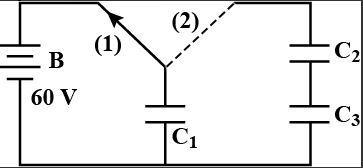
Find the sum of final charges on ${C_2}$ and ${C_3}$ if a capacitor ${C_1} = 1.0\mu F$ is charged up to a voltage $V = 60V$ by connecting it to a battery $B$ through switch (1) and now, ${C_1}$ is disconnected from a battery and connected to a circuit consisting of two uncharged capacitors ${C_2} = 3.0\mu F$ and ${C_3} = 6.0\mu F$ through a switch (2) as shown in the figure.
A. $40\mu C$
B. $36\mu C$
C. $20\mu C$
D. $54\mu C$
Answer
 Verified
602.4k+ views
Hint First of all, calculate the equivalent capacitance between ${C_2}$ and ${C_3}$. Then, calculate the charge passing from ${C_1}$ by using the formula of charge, $Q = CV$ (where, $Q$ is the charge, $C$ is the capacitance and $V$ is the potential difference across the capacitor).
Next, evaluate the potential difference between equivalent capacitors and ${C_1}$.
Then, calculate the charge across the equivalent capacitance.
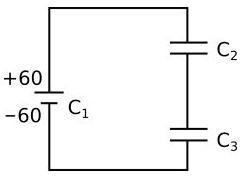
Complete step-by-step solution:Let $C'$ be the equivalent capacitance of ${C_2}$ and ${C_3}$.
As shown in figure, ${C_2}$ and ${C_3}$ are in series so, to calculate equivalent resistance, we have to use
$
\dfrac{1}{{C'}} = \dfrac{1}{{{C_2}}} + \dfrac{1}{{{C_3}}} \\
\Rightarrow \dfrac{1}{{C'}} = \dfrac{{{C_2} + {C_3}}}{{{C_2}{C_3}}} \\
\therefore C' = \dfrac{{{C_2}{C_3}}}{{{C_2} + {C_3}}} \\
$
Now, putting the values of ${C_2}$ and ${C_3}$ in the above expression –
$
C' = \dfrac{{3 \times 6}}{{3 + 6}} \\
C' = \dfrac{{18}}{9} = 2\mu F \\
$
Now, calculating the charge across the capacitor, ${C_1} = 1.0\mu F$
$\because Q = CV$
According to the question, the capacitance, ${C_1}$ is charged up to a voltage $V = 60V$
$
\therefore {Q_1} = 1 \times 60 \\
{Q_1} = 60\mu C \\
$
The potential difference between ${C_1}$ and $C'$ combined.
$V' = \dfrac{{{Q_1}}}{{{C_1} + C'}}$
Putting the values of capacitance and charge of ${C_1}$ in the above expression –
$
V' = \dfrac{{60}}{{1 + 2}} \\
\Rightarrow V' = \dfrac{{60}}{3} \\
\therefore V' = 20V \\
$
Now, calculating the charge of ${C_2}$ and ${C_3}$ system –
${Q_{23}} = C'V'$
Putting the values of $C'$ and $V'$ on the above expression –
${Q_{23}} = 2 \times 20 = 40\mu C$
Therefore, the charge on capacitors ${C_2}$ and ${C_3}$ is $40\mu C$.
Hence, option (A) is the correct answer.
Note:- The device which is used to store electrical energy is called a capacitor. The capacity of the capacitor to store the electricity is called Capacitance. The S.I unit of capacitance is Farad which is denoted by $F.$
The dimensional formula of capacitor is ${M^{ - 1}}{L^{ - 2}}{I^2}{T^4}.$
Next, evaluate the potential difference between equivalent capacitors and ${C_1}$.
Then, calculate the charge across the equivalent capacitance.
Complete step-by-step solution:Let $C'$ be the equivalent capacitance of ${C_2}$ and ${C_3}$.
As shown in figure, ${C_2}$ and ${C_3}$ are in series so, to calculate equivalent resistance, we have to use
$
\dfrac{1}{{C'}} = \dfrac{1}{{{C_2}}} + \dfrac{1}{{{C_3}}} \\
\Rightarrow \dfrac{1}{{C'}} = \dfrac{{{C_2} + {C_3}}}{{{C_2}{C_3}}} \\
\therefore C' = \dfrac{{{C_2}{C_3}}}{{{C_2} + {C_3}}} \\
$
Now, putting the values of ${C_2}$ and ${C_3}$ in the above expression –
$
C' = \dfrac{{3 \times 6}}{{3 + 6}} \\
C' = \dfrac{{18}}{9} = 2\mu F \\
$
Now, calculating the charge across the capacitor, ${C_1} = 1.0\mu F$
$\because Q = CV$
According to the question, the capacitance, ${C_1}$ is charged up to a voltage $V = 60V$
$
\therefore {Q_1} = 1 \times 60 \\
{Q_1} = 60\mu C \\
$
The potential difference between ${C_1}$ and $C'$ combined.
$V' = \dfrac{{{Q_1}}}{{{C_1} + C'}}$
Putting the values of capacitance and charge of ${C_1}$ in the above expression –
$
V' = \dfrac{{60}}{{1 + 2}} \\
\Rightarrow V' = \dfrac{{60}}{3} \\
\therefore V' = 20V \\
$
Now, calculating the charge of ${C_2}$ and ${C_3}$ system –
${Q_{23}} = C'V'$
Putting the values of $C'$ and $V'$ on the above expression –
${Q_{23}} = 2 \times 20 = 40\mu C$
Therefore, the charge on capacitors ${C_2}$ and ${C_3}$ is $40\mu C$.
Hence, option (A) is the correct answer.
Note:- The device which is used to store electrical energy is called a capacitor. The capacity of the capacitor to store the electricity is called Capacitance. The S.I unit of capacitance is Farad which is denoted by $F.$
The dimensional formula of capacitor is ${M^{ - 1}}{L^{ - 2}}{I^2}{T^4}.$
Recently Updated Pages
Master Class 12 Social Science: Engaging Questions & Answers for Success

Master Class 12 Physics: Engaging Questions & Answers for Success
Master Class 12 Maths: Engaging Questions & Answers for Success
Master Class 12 Economics: Engaging Questions & Answers for Success
Master Class 12 Chemistry: Engaging Questions & Answers for Success
Master Class 12 Business Studies: Engaging Questions & Answers for Success
Trending doubts
Which are the Top 10 Largest Countries of the World?
Draw a labelled sketch of the human eye class 12 physics CBSE
Explain the structure of megasporangium class 12 biology CBSE
What are the major means of transport Explain each class 12 social science CBSE
How many chromosomes are found in human ovum a 46 b class 12 biology CBSE
The diagram of the section of a maize grain is given class 12 biology CBSE