




Find the square root of \[15\]
Answer
 Verified
552.9k+ views
Hint: The square root of any number can be found by using the long division method. The complementary square root is nothing but the square of a number. So, the square root is of a number that gives a number that has been squared to get that number. The long division method uses only the multiples of the same numbers as divisors and quotients (that is \[1 \times 1,2 \times 2,3 \times 3,...\]).
Complete step by step answer:
It is given that we have to find the square root of the number \[15\]. We use the long division method to find the value of the square root of the number \[15\].
The square root of the given number can be written as \[\sqrt {15} \]. And it also is written as \[{15^{1/2}}\] since square root is nothing but a power raised to \[\dfrac{1}{2}\].
Let us start with the long division method.
First, find a number that gives a number that is nearest to \[15\] when multiplied to itself.
\[1 \times 1 = 1\] gives one which is less than \[15\] but it may not be nearest to \[15\] so let us check the next numbers.
\[2 \times 2 = 4\] gives four which is again less than \[15\] but it may not be nearest to \[15\]so let us check the next numbers.
\[3 \times 3 = 9\] gives nine which is again less than \[15\] but it may not be nearest to \[15\] so let us check the next numbers.
\[4 \times 4 = 16\] gives sixteen which is greater than \[15\] so we will take \[3 \times 3 = 9\].
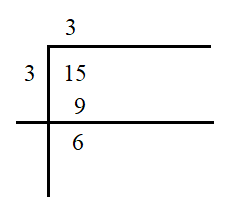
Now let us double the dividend by giving double zeros and bring it down.
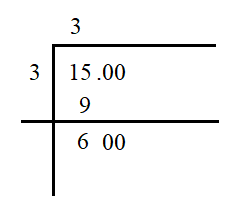
Now let’s again check for the number that gives a number that is nearest to \[600\] when multiplied to itself.
We get \[68 \times 68 = 544\]as the nearest number to \[600\]. So, we will take \[68\] as the divisor and its digit in the ones-place as the dividend.
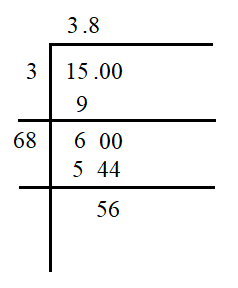
Now let us again double the dividend by giving double zeros and bring it down.
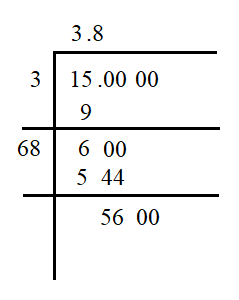
Now let’s again check for the number that gives a number that is nearest to \[5600\] when multiplied to itself.
We get \[767 \times 767 = 5369\] as the nearest number to \[5600\]. So, we will take \[767\] as the divisor and its digit in the ones-place as the dividend.
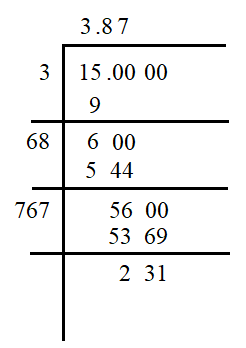
Now let us again double the dividend by giving double zeros and bring it down.
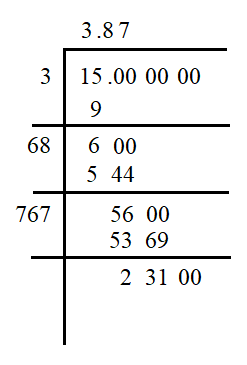
Now let’s again check for the number that gives a number that is nearest to \[23100\]when multiplied to itself.
We get \[7742 \times 7742 = 15484\] as the nearest number to \[23100\]. So, we will take \[7742\]as the divisor and its digit in the ones-place as the dividend.
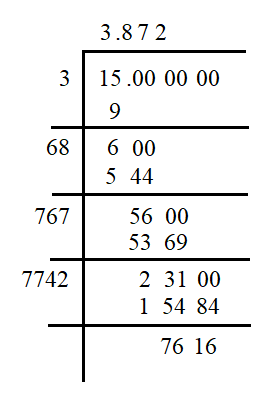
Three places after the decimal are enough for us so we will stop here. If we want more decimal places, we can proceed with the steps again.
Thus, the square root of \[15\] is \[3.872\].
Note: The long division is the best method to find the square root of a number more precisely.
If we want to have more numbers after decimal places, we can keep on proceeding with the steps we have done above until the required decimal point is obtained.
Complete step by step answer:
It is given that we have to find the square root of the number \[15\]. We use the long division method to find the value of the square root of the number \[15\].
The square root of the given number can be written as \[\sqrt {15} \]. And it also is written as \[{15^{1/2}}\] since square root is nothing but a power raised to \[\dfrac{1}{2}\].
Let us start with the long division method.
First, find a number that gives a number that is nearest to \[15\] when multiplied to itself.
\[1 \times 1 = 1\] gives one which is less than \[15\] but it may not be nearest to \[15\] so let us check the next numbers.
\[2 \times 2 = 4\] gives four which is again less than \[15\] but it may not be nearest to \[15\]so let us check the next numbers.
\[3 \times 3 = 9\] gives nine which is again less than \[15\] but it may not be nearest to \[15\] so let us check the next numbers.
\[4 \times 4 = 16\] gives sixteen which is greater than \[15\] so we will take \[3 \times 3 = 9\].
Now let us double the dividend by giving double zeros and bring it down.
Now let’s again check for the number that gives a number that is nearest to \[600\] when multiplied to itself.
We get \[68 \times 68 = 544\]as the nearest number to \[600\]. So, we will take \[68\] as the divisor and its digit in the ones-place as the dividend.
Now let us again double the dividend by giving double zeros and bring it down.
Now let’s again check for the number that gives a number that is nearest to \[5600\] when multiplied to itself.
We get \[767 \times 767 = 5369\] as the nearest number to \[5600\]. So, we will take \[767\] as the divisor and its digit in the ones-place as the dividend.
Now let us again double the dividend by giving double zeros and bring it down.
Now let’s again check for the number that gives a number that is nearest to \[23100\]when multiplied to itself.
We get \[7742 \times 7742 = 15484\] as the nearest number to \[23100\]. So, we will take \[7742\]as the divisor and its digit in the ones-place as the dividend.
Three places after the decimal are enough for us so we will stop here. If we want more decimal places, we can proceed with the steps again.
Thus, the square root of \[15\] is \[3.872\].
Note: The long division is the best method to find the square root of a number more precisely.
If we want to have more numbers after decimal places, we can keep on proceeding with the steps we have done above until the required decimal point is obtained.

Recently Updated Pages
Master Class 11 English: Engaging Questions & Answers for Success

Master Class 11 Social Science: Engaging Questions & Answers for Success
Master Class 11 Maths: Engaging Questions & Answers for Success
Master Class 11 Biology: Engaging Questions & Answers for Success
Master Class 11 Physics: Engaging Questions & Answers for Success
Master Class 11 Chemistry: Engaging Questions & Answers for Success
Trending doubts
In Indian rupees 1 trillion is equal to how many c class 8 maths CBSE
What is BLO What is the full form of BLO class 8 social science CBSE
What are the 12 elements of nature class 8 chemistry CBSE
Citizens of India can vote at the age of A 18 years class 8 social science CBSE
Which of the following leader has given the term insensate class 8 social science CBSE
Name the states through which the Tropic of Cancer class 8 social science CBSE