




Find the real solution of ${{\tan }^{-1}}\sqrt{x\left( x+1 \right)}+{{\sin }^{-1}}\sqrt{{{x}^{2}}+x+1}=\dfrac{\pi }{2}$.
Answer
 Verified
592.5k+ views
Hint: For this problem we need to calculate the real solution of the given equation. For this we are going to use the inverse trigonometric formulas. First, we will consider the value ${{\tan }^{-1}}\sqrt{x\left( x+1 \right)}$ and assume it to be $\theta $ and calculate the value of $\tan \theta $. From the value of $\tan \theta $ we will construct a triangle and find the value of $\theta $ in terms of ${{\cos }^{-1}}$. Now we will substitute this value as ${{\tan }^{-1}}\sqrt{x\left( x+1 \right)}$ in the given equation. Here we can use the inverse trigonometric formula which is ${{\sin }^{-1}}\theta +{{\cos }^{-1}}\theta =\dfrac{\pi }{2}$. From this we can equate the values which are in trigonometric ratios and simplify them to get the required result.
Complete step by step solution:
Given equation ${{\tan }^{-1}}\sqrt{x\left( x+1 \right)}+{{\sin }^{-1}}\sqrt{{{x}^{2}}+x+1}=\dfrac{\pi }{2}$.
Considering the value ${{\tan }^{-1}}\sqrt{x\left( x+1 \right)}$.
Let ${{\tan }^{-1}}\sqrt{x\left( x+1 \right)}=\theta $
Applying $\tan $ function on both sides of the above equation, then we will get
$\tan \theta =\tan \left( {{\tan }^{-1}}\left( \sqrt{x\left( x+1 \right)} \right) \right)$
The functions $\tan $ and ${{\tan }^{-1}}$ are get cancelled to each other, then the above equation is modified as
$\tan \theta =\sqrt{x\left( x+1 \right)}$
We have the definition of the $\tan \theta $ as $\dfrac{\text{Opposite side to }\theta }{\text{Adjacent side to }\theta }$. So, we can construct a triangle as
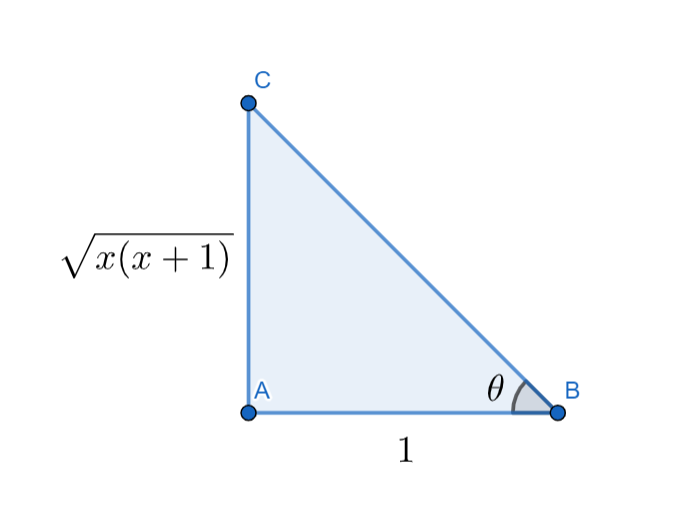
From Pythagoras theorem we can write the value of hypotenuse as
$\begin{align}
& hyp=\sqrt{{{1}^{2}}+{{\left( \sqrt{x\left( x+1 \right)} \right)}^{2}}} \\
& \Rightarrow hyp=\sqrt{1+{{x}^{2}}+x} \\
& \Rightarrow hyp=\sqrt{{{x}^{2}}+x+1} \\
\end{align}$
Now the value of $\cos \theta $ will be
$\begin{align}
& \cos \theta =\dfrac{\text{Adjacent side to }\theta }{\text{Hypotenuse}} \\
& \Rightarrow \cos \theta =\dfrac{1}{\sqrt{{{x}^{2}}+x+1}} \\
\end{align}$
From the above equation the value of $\theta $ will be
$\theta ={{\cos }^{-1}}\left( \dfrac{1}{\sqrt{{{x}^{2}}+x+1}} \right)$
Bur we have assumed that ${{\tan }^{-1}}\sqrt{x\left( x+1 \right)}=\theta $. From both these values, we can write
${{\tan }^{-1}}\sqrt{x\left( x+1 \right)}={{\cos }^{-1}}\left( \dfrac{1}{\sqrt{{{x}^{2}}+x+1}} \right)$
Substituting this value in the given equation ${{\tan }^{-1}}\sqrt{x\left( x+1 \right)}+{{\sin }^{-1}}\sqrt{{{x}^{2}}+x+1}=\dfrac{\pi }{2}$, then we will get
${{\cos }^{-1}}\left( \dfrac{1}{\sqrt{{{x}^{2}}+x+1}} \right)+{{\sin }^{-1}}\left( \sqrt{{{x}^{2}}+x+1} \right)=\dfrac{\pi }{2}$
We have the inverse trigonometric formula which is ${{\sin }^{-1}}\theta +{{\cos }^{-1}}\theta =\dfrac{\pi }{2}$. By considering this formula, from the above equation we can write
$\dfrac{1}{\sqrt{{{x}^{2}}+x+1}}=\sqrt{{{x}^{2}}+x+1}$
Simplifying the above equation by cross multiplication, then we will have
${{x}^{2}}+x+1=1$
Subtracting $1$ on both sides and taking $x$ as common from the terms ${{x}^{2}}+x$, then the above equation is modified as
$\begin{align}
& x\left( x+1 \right)+1-1=1-1 \\
& \Rightarrow x\left( x+1 \right)=0 \\
\end{align}$
Equating each term individually, then we will get
$\begin{align}
& x=0\text{ or }x+1=0 \\
& \Rightarrow x=0\text{ or }x=-1 \\
\end{align}$
Hence the real solution for the given equation ${{\tan }^{-1}}\sqrt{x\left( x+1 \right)}+{{\sin }^{-1}}\sqrt{{{x}^{2}}+x+1}=\dfrac{\pi }{2}$ is $x=0,-1$.
Note: For this problem we can also consider the term ${{\sin }^{-1}}\left( \sqrt{{{x}^{2}}+x+1} \right)$ and convert it into ${{\cot }^{-1}}$ by constructing a triangle and applying some basic trigonometric definitions and Pythagoras theorem. After that substitute the converted value in the given equation and use the inverse trigonometric formula ${{\tan }^{-1}}x+{{\cot }^{-1}}x=\dfrac{\pi }{2}$ and follow the above procedure to calculate the required result.
Complete step by step solution:
Given equation ${{\tan }^{-1}}\sqrt{x\left( x+1 \right)}+{{\sin }^{-1}}\sqrt{{{x}^{2}}+x+1}=\dfrac{\pi }{2}$.
Considering the value ${{\tan }^{-1}}\sqrt{x\left( x+1 \right)}$.
Let ${{\tan }^{-1}}\sqrt{x\left( x+1 \right)}=\theta $
Applying $\tan $ function on both sides of the above equation, then we will get
$\tan \theta =\tan \left( {{\tan }^{-1}}\left( \sqrt{x\left( x+1 \right)} \right) \right)$
The functions $\tan $ and ${{\tan }^{-1}}$ are get cancelled to each other, then the above equation is modified as
$\tan \theta =\sqrt{x\left( x+1 \right)}$
We have the definition of the $\tan \theta $ as $\dfrac{\text{Opposite side to }\theta }{\text{Adjacent side to }\theta }$. So, we can construct a triangle as
From Pythagoras theorem we can write the value of hypotenuse as
$\begin{align}
& hyp=\sqrt{{{1}^{2}}+{{\left( \sqrt{x\left( x+1 \right)} \right)}^{2}}} \\
& \Rightarrow hyp=\sqrt{1+{{x}^{2}}+x} \\
& \Rightarrow hyp=\sqrt{{{x}^{2}}+x+1} \\
\end{align}$
Now the value of $\cos \theta $ will be
$\begin{align}
& \cos \theta =\dfrac{\text{Adjacent side to }\theta }{\text{Hypotenuse}} \\
& \Rightarrow \cos \theta =\dfrac{1}{\sqrt{{{x}^{2}}+x+1}} \\
\end{align}$
From the above equation the value of $\theta $ will be
$\theta ={{\cos }^{-1}}\left( \dfrac{1}{\sqrt{{{x}^{2}}+x+1}} \right)$
Bur we have assumed that ${{\tan }^{-1}}\sqrt{x\left( x+1 \right)}=\theta $. From both these values, we can write
${{\tan }^{-1}}\sqrt{x\left( x+1 \right)}={{\cos }^{-1}}\left( \dfrac{1}{\sqrt{{{x}^{2}}+x+1}} \right)$
Substituting this value in the given equation ${{\tan }^{-1}}\sqrt{x\left( x+1 \right)}+{{\sin }^{-1}}\sqrt{{{x}^{2}}+x+1}=\dfrac{\pi }{2}$, then we will get
${{\cos }^{-1}}\left( \dfrac{1}{\sqrt{{{x}^{2}}+x+1}} \right)+{{\sin }^{-1}}\left( \sqrt{{{x}^{2}}+x+1} \right)=\dfrac{\pi }{2}$
We have the inverse trigonometric formula which is ${{\sin }^{-1}}\theta +{{\cos }^{-1}}\theta =\dfrac{\pi }{2}$. By considering this formula, from the above equation we can write
$\dfrac{1}{\sqrt{{{x}^{2}}+x+1}}=\sqrt{{{x}^{2}}+x+1}$
Simplifying the above equation by cross multiplication, then we will have
${{x}^{2}}+x+1=1$
Subtracting $1$ on both sides and taking $x$ as common from the terms ${{x}^{2}}+x$, then the above equation is modified as
$\begin{align}
& x\left( x+1 \right)+1-1=1-1 \\
& \Rightarrow x\left( x+1 \right)=0 \\
\end{align}$
Equating each term individually, then we will get
$\begin{align}
& x=0\text{ or }x+1=0 \\
& \Rightarrow x=0\text{ or }x=-1 \\
\end{align}$
Hence the real solution for the given equation ${{\tan }^{-1}}\sqrt{x\left( x+1 \right)}+{{\sin }^{-1}}\sqrt{{{x}^{2}}+x+1}=\dfrac{\pi }{2}$ is $x=0,-1$.
Note: For this problem we can also consider the term ${{\sin }^{-1}}\left( \sqrt{{{x}^{2}}+x+1} \right)$ and convert it into ${{\cot }^{-1}}$ by constructing a triangle and applying some basic trigonometric definitions and Pythagoras theorem. After that substitute the converted value in the given equation and use the inverse trigonometric formula ${{\tan }^{-1}}x+{{\cot }^{-1}}x=\dfrac{\pi }{2}$ and follow the above procedure to calculate the required result.
Recently Updated Pages
Master Class 12 Economics: Engaging Questions & Answers for Success

Master Class 12 Social Science: Engaging Questions & Answers for Success
Master Class 12 English: Engaging Questions & Answers for Success
Master Class 12 Maths: Engaging Questions & Answers for Success
Master Class 12 Physics: Engaging Questions & Answers for Success
Master Class 12 Biology: Engaging Questions & Answers for Success
Trending doubts
Draw a labelled sketch of the human eye class 12 physics CBSE
Which are the Top 10 Largest Countries of the World?
Draw ray diagrams each showing i myopic eye and ii class 12 physics CBSE
Which is the correct genotypic ratio of mendel dihybrid class 12 biology CBSE
Differentiate between homogeneous and heterogeneous class 12 chemistry CBSE
Which animal never drinks water in its entire life class 12 biology CBSE