




Find the principal value of \[{\tan ^{ - 1}}\left( { - \dfrac{1}{{\sqrt 3 }}} \right)\].
Answer
 Verified
650.4k+ views
Hint: The range of \[{\tan ^{ - 1}}\theta \] is between \[\left. {\left( { - \dfrac{\pi }{2},\dfrac{\pi }{2}} \right.} \right)\]. From the trigonometric table find the value of\[\left( { - \dfrac{1}{{\sqrt 3 }}} \right)\]. Now substitute this back into our given expression and simplify it to get the principal value.
Complete step-by-step answer:
A principal value of a function is the value selected at a point in the domain of a multiple-valued function, chosen so that the function has a single value at the point. The principal value of \[{\tan ^{ - 1}}\theta \]
The principal value of \[{\tan ^{ - 1}}\theta \] branches to,
\[{\tan ^{ - 1}}x \in \left( { - \dfrac{\pi }{2},\dfrac{\pi }{2}} \right)\].
Hence the principal value of the given function will be between the range\[\left( { - \dfrac{\pi }{2},\dfrac{\pi }{2}} \right)\] .
Now we have been given the function, \[{\tan ^{ - 1}}\left( { - \dfrac{1}{{\sqrt 3 }}} \right)\].
Let us first find the value of \[\left( { - \dfrac{1}{{\sqrt 3 }}} \right)\] from the above expression. By using the trigonometric table we can find the tangent function related to \[\left( { - \dfrac{1}{{\sqrt 3 }}} \right)\] . Let us draw the trigonometric table to make the identification of the function easier.
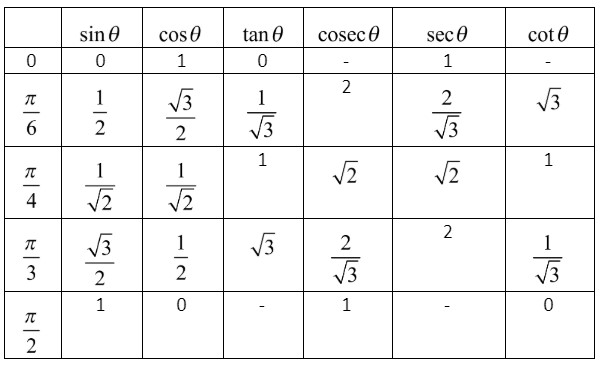
From the table we get that, \[\tan \dfrac{\pi }{6} = \dfrac{1}{{\sqrt 3 }}\].
In case of an inverse tangent function, \[{\tan ^{ - 1}}( - \theta ) = - \theta \]. Hence we get,
\[\tan \left( { - \dfrac{\pi }{6}} \right) = \left( { - \dfrac{1}{{\sqrt 3 }}} \right)\]
Now let us substitute \[\tan \left( { - \dfrac{\pi }{6}} \right)\]in the place of \[\left( { - \dfrac{1}{{\sqrt 3 }}} \right)\].Thus we can change the given expression as,
\[{\tan ^{ - 1}}\left( { - \dfrac{1}{{\sqrt 3 }}} \right) = {\tan ^{ - 1}}\left( {\tan \left( { - \dfrac{\pi }{6}} \right)} \right)\]
Now let us simplify the above expression to get the principal value.
\[
{\tan ^{ - 1}}\left( { - \dfrac{1}{{\sqrt 3 }}} \right) = {\tan ^{ - 1}}\left( {\tan \left( { - \dfrac{\pi }{6}} \right)} \right) \ \\
{\tan ^{ - 1}}\left( {\tan \left( { - \dfrac{\pi }{6}} \right)} \right) = \left( { - \dfrac{\pi }{6}} \right) \ \\
{\tan ^{ - 1}}\left( { - \dfrac{1}{{\sqrt 3 }}} \right) = \left( { - \dfrac{\pi }{6}} \right) \ \\
\]
Thus we got the principal value of the given inverse tangent function as, \[\left( { - \dfrac{\pi }{6}} \right)\].
\[\therefore {\tan ^{ - 1}}\left( { - \dfrac{1}{{\sqrt 3 }}} \right) = \left( { - \dfrac{\pi }{6}} \right)\].
Note: To solve a question like these you should be familiar with the domain and range of the sine functions as well as the domain and range of the inverse sine functions. For us the range of inverse tangent function is \[\left( { - \dfrac{\pi }{2},\dfrac{\pi }{2}} \right)\] and the domain of inverse function of tangent is \[\left( { - \infty ,\infty } \right)\]. Students should remember the important trigonometric ratios and standard angles to solve these types of questions.
Complete step-by-step answer:
A principal value of a function is the value selected at a point in the domain of a multiple-valued function, chosen so that the function has a single value at the point. The principal value of \[{\tan ^{ - 1}}\theta \]
The principal value of \[{\tan ^{ - 1}}\theta \] branches to,
\[{\tan ^{ - 1}}x \in \left( { - \dfrac{\pi }{2},\dfrac{\pi }{2}} \right)\].
Hence the principal value of the given function will be between the range\[\left( { - \dfrac{\pi }{2},\dfrac{\pi }{2}} \right)\] .
Now we have been given the function, \[{\tan ^{ - 1}}\left( { - \dfrac{1}{{\sqrt 3 }}} \right)\].
Let us first find the value of \[\left( { - \dfrac{1}{{\sqrt 3 }}} \right)\] from the above expression. By using the trigonometric table we can find the tangent function related to \[\left( { - \dfrac{1}{{\sqrt 3 }}} \right)\] . Let us draw the trigonometric table to make the identification of the function easier.
From the table we get that, \[\tan \dfrac{\pi }{6} = \dfrac{1}{{\sqrt 3 }}\].
In case of an inverse tangent function, \[{\tan ^{ - 1}}( - \theta ) = - \theta \]. Hence we get,
\[\tan \left( { - \dfrac{\pi }{6}} \right) = \left( { - \dfrac{1}{{\sqrt 3 }}} \right)\]
Now let us substitute \[\tan \left( { - \dfrac{\pi }{6}} \right)\]in the place of \[\left( { - \dfrac{1}{{\sqrt 3 }}} \right)\].Thus we can change the given expression as,
\[{\tan ^{ - 1}}\left( { - \dfrac{1}{{\sqrt 3 }}} \right) = {\tan ^{ - 1}}\left( {\tan \left( { - \dfrac{\pi }{6}} \right)} \right)\]
Now let us simplify the above expression to get the principal value.
\[
{\tan ^{ - 1}}\left( { - \dfrac{1}{{\sqrt 3 }}} \right) = {\tan ^{ - 1}}\left( {\tan \left( { - \dfrac{\pi }{6}} \right)} \right) \ \\
{\tan ^{ - 1}}\left( {\tan \left( { - \dfrac{\pi }{6}} \right)} \right) = \left( { - \dfrac{\pi }{6}} \right) \ \\
{\tan ^{ - 1}}\left( { - \dfrac{1}{{\sqrt 3 }}} \right) = \left( { - \dfrac{\pi }{6}} \right) \ \\
\]
Thus we got the principal value of the given inverse tangent function as, \[\left( { - \dfrac{\pi }{6}} \right)\].
\[\therefore {\tan ^{ - 1}}\left( { - \dfrac{1}{{\sqrt 3 }}} \right) = \left( { - \dfrac{\pi }{6}} \right)\].
Note: To solve a question like these you should be familiar with the domain and range of the sine functions as well as the domain and range of the inverse sine functions. For us the range of inverse tangent function is \[\left( { - \dfrac{\pi }{2},\dfrac{\pi }{2}} \right)\] and the domain of inverse function of tangent is \[\left( { - \infty ,\infty } \right)\]. Students should remember the important trigonometric ratios and standard angles to solve these types of questions.
Recently Updated Pages
Master Class 12 Business Studies: Engaging Questions & Answers for Success

Master Class 12 Chemistry: Engaging Questions & Answers for Success
Master Class 12 Biology: Engaging Questions & Answers for Success
Class 12 Question and Answer - Your Ultimate Solutions Guide
Master Class 11 English: Engaging Questions & Answers for Success
Master Class 11 Social Science: Engaging Questions & Answers for Success
Trending doubts
Which are the Top 10 Largest Countries of the World?
Draw a labelled sketch of the human eye class 12 physics CBSE
Differentiate between homogeneous and heterogeneous class 12 chemistry CBSE
Differentiate between Pyramid of energy and pyramid class 12 biology CBSE
Why is the cell called the structural and functional class 12 biology CBSE
Draw the diagram of the pyramid of energy Explain In class 12 biology CBSE