




Find the power delivered by the sources in the circuit shown in figure:

Answer
 Verified
499.8k+ views
Hint: In question such as these we can easily see that this circuit form a closed loop so the best and the simplest way to solve his problem is by applying the Kirchhoff’s voltage law as a close loop is given, we can determine the unknown variables that helps in simplifying the problem. Kirchhoff’s voltage law can be applied anywhere if a closed loop is given.
Formula used:
$P = {i^2}R$
Where, $P$ is the power, $i$ is the current and $R$ is the resistance
Conventions:
-If moving in the direction of current voltage decreases if a resistor is encountered.
-Voltage decreases if the current moves against the direction of the voltage source(i.e., from – to +).
Complete step by step answer:
Let’s start by applying Kirchhoff’s voltage law in the loop ‘a b c d’, starting from the point a and moving in the direction of the current.
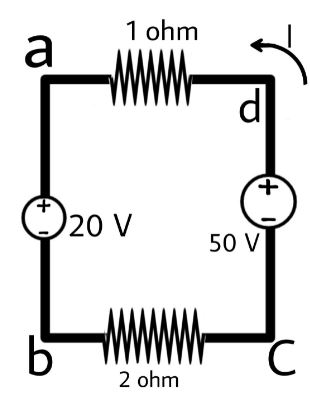
At first we encounter a voltage source of 20-volt but it is in the opposite direction to the flow of current so, as per the sign convention we get a decrease of 20-volt (-20 V). Then a resistor of 2 ohm, which decreases the potential by $2i$. A 50-volt voltage source increases the potential followed by the decrease of potential by $i$. Thus, we reach the point ‘a’ from where we started.
By Kirchhoff’s voltage law
$ - 20 - 2i + 50 - i = 0$
$\Rightarrow 30 - 3i = 0$
$\Rightarrow 30 = 3i$
$\Rightarrow i = 10$
Since we know the current, we can find the value of power dissipated by the formula $\left( {P = {i^2}R} \right)$
Total power:
$P = {10^2} \times 2 + {10^2} \times 1$
$\Rightarrow P = 200 + 100$
$\therefore P = 300\,W$
Thus, the total power dissipated is 300 watts.
Note: There is also a direct way to solve this problem for competitive exams.First, we find the total equivalent voltage of the circuit which is 30-volt as the two sources are align against each other, but the resistance gets added simply and these two are in series with each other, so total resistance becomes 3 ohms. Thus, we can find the current and solve this problem.
Formula used:
$P = {i^2}R$
Where, $P$ is the power, $i$ is the current and $R$ is the resistance
Conventions:
-If moving in the direction of current voltage decreases if a resistor is encountered.
-Voltage decreases if the current moves against the direction of the voltage source(i.e., from – to +).
Complete step by step answer:
Let’s start by applying Kirchhoff’s voltage law in the loop ‘a b c d’, starting from the point a and moving in the direction of the current.
At first we encounter a voltage source of 20-volt but it is in the opposite direction to the flow of current so, as per the sign convention we get a decrease of 20-volt (-20 V). Then a resistor of 2 ohm, which decreases the potential by $2i$. A 50-volt voltage source increases the potential followed by the decrease of potential by $i$. Thus, we reach the point ‘a’ from where we started.
By Kirchhoff’s voltage law
$ - 20 - 2i + 50 - i = 0$
$\Rightarrow 30 - 3i = 0$
$\Rightarrow 30 = 3i$
$\Rightarrow i = 10$
Since we know the current, we can find the value of power dissipated by the formula $\left( {P = {i^2}R} \right)$
Total power:
$P = {10^2} \times 2 + {10^2} \times 1$
$\Rightarrow P = 200 + 100$
$\therefore P = 300\,W$
Thus, the total power dissipated is 300 watts.
Note: There is also a direct way to solve this problem for competitive exams.First, we find the total equivalent voltage of the circuit which is 30-volt as the two sources are align against each other, but the resistance gets added simply and these two are in series with each other, so total resistance becomes 3 ohms. Thus, we can find the current and solve this problem.
Recently Updated Pages
Three beakers labelled as A B and C each containing 25 mL of water were taken A small amount of NaOH anhydrous CuSO4 and NaCl were added to the beakers A B and C respectively It was observed that there was an increase in the temperature of the solutions contained in beakers A and B whereas in case of beaker C the temperature of the solution falls Which one of the following statements isarecorrect i In beakers A and B exothermic process has occurred ii In beakers A and B endothermic process has occurred iii In beaker C exothermic process has occurred iv In beaker C endothermic process has occurred

Master Class 12 Social Science: Engaging Questions & Answers for Success
Master Class 12 Physics: Engaging Questions & Answers for Success
Master Class 12 Maths: Engaging Questions & Answers for Success
Master Class 12 Economics: Engaging Questions & Answers for Success
Master Class 12 Chemistry: Engaging Questions & Answers for Success
Three beakers labelled as A B and C each containing 25 mL of water were taken A small amount of NaOH anhydrous CuSO4 and NaCl were added to the beakers A B and C respectively It was observed that there was an increase in the temperature of the solutions contained in beakers A and B whereas in case of beaker C the temperature of the solution falls Which one of the following statements isarecorrect i In beakers A and B exothermic process has occurred ii In beakers A and B endothermic process has occurred iii In beaker C exothermic process has occurred iv In beaker C endothermic process has occurred
Master Class 12 Social Science: Engaging Questions & Answers for Success
Master Class 12 Physics: Engaging Questions & Answers for Success
Trending doubts
Which are the Top 10 Largest Countries of the World?
Draw a labelled sketch of the human eye class 12 physics CBSE
Differentiate between homogeneous and heterogeneous class 12 chemistry CBSE
What are the major means of transport Explain each class 12 social science CBSE
Sulphuric acid is known as the king of acids State class 12 chemistry CBSE
Why should a magnesium ribbon be cleaned before burning class 12 chemistry CBSE