




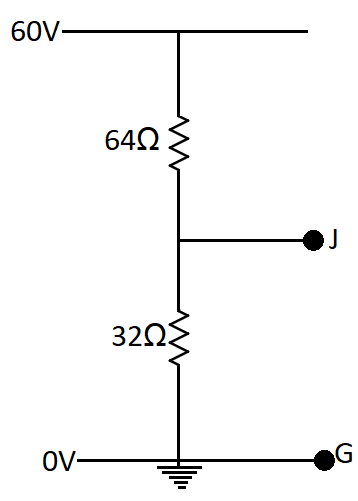
Find the potential of J with respect to G.
(A) $ 40V $
(B) $ 60V $
(C) $ 20V $
(D) $ 30V $
Answer
 Verified
594k+ views
Hint
We need to first find the current that is flowing through this circuit. Then we can use the value of the current to find the potential drop occurring across the resistor $ 64\Omega $ . So then subtracting this value from the high we get the potential at J. Then to find the potential at J with respect to G we need to subtract the potential at G from J.
Formula Used: In this solution we will be using the following formula,
$ V = IR $
where $ V $ is the potential, $ I $ is the current and $ R $ is the resistance across the circuit.
Complete step by step answer
To solve this problem, we first need to calculate the current that is flowing in the circuit from the point A to the ground as in the figure,
To find the current in the circuit, we need to find the equivalent resistance in the circuit. We can see from the diagram that the resistance $ 64\Omega $ and $ 32\Omega $ are in series. So their equivalent will be the sum of these resistances. Hence, $ R = \left( {64 + 32} \right)\Omega $ .
This will be equal to,
$ R = 96\Omega $
So from Ohm’s law, the current will be given by the formula,
$ V = IR $
Substituting $ V = 60V $ and $ R = 96\Omega $ we get,
$ 60 = I \times 96 $
So we get the current as,
$ I = \dfrac{{60}}{{96}}A $
Hence we get,
$ I = 0.625A $
Now the potential at the point J will be the potential at the point A minus the potential drop across the $ 64\Omega $ resistance.
Hence the potential at J is given by,
$ {V_J} = {V_A} - \left( {64 \times I} \right) $
So substituting we get,
$ {V_J} = 60 - \left( {64 \times 0.625} \right) $
So calculating the value we get the potential at the point J as,
$ {V_J} = 20V $
Now the potential at the point J with respect to the point G will be given by the potential at point J minus the potential at the point G. The potential at the point G is 0. So we have,
$ {V_{JG}} = {V_J} - {V_G} $
Substituting the values we get,
$ {V_{JG}} = 20 - 0 $
Hence the potential at the point J with respect to the point G is,
$ {V_{JG}} = 20V $
So the correct answer is option C.
Note
We solved this problem based on the Ohm’s law. The Ohm’s law states that the current through a conductor between two points is directly proportional to the voltage across the two points. On removing the proportionality, we get the constant which is termed as the resistance.
We need to first find the current that is flowing through this circuit. Then we can use the value of the current to find the potential drop occurring across the resistor $ 64\Omega $ . So then subtracting this value from the high we get the potential at J. Then to find the potential at J with respect to G we need to subtract the potential at G from J.
Formula Used: In this solution we will be using the following formula,
$ V = IR $
where $ V $ is the potential, $ I $ is the current and $ R $ is the resistance across the circuit.
Complete step by step answer
To solve this problem, we first need to calculate the current that is flowing in the circuit from the point A to the ground as in the figure,
To find the current in the circuit, we need to find the equivalent resistance in the circuit. We can see from the diagram that the resistance $ 64\Omega $ and $ 32\Omega $ are in series. So their equivalent will be the sum of these resistances. Hence, $ R = \left( {64 + 32} \right)\Omega $ .
This will be equal to,
$ R = 96\Omega $
So from Ohm’s law, the current will be given by the formula,
$ V = IR $
Substituting $ V = 60V $ and $ R = 96\Omega $ we get,
$ 60 = I \times 96 $
So we get the current as,
$ I = \dfrac{{60}}{{96}}A $
Hence we get,
$ I = 0.625A $
Now the potential at the point J will be the potential at the point A minus the potential drop across the $ 64\Omega $ resistance.
Hence the potential at J is given by,
$ {V_J} = {V_A} - \left( {64 \times I} \right) $
So substituting we get,
$ {V_J} = 60 - \left( {64 \times 0.625} \right) $
So calculating the value we get the potential at the point J as,
$ {V_J} = 20V $
Now the potential at the point J with respect to the point G will be given by the potential at point J minus the potential at the point G. The potential at the point G is 0. So we have,
$ {V_{JG}} = {V_J} - {V_G} $
Substituting the values we get,
$ {V_{JG}} = 20 - 0 $
Hence the potential at the point J with respect to the point G is,
$ {V_{JG}} = 20V $
So the correct answer is option C.
Note
We solved this problem based on the Ohm’s law. The Ohm’s law states that the current through a conductor between two points is directly proportional to the voltage across the two points. On removing the proportionality, we get the constant which is termed as the resistance.
Recently Updated Pages
Master Class 12 Business Studies: Engaging Questions & Answers for Success

Master Class 12 Biology: Engaging Questions & Answers for Success
Master Class 12 Chemistry: Engaging Questions & Answers for Success
Class 12 Question and Answer - Your Ultimate Solutions Guide
Master Class 11 Social Science: Engaging Questions & Answers for Success
Master Class 11 English: Engaging Questions & Answers for Success
Trending doubts
Which is more stable and why class 12 chemistry CBSE
Which are the Top 10 Largest Countries of the World?
Draw a labelled sketch of the human eye class 12 physics CBSE
Differentiate between homogeneous and heterogeneous class 12 chemistry CBSE
What are the major means of transport Explain each class 12 social science CBSE
Sulphuric acid is known as the king of acids State class 12 chemistry CBSE