




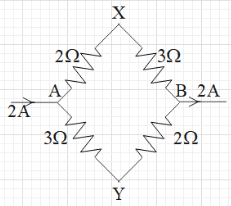
Find the potential difference between X and Y in volts is :-
A. 1
B. -1
C. 2
D. -2
Answer
 Verified
576.6k+ views
Hint: Find the effective resistance of the upper and lower combination of the resistance by using the formula for the effective resistance of two resistances in series connection. Then use Ohm’s law to find the potential difference between X and Y.
Formula used:
$V=iR$
where $V$ is the potential difference across the resistance and $i$ is the current in the resistance $R$.
Complete step by step answer:
Let us calculate the effective resistance of the circuit.When two resistances ${{R}_{1}}$ and ${{R}_{2}}$ are connected in series, the effective resistance of the two is equal to ${{R}_{eff}}={{R}_{1}}+{{R}_{2}}$.
We can see that the two resistances $2\Omega $ and $3\Omega $, meeting at point X, are in series connected. Therefore, the effective resistance of the two is equal to,
${{R}_{eff,1}}=2+3=5\Omega $
Similarly, the effective resistance of the other pair of $2\Omega $ and $3\Omega$ resistances is equal to ${{R}_{eff,2}}=2+3=5\Omega $.
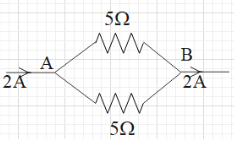
The two $5\Omega $ resistances are between the same potential differences (say V).
From Ohm’s law, we know that $V=iR$, where V is the potential difference across the resistance and i is the current in the resistance R.
Since the potential differences and the resistances are the same, the current in both resistance will be the same.
And by junction law at point Y, we get that $2=i+i$.
$\Rightarrow i=1A$.
Now, the potential difference between A and X is equal to ${{V}_{X}}-{{V}_{A}}=(1)(2)=2V$ …. (i).
The potential difference between A and Y is equal to ${{V}_{A}}-{{V}_{Y}}=(1)(3)=3V$….. (ii).
Subtract (ii) by (i).
$\Rightarrow {{V}_{A}}-{{V}_{Y}}-\left( {{V}_{A}}-{{V}_{X}} \right)=3-2$
$\therefore {{V}_{X}}-{{V}_{Y}}=1\,V$
Hence, the correct option is A.
Note:When two resistances are connected parallel to each other, the reciprocal of the effective resistance of the two is equal to the sum of the reciprocal of the individual resistances i.e. $\dfrac{1}{{{R}_{eff}}}=\dfrac{1}{{{R}_{1}}}+\dfrac{1}{{{R}_{2}}}$.The major difference between series and the parallel circuit is the amount of current that flows through each of the components in the circuit. In a series circuit, the same amount of current flows through all the components placed in it. On the other hand, in parallel circuits, the components are placed in parallel with each other due to this the circuit splits the current flow.
Formula used:
$V=iR$
where $V$ is the potential difference across the resistance and $i$ is the current in the resistance $R$.
Complete step by step answer:
Let us calculate the effective resistance of the circuit.When two resistances ${{R}_{1}}$ and ${{R}_{2}}$ are connected in series, the effective resistance of the two is equal to ${{R}_{eff}}={{R}_{1}}+{{R}_{2}}$.
We can see that the two resistances $2\Omega $ and $3\Omega $, meeting at point X, are in series connected. Therefore, the effective resistance of the two is equal to,
${{R}_{eff,1}}=2+3=5\Omega $
Similarly, the effective resistance of the other pair of $2\Omega $ and $3\Omega$ resistances is equal to ${{R}_{eff,2}}=2+3=5\Omega $.
The two $5\Omega $ resistances are between the same potential differences (say V).
From Ohm’s law, we know that $V=iR$, where V is the potential difference across the resistance and i is the current in the resistance R.
Since the potential differences and the resistances are the same, the current in both resistance will be the same.
And by junction law at point Y, we get that $2=i+i$.
$\Rightarrow i=1A$.
Now, the potential difference between A and X is equal to ${{V}_{X}}-{{V}_{A}}=(1)(2)=2V$ …. (i).
The potential difference between A and Y is equal to ${{V}_{A}}-{{V}_{Y}}=(1)(3)=3V$….. (ii).
Subtract (ii) by (i).
$\Rightarrow {{V}_{A}}-{{V}_{Y}}-\left( {{V}_{A}}-{{V}_{X}} \right)=3-2$
$\therefore {{V}_{X}}-{{V}_{Y}}=1\,V$
Hence, the correct option is A.
Note:When two resistances are connected parallel to each other, the reciprocal of the effective resistance of the two is equal to the sum of the reciprocal of the individual resistances i.e. $\dfrac{1}{{{R}_{eff}}}=\dfrac{1}{{{R}_{1}}}+\dfrac{1}{{{R}_{2}}}$.The major difference between series and the parallel circuit is the amount of current that flows through each of the components in the circuit. In a series circuit, the same amount of current flows through all the components placed in it. On the other hand, in parallel circuits, the components are placed in parallel with each other due to this the circuit splits the current flow.
Recently Updated Pages
Master Class 12 Social Science: Engaging Questions & Answers for Success

Master Class 12 Physics: Engaging Questions & Answers for Success
Master Class 12 Maths: Engaging Questions & Answers for Success
Master Class 12 Economics: Engaging Questions & Answers for Success
Master Class 12 Chemistry: Engaging Questions & Answers for Success
Master Class 12 Business Studies: Engaging Questions & Answers for Success
Trending doubts
Which are the Top 10 Largest Countries of the World?
Draw a labelled sketch of the human eye class 12 physics CBSE
Explain the structure of megasporangium class 12 biology CBSE
What are the major means of transport Explain each class 12 social science CBSE
How many chromosomes are found in human ovum a 46 b class 12 biology CBSE
The diagram of the section of a maize grain is given class 12 biology CBSE