




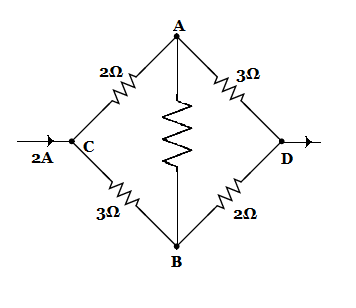
Find the potential difference between points $A$ and $B$ i.e. (${V_A} - {V_B}$) in the network shown in figure.
Answer
 Verified
588.6k+ views
Hint: We shall assume the resistance of the middle resistance as $R$ and the current flowing through it as $I$. We will also need to assume another current which has been assumed as ${I_1}$ flowing in the branch $C\;A$. The new diagram is as shown below with the currents shown as applicable. Next, we shall apply KVL in the loops $AC\;BA$ and $AD\;BA$ to get two equations from which we calculate $I$.
Complete step by step solution:
The diagram has been redrawn with the currents assumed in the respective branches. All the assumed currents and resistance have been shown in red.
We have assumed the value of the resistance in the branch $A\;B$ as $R$. The voltage between the points $A$ and $B$ i.e. (${V_A} - {V_B}$) in the network shown will be dependent on the value of the resistance $R$.
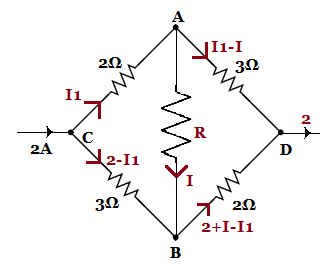
The values of the currents in each branch have been shown. We will apply Kirchhoff's Voltage Law in the loop $AC\;BA$ and $AD\;BA$ respectively to get the required values of ${I_1}$ and $I$.
After applying Kirchhoff's Voltage Law in the loop $AD\;BA$, we will get
$IR + 2(2 + I - {I_1}) = 3({I_1} - I)$
$ \Rightarrow IR + 4 + 2I - 2{I_1} = 3{I_1} - 3I$
Now on rearranging the terms, we get
$ \Rightarrow IR + 5I = 5{I_1} - 4$
$ \Rightarrow I = \dfrac{{5{I_1} - 4}}{{R + 5}}$
Again applying Kirchhoff's Voltage Law in the loop $AB\;CA$, we get
$2{I_1} + IR = (2 - {I_1})3$
Now substituting the value of $I$ in the above equation, we get
$2{I_1} + (\dfrac{{5{I_1} - 4}}{{R + 5}})R = (2 - {I_1})3$
$ \Rightarrow (R + 5)2{I_1} + R(5{I_1} - 4) = (2 - {I_1})3(R + 5)$
$ \Rightarrow 2R{I_1} + 10{I_1} + 5R{I_1} - 4R = 6R + 30 - 3{I_1}R - 15{I_1}$
On rearranging the terms, we get
$ \Rightarrow 10R{I_1} + 25{I_1} = 10R + 30$
$ \Rightarrow {I_1} = \dfrac{{2R + 6}}{{2R + 5}}$
Now, substituting this value of ${I_1}$ in $I$, we get
$I = \dfrac{1}{{R + 5}}(\dfrac{{10R + 30}}{{2R + 5}} - 4)$
$ \Rightarrow I = \dfrac{1}{{R + 5}}(\dfrac{{10R + 30 - 8R - 20}}{{2R + 5}})$
$ \Rightarrow I = \dfrac{1}{{R + 5}}(\dfrac{{2R + 10}}{{2R + 5}})$
Upon solving further we get
$I = \dfrac{2}{{2R + 5}}$.
Now the voltage drop between the points $A$ and $B$ i.e. (${V_A} - {V_B}$) is given by
${V_A} - {V_B} = IR$
$ \Rightarrow {V_A} - {V_B} = \dfrac{{2R}}{{2R + 5}}$
This is the required potential difference between the two given points.
Thus the required answer is $\dfrac{{2R}}{{2R + 5}}{\mkern 1mu} V$.
Note:
We have assumed the resistance of the middle resistor, as the voltage drop will be dependent on the resistance of the resistor. This is already shown by the answer found as ${V_A} - {V_B} = \dfrac{{2R}}{{2R + 5}}$ is an equation dependent on the value of the assumed resistance $R$. We can also see that since the product of the diagonal resistances is not equal in the above bridge-circuit, some current will flow, assumed $I$.
Complete step by step solution:
The diagram has been redrawn with the currents assumed in the respective branches. All the assumed currents and resistance have been shown in red.
We have assumed the value of the resistance in the branch $A\;B$ as $R$. The voltage between the points $A$ and $B$ i.e. (${V_A} - {V_B}$) in the network shown will be dependent on the value of the resistance $R$.
The values of the currents in each branch have been shown. We will apply Kirchhoff's Voltage Law in the loop $AC\;BA$ and $AD\;BA$ respectively to get the required values of ${I_1}$ and $I$.
After applying Kirchhoff's Voltage Law in the loop $AD\;BA$, we will get
$IR + 2(2 + I - {I_1}) = 3({I_1} - I)$
$ \Rightarrow IR + 4 + 2I - 2{I_1} = 3{I_1} - 3I$
Now on rearranging the terms, we get
$ \Rightarrow IR + 5I = 5{I_1} - 4$
$ \Rightarrow I = \dfrac{{5{I_1} - 4}}{{R + 5}}$
Again applying Kirchhoff's Voltage Law in the loop $AB\;CA$, we get
$2{I_1} + IR = (2 - {I_1})3$
Now substituting the value of $I$ in the above equation, we get
$2{I_1} + (\dfrac{{5{I_1} - 4}}{{R + 5}})R = (2 - {I_1})3$
$ \Rightarrow (R + 5)2{I_1} + R(5{I_1} - 4) = (2 - {I_1})3(R + 5)$
$ \Rightarrow 2R{I_1} + 10{I_1} + 5R{I_1} - 4R = 6R + 30 - 3{I_1}R - 15{I_1}$
On rearranging the terms, we get
$ \Rightarrow 10R{I_1} + 25{I_1} = 10R + 30$
$ \Rightarrow {I_1} = \dfrac{{2R + 6}}{{2R + 5}}$
Now, substituting this value of ${I_1}$ in $I$, we get
$I = \dfrac{1}{{R + 5}}(\dfrac{{10R + 30}}{{2R + 5}} - 4)$
$ \Rightarrow I = \dfrac{1}{{R + 5}}(\dfrac{{10R + 30 - 8R - 20}}{{2R + 5}})$
$ \Rightarrow I = \dfrac{1}{{R + 5}}(\dfrac{{2R + 10}}{{2R + 5}})$
Upon solving further we get
$I = \dfrac{2}{{2R + 5}}$.
Now the voltage drop between the points $A$ and $B$ i.e. (${V_A} - {V_B}$) is given by
${V_A} - {V_B} = IR$
$ \Rightarrow {V_A} - {V_B} = \dfrac{{2R}}{{2R + 5}}$
This is the required potential difference between the two given points.
Thus the required answer is $\dfrac{{2R}}{{2R + 5}}{\mkern 1mu} V$.
Note:
We have assumed the resistance of the middle resistor, as the voltage drop will be dependent on the resistance of the resistor. This is already shown by the answer found as ${V_A} - {V_B} = \dfrac{{2R}}{{2R + 5}}$ is an equation dependent on the value of the assumed resistance $R$. We can also see that since the product of the diagonal resistances is not equal in the above bridge-circuit, some current will flow, assumed $I$.
Recently Updated Pages
Master Class 12 Business Studies: Engaging Questions & Answers for Success

Master Class 12 Biology: Engaging Questions & Answers for Success
Master Class 12 Chemistry: Engaging Questions & Answers for Success
Class 12 Question and Answer - Your Ultimate Solutions Guide
Master Class 11 Social Science: Engaging Questions & Answers for Success
Master Class 11 English: Engaging Questions & Answers for Success
Trending doubts
Which are the Top 10 Largest Countries of the World?
Draw a labelled sketch of the human eye class 12 physics CBSE
Differentiate between homogeneous and heterogeneous class 12 chemistry CBSE
Sulphuric acid is known as the king of acids State class 12 chemistry CBSE
Why is the cell called the structural and functional class 12 biology CBSE
Which is the correct genotypic ratio of mendel dihybrid class 12 biology CBSE