




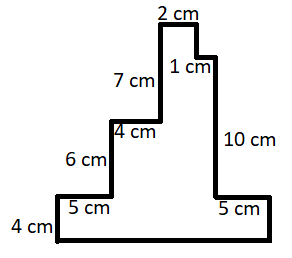
Find the perimeter of the given figure (not drawn to scale).
$\left( a \right)$ 42 cm
$\left( b \right)$ 74 cm
$\left( c \right)$ 68 cm
$\left( d \right)$ 65 cm
Answer
 Verified
626.7k+ views
Hint: In this particular question use the concept that the perimeter of any shape is the sum of all the sides so first calculate the length of all the sides then simply add them so use these concepts to reach the solution of the question.
Complete step by step answer:
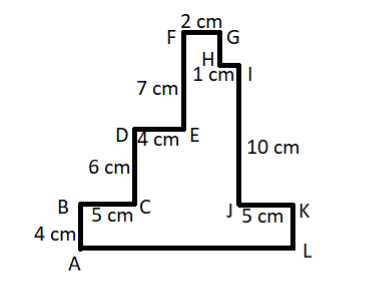
Now first mark all the corners of the given figure as shown in the above figure.
So from this figure we can say that,
AB = 4 cm, BC = 5 cm, CD = 6 cm, DE = 4 cm, EF = 7 cm, FG = 2 cm, HI = 1 cm, IJ = 10 cm and JK = 5 cm.
Now first find out the lengths of the sides GH, KL and LA.
So from the above figure we can say that, AB = KL = 4 cm.
And AL = BC + DE + FG + HI + JK
So substitute the values we have,
Therefore, AL = 5 + 4 + 2 + 1 + 5 = 17 cm.
Now the height of the given figure is,
Height = AB + CD + EF = 4 + 6 + 7 = 17 cm.
Now, GH = height of the given figure – IJ – KL = 17 – 10 – 4 = 3 cm.
Now as we know that the perimeter of any shape is the sum of all the sides so we have,
Perimeter of given figure = AB + BC + CD + DE + EF + FG + GH + HI + IJ + JK + KL + LA.
Now substitute all the values we have,
Perimeter of given figure = 4 + 5 + 6 + 4 + 7 + 2 + 3 + 1 + 10 + 5 + 4 + 17 = 68 cm.
So this is the required answer.
So, the correct answer is “Option C”.
Note: Whenever we face such types of questions the key concept involved in this is the basic idea of length and height, so first find out the length of the missing sides as above we calculated then add all the lengths of these sides as above to get the required perimeter of the given figure.
Complete step by step answer:
Now first mark all the corners of the given figure as shown in the above figure.
So from this figure we can say that,
AB = 4 cm, BC = 5 cm, CD = 6 cm, DE = 4 cm, EF = 7 cm, FG = 2 cm, HI = 1 cm, IJ = 10 cm and JK = 5 cm.
Now first find out the lengths of the sides GH, KL and LA.
So from the above figure we can say that, AB = KL = 4 cm.
And AL = BC + DE + FG + HI + JK
So substitute the values we have,
Therefore, AL = 5 + 4 + 2 + 1 + 5 = 17 cm.
Now the height of the given figure is,
Height = AB + CD + EF = 4 + 6 + 7 = 17 cm.
Now, GH = height of the given figure – IJ – KL = 17 – 10 – 4 = 3 cm.
Now as we know that the perimeter of any shape is the sum of all the sides so we have,
Perimeter of given figure = AB + BC + CD + DE + EF + FG + GH + HI + IJ + JK + KL + LA.
Now substitute all the values we have,
Perimeter of given figure = 4 + 5 + 6 + 4 + 7 + 2 + 3 + 1 + 10 + 5 + 4 + 17 = 68 cm.
So this is the required answer.
So, the correct answer is “Option C”.
Note: Whenever we face such types of questions the key concept involved in this is the basic idea of length and height, so first find out the length of the missing sides as above we calculated then add all the lengths of these sides as above to get the required perimeter of the given figure.
Recently Updated Pages
Master Class 9 General Knowledge: Engaging Questions & Answers for Success

Master Class 9 Maths: Engaging Questions & Answers for Success
Master Class 9 Science: Engaging Questions & Answers for Success
Master Class 9 English: Engaging Questions & Answers for Success
Master Class 9 Social Science: Engaging Questions & Answers for Success
Class 9 Question and Answer - Your Ultimate Solutions Guide
Trending doubts
Find the sum of series 1 + 2 + 3 + 4 + 5 + + 100 class 9 maths CBSE
Difference Between Plant Cell and Animal Cell
Fill the blanks with the suitable prepositions 1 The class 9 english CBSE
What is pollution? How many types of pollution? Define it
What is the Full Form of ICSE / ISC ?
Name 10 Living and Non living things class 9 biology CBSE