




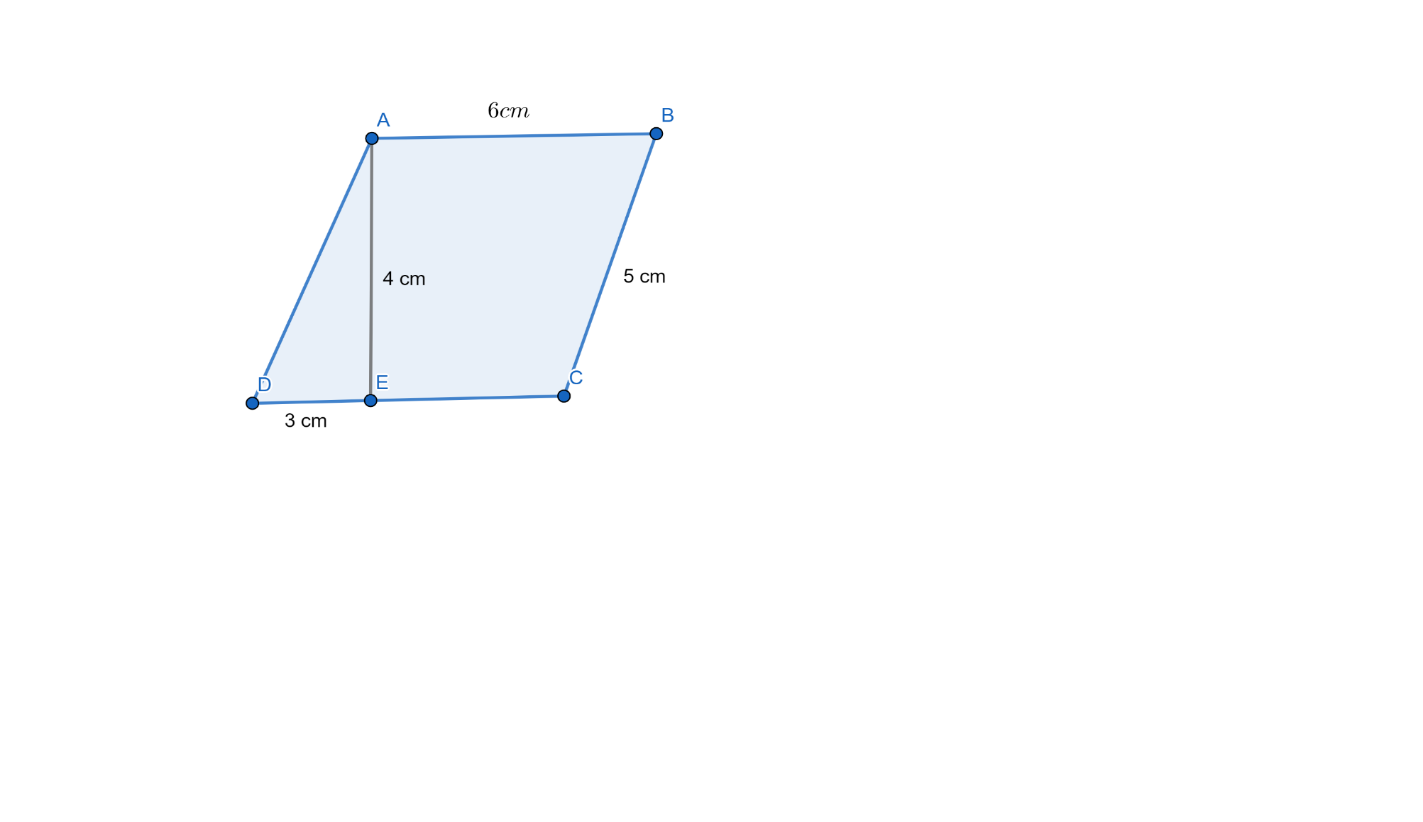
Find the perimeter of the given figure:
Answer
 Verified
653.4k+ views
Hint: We will first prove that the opposite sides are parallel and of equal length and after that we have to find the perimeter of this given figure just by adding all the four sides of this quadrilateral.
Complete step-by-step answer:
First we will state the definition of perimeter.
Perimeter: The sum of all the sides of a polygon.
Let’s name the quadrilateral ABCD in clock wise direction from the top left point.
So,
AB = 6 cm (upper line)
BC = 5 cm
CD = ?
DA = ?
Let’s find CD and DA,
From the given figure we can see that AB and CD are parallel.
And we have drawn a perpendicular line from A on the line CD which is of length 4 cm ( let that point be E)
AED is a right angle triangle given AE = 4 cm and DE = 3 cm.
So, applying Pythagoras theorem which is $hypotenuse=\sqrt{bas{{e}^{2}}+heigh{{t}^{2}}}$ .
So, AD = $\sqrt{D{{E}^{2}}+A{{E}^{2}}}=\sqrt{{{3}^{2}}+{{4}^{2}}}=5$ cm.
Hence, AD = BC and AB and CD are parallel so the given figure is parallelogram having length of opposite side same.
So, CD = 6 cm and DA = 5 cm.
Now we have everything that we need to calculate perimeter.
Therefore, perimeter = 6+5+6+5 = 22 cm.
Note: The most important part in this question is how to prove that the given figure is parallelogram, one can make mistakes in this part if he doesn't know the properties of parallelogram and then he or she will face difficulty in proving this statement.
Complete step-by-step answer:
First we will state the definition of perimeter.
Perimeter: The sum of all the sides of a polygon.
Let’s name the quadrilateral ABCD in clock wise direction from the top left point.
So,
AB = 6 cm (upper line)
BC = 5 cm
CD = ?
DA = ?
Let’s find CD and DA,
From the given figure we can see that AB and CD are parallel.
And we have drawn a perpendicular line from A on the line CD which is of length 4 cm ( let that point be E)
AED is a right angle triangle given AE = 4 cm and DE = 3 cm.
So, applying Pythagoras theorem which is $hypotenuse=\sqrt{bas{{e}^{2}}+heigh{{t}^{2}}}$ .
So, AD = $\sqrt{D{{E}^{2}}+A{{E}^{2}}}=\sqrt{{{3}^{2}}+{{4}^{2}}}=5$ cm.
Hence, AD = BC and AB and CD are parallel so the given figure is parallelogram having length of opposite side same.
So, CD = 6 cm and DA = 5 cm.
Now we have everything that we need to calculate perimeter.
Therefore, perimeter = 6+5+6+5 = 22 cm.
Note: The most important part in this question is how to prove that the given figure is parallelogram, one can make mistakes in this part if he doesn't know the properties of parallelogram and then he or she will face difficulty in proving this statement.

Recently Updated Pages
Master Class 11 English: Engaging Questions & Answers for Success

Master Class 11 Social Science: Engaging Questions & Answers for Success
Master Class 11 Maths: Engaging Questions & Answers for Success
Master Class 11 Biology: Engaging Questions & Answers for Success
Master Class 11 Physics: Engaging Questions & Answers for Success
Master Class 11 Chemistry: Engaging Questions & Answers for Success
Trending doubts
In Indian rupees 1 trillion is equal to how many c class 8 maths CBSE
What is BLO What is the full form of BLO class 8 social science CBSE
What are the 12 elements of nature class 8 chemistry CBSE
Citizens of India can vote at the age of A 18 years class 8 social science CBSE
Which of the following leader has given the term insensate class 8 social science CBSE
Name the states through which the Tropic of Cancer class 8 social science CBSE