




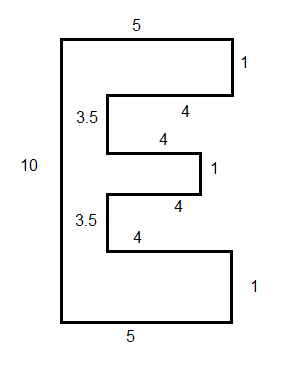
Find the perimeter of the following image ‘E’.
Answer
 Verified
613.5k+ views
Hint: We find the perimeter of these type of figures by adding the individual lengths of all the sides. So, we analyse the data to find individual lengths and then use addition to find the solution of the problem.
Complete step-by-step answer:
Here the image has a shape of English letter ‘E’. the length of the of the individual sides are given there. Now, we name the sides and find out their lengths.
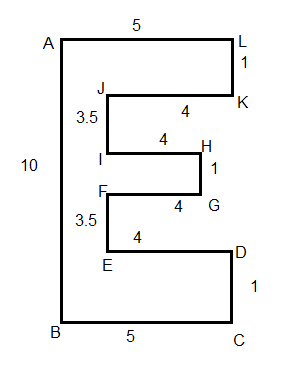
So, the sides are AB, BC, CD, DE, EF, FG, GH, HI, IJ, JK, KL, LA. In total there are 12 sides. Now, we find lengths of the sides and put the values.
So, AB = 10, BC = 5, CD = 1, DE = 4, EF = 3.5, FG = 4, GH = 1, HI = 4, IJ = 3.5, JK = 4, KL = 1, LA = 5.
Now we find the perimeter of the figure. Let’s the perimeter be P.
So, $P=AB+BC+CD+DE+EF+FG+GH+HI+IJ+JK+KL+LA$.
The addition of all the side lengths is the perimeter.
Now, we put the values of the sides in the equation
\[\begin{align}
& P=AB+BC+CD+DE+EF+FG+GH+HI+IJ+JK+KL+LA \\
& \Rightarrow P=10+5+1+4+3.5+4+1+4+3.5+4+1+5=46 \\
\end{align}\]
So, the perimeter of the figure is 46 units.
Note: We can also take the similar sides and sort them out to add multiplicity to that side to ease the problem. Like in this case $CD=GH=KL=1$, $DE=FG=HI=JK=4$, $EF=IJ=3.5$ and $AL=BC=5$. So, the multipliers are 3, 4, 2, 2 respectively according to the number of similar sides.
Complete step-by-step answer:
Here the image has a shape of English letter ‘E’. the length of the of the individual sides are given there. Now, we name the sides and find out their lengths.
So, the sides are AB, BC, CD, DE, EF, FG, GH, HI, IJ, JK, KL, LA. In total there are 12 sides. Now, we find lengths of the sides and put the values.
So, AB = 10, BC = 5, CD = 1, DE = 4, EF = 3.5, FG = 4, GH = 1, HI = 4, IJ = 3.5, JK = 4, KL = 1, LA = 5.
Now we find the perimeter of the figure. Let’s the perimeter be P.
So, $P=AB+BC+CD+DE+EF+FG+GH+HI+IJ+JK+KL+LA$.
The addition of all the side lengths is the perimeter.
Now, we put the values of the sides in the equation
\[\begin{align}
& P=AB+BC+CD+DE+EF+FG+GH+HI+IJ+JK+KL+LA \\
& \Rightarrow P=10+5+1+4+3.5+4+1+4+3.5+4+1+5=46 \\
\end{align}\]
So, the perimeter of the figure is 46 units.
Note: We can also take the similar sides and sort them out to add multiplicity to that side to ease the problem. Like in this case $CD=GH=KL=1$, $DE=FG=HI=JK=4$, $EF=IJ=3.5$ and $AL=BC=5$. So, the multipliers are 3, 4, 2, 2 respectively according to the number of similar sides.
Recently Updated Pages
Master Class 9 General Knowledge: Engaging Questions & Answers for Success

Master Class 9 Maths: Engaging Questions & Answers for Success
Master Class 9 Science: Engaging Questions & Answers for Success
Master Class 9 English: Engaging Questions & Answers for Success
Master Class 9 Social Science: Engaging Questions & Answers for Success
Class 9 Question and Answer - Your Ultimate Solutions Guide
Trending doubts
Find the sum of series 1 + 2 + 3 + 4 + 5 + + 100 class 9 maths CBSE
Difference Between Plant Cell and Animal Cell
Fill the blanks with the suitable prepositions 1 The class 9 english CBSE
What is pollution? How many types of pollution? Define it
What is the Full Form of ICSE / ISC ?
Name 10 Living and Non living things class 9 biology CBSE