




Find the number of right angles turned through by the hour hand of a clock when its goes from;
$\left( 1 \right)3$ to $6$
$\left( 2 \right)2$ to $8$
$\left( 3 \right)5$ to $11$
$\left( 4 \right)10$ to $1$
$\left( 5 \right)12$ to $9$
$\left( 6 \right)12$ to $6$
Answer
 Verified
509.1k+ views
Hint:To solve this question, we must be familiar with some basic concepts of clocks. The hour hand of a properly functioning clock revolves ${360^0}$ in one complete revolution. In other words, we can say that the hour hand forms $4$ right angle triangles in one revolution of a clock. Here, one revolution means a complete $12$ hour period.
Complete step by step answer:
Presented below is the basic representation of a clock;
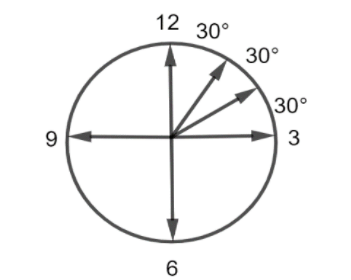
$ \Rightarrow {\text{One revolution = 12 hours = }}{360^0}$
Therefore, ${\text{one hour = }}\dfrac{{{{360}^0}}}{{12}} = {\text{3}}{{\text{0}}^0}$
$\left( 1 \right)3{\text{ to 6}}$:
From $3{\text{ to 6}}$, the time difference is $6 - 3{\text{ = 3 hours}}$. By interpretation, we can say that the hour hand revolves by ${90^0}$ or $1$ right angled triangle.
Or by the formula, we can solve easily;
$ \Rightarrow 3 \times \dfrac{{{{360}^0}}}{{12}} = {90^0}$
Therefore, the correct answer for this question is ${90^o}$ i.e. one right angle triangle.
$\left( 2 \right){\text{2 to 8}}$:
From ${\text{2 to 8}}$, the time difference is $8 - 2{\text{ = 6 hours}}$. By interpretation, we can say that the hour hand revolves by ${180^0}$ or $2$ right angled triangles.
Or by the formula, we can solve easily;
$ \Rightarrow 6 \times \dfrac{{{{360}^0}}}{{12}} = {180^0}{\text{ or 9}}{{\text{0}}^0} + {90^0}$
Therefore, the correct answer for this question is ${180^0}$ i.e. two right angle triangles.
$\left( 3 \right){\text{5 to 11}}$:
From ${\text{5 to 11}}$, the time difference is ${\text{11 - 5 = 6 hours}}$. By interpretation, we can say that the hour hand revolves by ${180^0}$ or $2$ right angled triangles.
Or by the formula, we can solve easily;
$ \Rightarrow 6 \times \dfrac{{{{360}^0}}}{{12}} = {180^0}{\text{ or 9}}{{\text{0}}^0} + {90^0}$
Therefore, the correct answer for this question is ${180^0}$ i.e. two right angle triangles.
$\left( 4 \right){\text{10 to 1}}$:
From ${\text{10 to 1}}$, the time difference is ${\text{10 - 1 = 3 hours}}$. By interpretation, we can say that the hour hand revolves by ${90^0}$ or 1 right angled triangles.
Or by the formula, we can solve easily;
$ \Rightarrow 3 \times \dfrac{{{{360}^0}}}{{12}} = {90^0}{\text{ }}$
Therefore, the correct answer for this question is ${90^0}$ i.e. one right angle triangle.
$\left( 5 \right){\text{12 to 9}}$:
From ${\text{12 to 9}}$, the time difference is ${\text{12 - 9 = 9 hours}}$. By interpretation, we can say that the hour hand revolves by ${180^0}$ or $2$ right angled triangles.
Or by the formula, we can solve easily;
$ \Rightarrow 9 \times \dfrac{{{{360}^0}}}{{12}} = {270^0}{\text{ }}$or ${90^0} + {90^0} + {90^0}$
Therefore, the correct answer for this question is ${270^0}$ i.e. three right angle triangles.
$\left( 6 \right){\text{12 to 6}}$:
From ${\text{12 to 6}}$, the time difference is ${\text{12 - 6 = 6 hours}}$. By interpretation, we can say that the hour hand revolves by ${180^0}$ or $2$ right angled triangles.
Or by the formula, we can solve easily;
$ \Rightarrow 6 \times \dfrac{{{{360}^0}}}{{12}} = {180^0}{\text{ }}$or ${90^0} + {90^0}$
Therefore, the correct answer for this question is ${180^0}$ i.e. two right angle triangles.
Note:We should be familiar with the basic concepts of clocks in order to solve this question. A clock is a complete circle having ${360^0}$. It can be divided into $12$ equal parts , each part is $\dfrac{{{{360}^0}}}{{12}} = {30^0}$. The hour hand completes ${360^0}$ in 12 hours and ${30^0}$ in $1$ hour . The minute hand completes ${360^0}$ in $60$ minutes and ${6^0}$ in $1$ minute.
Complete step by step answer:
Presented below is the basic representation of a clock;
$ \Rightarrow {\text{One revolution = 12 hours = }}{360^0}$
Therefore, ${\text{one hour = }}\dfrac{{{{360}^0}}}{{12}} = {\text{3}}{{\text{0}}^0}$
$\left( 1 \right)3{\text{ to 6}}$:
From $3{\text{ to 6}}$, the time difference is $6 - 3{\text{ = 3 hours}}$. By interpretation, we can say that the hour hand revolves by ${90^0}$ or $1$ right angled triangle.
Or by the formula, we can solve easily;
$ \Rightarrow 3 \times \dfrac{{{{360}^0}}}{{12}} = {90^0}$
Therefore, the correct answer for this question is ${90^o}$ i.e. one right angle triangle.
$\left( 2 \right){\text{2 to 8}}$:
From ${\text{2 to 8}}$, the time difference is $8 - 2{\text{ = 6 hours}}$. By interpretation, we can say that the hour hand revolves by ${180^0}$ or $2$ right angled triangles.
Or by the formula, we can solve easily;
$ \Rightarrow 6 \times \dfrac{{{{360}^0}}}{{12}} = {180^0}{\text{ or 9}}{{\text{0}}^0} + {90^0}$
Therefore, the correct answer for this question is ${180^0}$ i.e. two right angle triangles.
$\left( 3 \right){\text{5 to 11}}$:
From ${\text{5 to 11}}$, the time difference is ${\text{11 - 5 = 6 hours}}$. By interpretation, we can say that the hour hand revolves by ${180^0}$ or $2$ right angled triangles.
Or by the formula, we can solve easily;
$ \Rightarrow 6 \times \dfrac{{{{360}^0}}}{{12}} = {180^0}{\text{ or 9}}{{\text{0}}^0} + {90^0}$
Therefore, the correct answer for this question is ${180^0}$ i.e. two right angle triangles.
$\left( 4 \right){\text{10 to 1}}$:
From ${\text{10 to 1}}$, the time difference is ${\text{10 - 1 = 3 hours}}$. By interpretation, we can say that the hour hand revolves by ${90^0}$ or 1 right angled triangles.
Or by the formula, we can solve easily;
$ \Rightarrow 3 \times \dfrac{{{{360}^0}}}{{12}} = {90^0}{\text{ }}$
Therefore, the correct answer for this question is ${90^0}$ i.e. one right angle triangle.
$\left( 5 \right){\text{12 to 9}}$:
From ${\text{12 to 9}}$, the time difference is ${\text{12 - 9 = 9 hours}}$. By interpretation, we can say that the hour hand revolves by ${180^0}$ or $2$ right angled triangles.
Or by the formula, we can solve easily;
$ \Rightarrow 9 \times \dfrac{{{{360}^0}}}{{12}} = {270^0}{\text{ }}$or ${90^0} + {90^0} + {90^0}$
Therefore, the correct answer for this question is ${270^0}$ i.e. three right angle triangles.
$\left( 6 \right){\text{12 to 6}}$:
From ${\text{12 to 6}}$, the time difference is ${\text{12 - 6 = 6 hours}}$. By interpretation, we can say that the hour hand revolves by ${180^0}$ or $2$ right angled triangles.
Or by the formula, we can solve easily;
$ \Rightarrow 6 \times \dfrac{{{{360}^0}}}{{12}} = {180^0}{\text{ }}$or ${90^0} + {90^0}$
Therefore, the correct answer for this question is ${180^0}$ i.e. two right angle triangles.
Note:We should be familiar with the basic concepts of clocks in order to solve this question. A clock is a complete circle having ${360^0}$. It can be divided into $12$ equal parts , each part is $\dfrac{{{{360}^0}}}{{12}} = {30^0}$. The hour hand completes ${360^0}$ in 12 hours and ${30^0}$ in $1$ hour . The minute hand completes ${360^0}$ in $60$ minutes and ${6^0}$ in $1$ minute.
Recently Updated Pages
Master Class 12 Economics: Engaging Questions & Answers for Success

Master Class 12 English: Engaging Questions & Answers for Success
Master Class 12 Social Science: Engaging Questions & Answers for Success
Master Class 12 Maths: Engaging Questions & Answers for Success
Master Class 12 Physics: Engaging Questions & Answers for Success
Master Class 9 General Knowledge: Engaging Questions & Answers for Success
Trending doubts
Which are the Top 10 Largest Countries of the World?
Draw a labelled sketch of the human eye class 12 physics CBSE
Differentiate between homogeneous and heterogeneous class 12 chemistry CBSE
Sulphuric acid is known as the king of acids State class 12 chemistry CBSE
Why is the cell called the structural and functional class 12 biology CBSE
Draw ray diagrams each showing i myopic eye and ii class 12 physics CBSE