




How would you find the number of diastereomers?
Answer
 Verified
565.8k+ views
Hint: As we are aware with the diastereomers which are basically those stereoisomers that are non-superimposable as well as are not the mirror images of each other. They also possess the chiral carbons.
Complete step by step answer:
We know that the diastereomers are the chiral carbon containing compounds where chiral carbon is defined as the compound having all the four different groups attached to the central atoms of carbon.
We know that the total number of stereoisomers can be calculated using the formula written as ${2^n}$ where ‘n’ is the number of chiral carbons or centres present in the compound. Diastereomers are the compounds that possess the same molecular formula but are non-superimposable meaning that the molecules can never be placed similarly on top of one another and they are also non-mirror images of each other. We should also consider the Fischer projection of the stereoisomers which shows that the configuration of the compound is opposite at one or more than one chiral centre.
Therefore, we can say that if any given compound possesses a single chiral carbon centre then it will generally form two diastereomers. If the compound contains a total of two asymmetric carbons or chiral carbons then it will form four diastereomers proven by the above given formula.
For example:
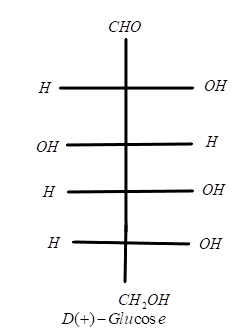
In the case of dextrose (+) glucose, the number of chiral carbons $(n)$ is $4$. Using the above formula, we can find out the number of diastereomers.
${2^4} = 2 \times 2 \times 2 \times 2 = 16$
It means dextrose (+) glucose has 16 diastereomers.
Note: Always remember that the diastereomers are non-superimposable and non-mirror images which is different from enantiomers where enantiomers are those molecules which are actually the mirror images of each other but just like diastereomers, they are also non-superimposable images of each other.
Complete step by step answer:
We know that the diastereomers are the chiral carbon containing compounds where chiral carbon is defined as the compound having all the four different groups attached to the central atoms of carbon.
We know that the total number of stereoisomers can be calculated using the formula written as ${2^n}$ where ‘n’ is the number of chiral carbons or centres present in the compound. Diastereomers are the compounds that possess the same molecular formula but are non-superimposable meaning that the molecules can never be placed similarly on top of one another and they are also non-mirror images of each other. We should also consider the Fischer projection of the stereoisomers which shows that the configuration of the compound is opposite at one or more than one chiral centre.
Therefore, we can say that if any given compound possesses a single chiral carbon centre then it will generally form two diastereomers. If the compound contains a total of two asymmetric carbons or chiral carbons then it will form four diastereomers proven by the above given formula.
For example:
In the case of dextrose (+) glucose, the number of chiral carbons $(n)$ is $4$. Using the above formula, we can find out the number of diastereomers.
${2^4} = 2 \times 2 \times 2 \times 2 = 16$
It means dextrose (+) glucose has 16 diastereomers.
Note: Always remember that the diastereomers are non-superimposable and non-mirror images which is different from enantiomers where enantiomers are those molecules which are actually the mirror images of each other but just like diastereomers, they are also non-superimposable images of each other.
Recently Updated Pages
Master Class 12 Business Studies: Engaging Questions & Answers for Success

Master Class 12 Chemistry: Engaging Questions & Answers for Success
Master Class 12 Biology: Engaging Questions & Answers for Success
Class 12 Question and Answer - Your Ultimate Solutions Guide
Master Class 11 English: Engaging Questions & Answers for Success
Master Class 11 Maths: Engaging Questions & Answers for Success
Trending doubts
Which is more stable and why class 12 chemistry CBSE
Which are the Top 10 Largest Countries of the World?
Draw a labelled sketch of the human eye class 12 physics CBSE
Differentiate between homogeneous and heterogeneous class 12 chemistry CBSE
What are the major means of transport Explain each class 12 social science CBSE
Sulphuric acid is known as the king of acids State class 12 chemistry CBSE