




Find the maximum area of the rectangle, that can be formed with fixed perimeter 20 units.
Answer
 Verified
618.9k+ views
Hint: We have been given the perimeter of the rectangle and we have asked to find the area of the rectangle. First, we need to know the formula of the perimeter of the rectangle which is given by Perimeter = 2(l + b), where (l) is the length of the rectangle and (b) is the breadth of the rectangle. The area of the rectangle is given by the product of any two adjacent sides.
Complete step-by-step answer:
We have given the perimeter of the rectangle.
And we need to find the maximum area of the rectangle.
Let the length of the rectangle be (l).
Let the breadth of the rectangle be (b).
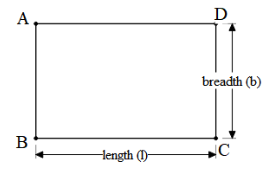
The perimeter of the rectangle is the sum of two sides.
Therefore, $ 2\left( l+b \right)=20 $ .
Simplifying further we get,
$ l+b=\dfrac{20}{2}=10...........(i) $
Writing the equation in terms of length (l) we get,
$ b=\left( 10-l \right).........(ii) $
Area of the rectangle is given by the product of any two adjacent sides of the rectangle.
Let the area of the rectangle be (A).
Therefore, $ A=l.b............(iii) $
Substituting the equation (ii) in equation (iii), we get,
$ A=\left( 10-b \right).b $
Solving this we get,
$ A=10b-{{b}^{2}}........(iv) $
To find the maxima we need to differentiate the area with respect to the breadth and equate to zero.
$ \dfrac{dA}{db}=0...............(v) $
Therefore, differentiating, we get,
$ \begin{align}
& \dfrac{d}{db}\left( 10b-{{b}^{2}} \right)=0 \\
& \Rightarrow 10-2b=0 \\
\end{align} $
Solving for b we get,
$ \begin{align}
& 10=2b \\
& \Rightarrow b=5 \\
\end{align} $
Substituting the value of b = 5 in equation (i), we get,
$ \begin{align}
& l+5=10 \\
& l=5 \\
\end{align} $
Therefore, the dimensions of the rectangle are l = 5 units and b = 5 units
Substituting the values in equation (iii), we get,
$ A=5\times 5=25 $
Therefore, the maximum area of the rectangle is 25 square units.
Note: We can also solve his problem with another approach. We can write the equation in terms of breadth and differentiate the equation of area with respect to length. The answer would not have changed, as the information remains intact in the equation. Also, we can see that we get the maximum area when both sides are equal. This converts the rectangle to a square.
Complete step-by-step answer:
We have given the perimeter of the rectangle.
And we need to find the maximum area of the rectangle.
Let the length of the rectangle be (l).
Let the breadth of the rectangle be (b).
The perimeter of the rectangle is the sum of two sides.
Therefore, $ 2\left( l+b \right)=20 $ .
Simplifying further we get,
$ l+b=\dfrac{20}{2}=10...........(i) $
Writing the equation in terms of length (l) we get,
$ b=\left( 10-l \right).........(ii) $
Area of the rectangle is given by the product of any two adjacent sides of the rectangle.
Let the area of the rectangle be (A).
Therefore, $ A=l.b............(iii) $
Substituting the equation (ii) in equation (iii), we get,
$ A=\left( 10-b \right).b $
Solving this we get,
$ A=10b-{{b}^{2}}........(iv) $
To find the maxima we need to differentiate the area with respect to the breadth and equate to zero.
$ \dfrac{dA}{db}=0...............(v) $
Therefore, differentiating, we get,
$ \begin{align}
& \dfrac{d}{db}\left( 10b-{{b}^{2}} \right)=0 \\
& \Rightarrow 10-2b=0 \\
\end{align} $
Solving for b we get,
$ \begin{align}
& 10=2b \\
& \Rightarrow b=5 \\
\end{align} $
Substituting the value of b = 5 in equation (i), we get,
$ \begin{align}
& l+5=10 \\
& l=5 \\
\end{align} $
Therefore, the dimensions of the rectangle are l = 5 units and b = 5 units
Substituting the values in equation (iii), we get,
$ A=5\times 5=25 $
Therefore, the maximum area of the rectangle is 25 square units.
Note: We can also solve his problem with another approach. We can write the equation in terms of breadth and differentiate the equation of area with respect to length. The answer would not have changed, as the information remains intact in the equation. Also, we can see that we get the maximum area when both sides are equal. This converts the rectangle to a square.
Recently Updated Pages
Master Class 11 English: Engaging Questions & Answers for Success

Master Class 11 Maths: Engaging Questions & Answers for Success
Class 11 Question and Answer - Your Ultimate Solutions Guide
Master Class 11 Biology: Engaging Questions & Answers for Success
Master Class 11 Physics: Engaging Questions & Answers for Success
Master Class 11 Accountancy: Engaging Questions & Answers for Success
Trending doubts
What is BLO What is the full form of BLO class 8 social science CBSE
What are the 12 elements of nature class 8 chemistry CBSE
Citizens of India can vote at the age of A 18 years class 8 social science CBSE
Name the states through which the Tropic of Cancer class 8 social science CBSE
Right to vote is a AFundamental Right BFundamental class 8 social science CBSE
Advantages and disadvantages of science