




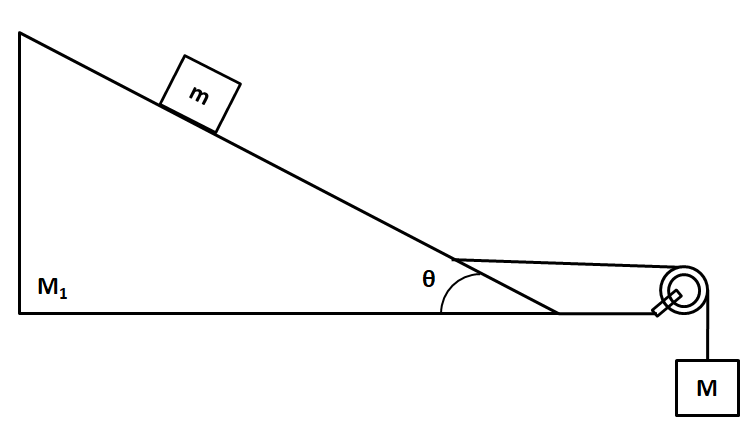
Find the mass $M$ of the hanging block as shown in the figure which will prevent the smaller block from slipping over the triangular block. All the surfaces are frictionless and the strings and the pulleys are light.
(A) $\dfrac{{m + {M_1}}}{{(\sin \theta - 1)}}$
(B) $\dfrac{{m + {M_1}}}{{(\cos \theta - 1)}}$
(C) $\dfrac{{m + {M_1}}}{{(\tan \theta - 1)}}$
(D) $\dfrac{{m + {M_1}}}{{(\cot \theta - 1)}}$
Answer
 Verified
593.4k+ views
Hint
To solve this question, we have to draw the FBD for each of the blocks given in the question. Then, we have to use Newton's second law to obtain the equation of forces on the blocks. Solving those equations will lead us to the final answer.
Complete step by step answer
Let the acceleration of the hanging block of mass $M$ be $a$ downwards. Then, due to constraint motion, the acceleration of the triangular block of mass ${M_1}$ will be $a$ to the right.
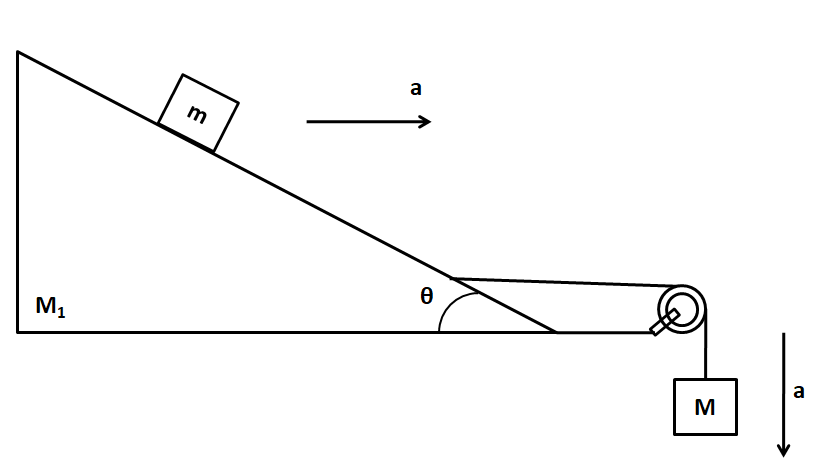
Considering the FBD of the hanging block
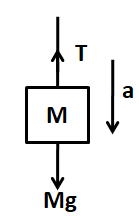
$Mg - T = Ma$ (1)
Now, considering the FBD of the smaller block of mass$M$
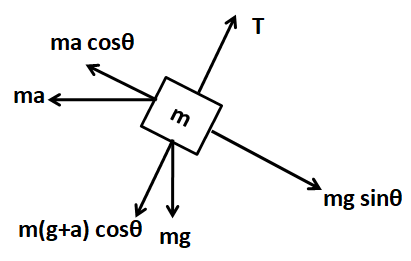
For no slipping, we have
$\Rightarrow ma\cos \theta = mg\sin \theta $
Dividing by $m\cos \theta $ both the sides, we have
$\Rightarrow a = g\tan \theta $ (2)
If the smaller block is not slipping over the triangular block, then the force of tension is pulling both the blocks as a single block of mass $\left( {{M_1} + m} \right)$ with the acceleration $a$.
$\therefore T = \left( {{M_1} + m} \right)a$ (3)
Substituting (3) in (1), we get
$\Rightarrow Mg - \left( {{M_1} + m} \right)a = Ma$
$\Rightarrow Mg - Ma = \left( {{M_1} + m} \right)a$
Taking $M$ common
$\Rightarrow M(g - a) = \left( {{M_1} + m} \right)a$
$\Rightarrow M = \dfrac{{\left( {{M_1} + m} \right)a}}{{(g - a)}}$ (4)
Now substituting (2) in (4)
$\Rightarrow M = \dfrac{{\left( {{M_1} + m} \right)g\tan \theta }}{{(g - g\tan \theta )}}$
Dividing the numerator and the denominator by $g\tan \theta$ we get
$\Rightarrow M = \dfrac{{\left( {{M_1} + m} \right)}}{{(\cot \theta - 1)}}$
$\Rightarrow M = \dfrac{{m + {M_1}}}{{(\cot \theta - 1)}}$
So, the mass of the hanging block which will prevent the smaller block from slipping is $\Rightarrow \dfrac{{m + {M_1}}}{{(\cot \theta - 1)}}$
Hence, the correct answer is option D.
Note
The force of tension cannot be directly transferred on to the smaller block. It is applied on the triangular block and the smaller block together as a system. The only force which can be applied on the smaller block is the pseudo force $ma$, which acts opposite to the acceleration of the triangular block, that is, towards the left.
To solve this question, we have to draw the FBD for each of the blocks given in the question. Then, we have to use Newton's second law to obtain the equation of forces on the blocks. Solving those equations will lead us to the final answer.
Complete step by step answer
Let the acceleration of the hanging block of mass $M$ be $a$ downwards. Then, due to constraint motion, the acceleration of the triangular block of mass ${M_1}$ will be $a$ to the right.
Considering the FBD of the hanging block
$Mg - T = Ma$ (1)
Now, considering the FBD of the smaller block of mass$M$
For no slipping, we have
$\Rightarrow ma\cos \theta = mg\sin \theta $
Dividing by $m\cos \theta $ both the sides, we have
$\Rightarrow a = g\tan \theta $ (2)
If the smaller block is not slipping over the triangular block, then the force of tension is pulling both the blocks as a single block of mass $\left( {{M_1} + m} \right)$ with the acceleration $a$.
$\therefore T = \left( {{M_1} + m} \right)a$ (3)
Substituting (3) in (1), we get
$\Rightarrow Mg - \left( {{M_1} + m} \right)a = Ma$
$\Rightarrow Mg - Ma = \left( {{M_1} + m} \right)a$
Taking $M$ common
$\Rightarrow M(g - a) = \left( {{M_1} + m} \right)a$
$\Rightarrow M = \dfrac{{\left( {{M_1} + m} \right)a}}{{(g - a)}}$ (4)
Now substituting (2) in (4)
$\Rightarrow M = \dfrac{{\left( {{M_1} + m} \right)g\tan \theta }}{{(g - g\tan \theta )}}$
Dividing the numerator and the denominator by $g\tan \theta$ we get
$\Rightarrow M = \dfrac{{\left( {{M_1} + m} \right)}}{{(\cot \theta - 1)}}$
$\Rightarrow M = \dfrac{{m + {M_1}}}{{(\cot \theta - 1)}}$
So, the mass of the hanging block which will prevent the smaller block from slipping is $\Rightarrow \dfrac{{m + {M_1}}}{{(\cot \theta - 1)}}$
Hence, the correct answer is option D.
Note
The force of tension cannot be directly transferred on to the smaller block. It is applied on the triangular block and the smaller block together as a system. The only force which can be applied on the smaller block is the pseudo force $ma$, which acts opposite to the acceleration of the triangular block, that is, towards the left.
Recently Updated Pages
Master Class 11 Social Science: Engaging Questions & Answers for Success

Master Class 11 English: Engaging Questions & Answers for Success
Master Class 11 Maths: Engaging Questions & Answers for Success
Master Class 11 Chemistry: Engaging Questions & Answers for Success
Master Class 11 Biology: Engaging Questions & Answers for Success
Master Class 11 Physics: Engaging Questions & Answers for Success
Trending doubts
Differentiate between an exothermic and an endothermic class 11 chemistry CBSE
One Metric ton is equal to kg A 10000 B 1000 C 100 class 11 physics CBSE
Difference Between Prokaryotic Cells and Eukaryotic Cells
There are 720 permutations of the digits 1 2 3 4 5 class 11 maths CBSE
Draw a diagram of a plant cell and label at least eight class 11 biology CBSE
Two of the body parts which do not appear in MRI are class 11 biology CBSE