




How do I find the major and minor axes of an ellipse$?$
Answer
 Verified
605.7k+ views
Hint: An ellipse is a closed curve and conic section, formed by the intersection of a plane with a right circular cone. and the standard form equation of the ellipse is written as-
If the ellipse is horizontal when $(a>b)$
$\Rightarrow \dfrac{{{(x-h)}^{2}}}{{{a}^{2}}}+\dfrac{{{(y-k)}^{2}}}{{{b}^{2}}}=1$
And if the ellipse is vertical when $(b>a)$then it will be written as
$\Rightarrow \dfrac{{{(y-k)}^{2}}}{{{b}^{2}}}+\dfrac{{{(x-h)}^{2}}}{{{a}^{2}}}=1$
In the above term $(h,k)$is the center coordinate of the ellipse.
$a$and $b$are the endpoint major and minor axis.
Complete step by step solution:
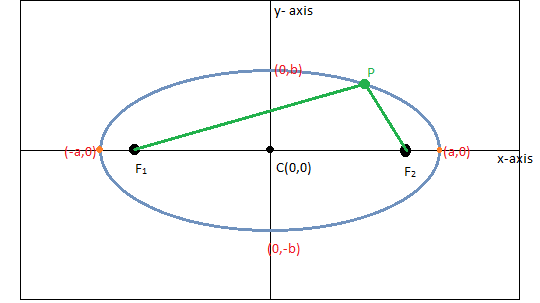
The ellipse has two axes one axis is called the major axis and the other one is the minor axis
Major axis: - The longest width across the ellipse is called the major axis. For a horizontally oriented ellipse, the major axis is parallel to the x-axis. And $2a$ is the length of the major axis. $(h\pm a,k)$are the coordinates of the major axis.
For a vertically oriented ellipse, the major axis is parallel to the y-axis and the coordinates of the major axis are $(k,h\pm b)$.
Minor axis: - The shortest width across the ellipse is called the minor axis. For a horizontally oriented ellipse, the minor axis is parallel to the y-axis. $2b$ is the length of the minor axis. $(h,k\pm b)$are the coordinates of the minor axis.
For a vertically oriented ellipse, the minor axis is parallel to the x-axis and the coordinates of the minor axis are $(k\pm a,h)$.
For example: If the ellipse is $\dfrac{{{(x+1)}^{2}}}{4}+\dfrac{{{(y-2)}^{2}}}{1}=1$
Then we can see that the major axis is parallel to the x-axis because $a>b$
Thus, $a=2$ and $b=1$ the coordinate will be $(-1,2)$.
Hence the major axis length is $2$ and the length of the minor axis is $1$.
Note:
The eccentricity value of the ellipse is greater than or equal to zero and less than one and it is denoted by $e$. If the shortest width $'b'$ and longest width $'a'$ of the ellipse will be equal then it is called the circle. The two points in the ellipse are called the foci of the ellipse.
If the ellipse is horizontal when $(a>b)$
$\Rightarrow \dfrac{{{(x-h)}^{2}}}{{{a}^{2}}}+\dfrac{{{(y-k)}^{2}}}{{{b}^{2}}}=1$
And if the ellipse is vertical when $(b>a)$then it will be written as
$\Rightarrow \dfrac{{{(y-k)}^{2}}}{{{b}^{2}}}+\dfrac{{{(x-h)}^{2}}}{{{a}^{2}}}=1$
In the above term $(h,k)$is the center coordinate of the ellipse.
$a$and $b$are the endpoint major and minor axis.
Complete step by step solution:
The ellipse has two axes one axis is called the major axis and the other one is the minor axis
Major axis: - The longest width across the ellipse is called the major axis. For a horizontally oriented ellipse, the major axis is parallel to the x-axis. And $2a$ is the length of the major axis. $(h\pm a,k)$are the coordinates of the major axis.
For a vertically oriented ellipse, the major axis is parallel to the y-axis and the coordinates of the major axis are $(k,h\pm b)$.
Minor axis: - The shortest width across the ellipse is called the minor axis. For a horizontally oriented ellipse, the minor axis is parallel to the y-axis. $2b$ is the length of the minor axis. $(h,k\pm b)$are the coordinates of the minor axis.
For a vertically oriented ellipse, the minor axis is parallel to the x-axis and the coordinates of the minor axis are $(k\pm a,h)$.
For example: If the ellipse is $\dfrac{{{(x+1)}^{2}}}{4}+\dfrac{{{(y-2)}^{2}}}{1}=1$
Then we can see that the major axis is parallel to the x-axis because $a>b$
Thus, $a=2$ and $b=1$ the coordinate will be $(-1,2)$.
Hence the major axis length is $2$ and the length of the minor axis is $1$.
Note:
The eccentricity value of the ellipse is greater than or equal to zero and less than one and it is denoted by $e$. If the shortest width $'b'$ and longest width $'a'$ of the ellipse will be equal then it is called the circle. The two points in the ellipse are called the foci of the ellipse.
Recently Updated Pages
Basicity of sulphurous acid and sulphuric acid are

Master Class 12 Economics: Engaging Questions & Answers for Success
Master Class 12 Biology: Engaging Questions & Answers for Success
Master Class 11 English: Engaging Questions & Answers for Success
Master Class 11 Physics: Engaging Questions & Answers for Success
Master Class 11 Computer Science: Engaging Questions & Answers for Success
Trending doubts
Draw a labelled sketch of the human eye class 12 physics CBSE
The chemical formula of tear gas is A CO Cl 2 B C 10 class 12 chemistry CBSE
Draw ray diagrams each showing i myopic eye and ii class 12 physics CBSE
Which are the Top 10 Largest Countries of the World?
Differentiate between homogeneous and heterogeneous class 12 chemistry CBSE
Which is the correct genotypic ratio of mendel dihybrid class 12 biology CBSE