




Find the locus of intersection of tangents which meet at a given angle \[\alpha \]with ellipse \[\dfrac{{{x}^{2}}}{{{a}^{2}}}+\dfrac{{{y}^{2}}}{{{b}^{2}}}=1\].
Answer
 Verified
636k+ views
Hint: Use the standard equation of tangent for ellipse for tangent \[y=mx\pm \sqrt{{{a}^{2}}{{m}^{2}}+{{b}^{2}}}\], then form a quadratic in ‘m’ and use formula \[\tan \theta =\left| \dfrac{{{m}_{1}}-{{m}_{2}}}{1+{{m}_{1}}{{m}_{2}}} \right|\]to get locus.
Complete step-by-step answer:
We have considered ellipse equation as \[\dfrac{{{x}^{2}}}{{{a}^{2}}}+\dfrac{{{y}^{2}}}{{{b}^{2}}}=1\left\{ \because a>b \right\}\]
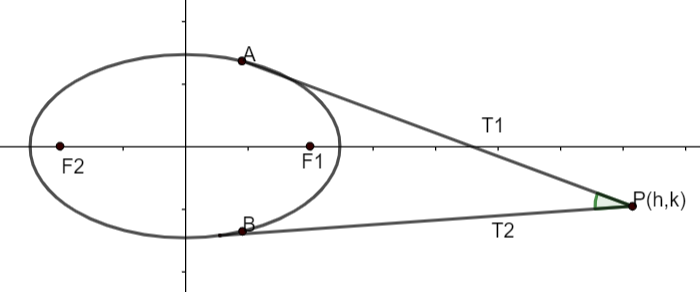
Let the point of intersection be P (h, k).
As we know,
Equation to the tangent \[\dfrac{{{x}^{2}}}{{{a}^{2}}}+\dfrac{{{y}^{2}}}{{{b}^{2}}}=1\]in slope form is
\[y=mx\pm \sqrt{{{a}^{2}}{{m}^{2}}+{{b}^{2}}}\]
As, this equation will pass through (h, k).
Hence,
\[k=mh\pm \sqrt{{{a}^{2}}{{m}^{2}}+{{b}^{2}}}\]
\[k-mh=\pm \sqrt{{{a}^{2}}{{m}^{2}}+{{b}^{2}}}\]
Squaring both sides
\[\begin{align}
& {{\left( k-mh \right)}^{2}}={{a}^{2}}{{m}^{2}}+{{b}^{2}} \\
& {{k}^{2}}+{{m}^{2}}{{h}^{2}}-2kmh={{a}^{2}}{{m}^{2}}+{{b}^{2}} \\
& \left( {{h}^{2}}-{{a}^{2}} \right){{m}^{2}}-2mhk+{{k}^{2}}-{{b}^{2}}=0-(1)\left\{ \because {{\left( APB \right)}^{2}}={{A}^{2}}+{{B}^{2}}+2AB \right\} \\
\end{align}\]
This equation is quadratic in m and has two roots. Let’s suppose \[{{m}_{1}}\]and \[{{m}_{2}}\]which are slopes of \[{{T}_{1}}\]and \[{{T}_{2}}\]tangents shown in diagram: -
As, if we have quadratic \[A{{X}^{2}}+BX+C=0\]
Then sum of roots \[=\dfrac{-B}{A}\]
Product of roots \[=\dfrac{C}{A}\]
Hence, from the equation (1)
\[\begin{align}
& {{m}_{1}}+{{m}_{2}}=\dfrac{2hk}{{{h}^{2}}-{{a}^{2}}} \\
& {{m}_{1}}.{{m}_{2}}=\dfrac{{{k}^{2}}-{{b}^{2}}}{{{h}^{2}}-{{a}^{2}}} \\
\end{align}\]
As, \[\tan \alpha =\left| \dfrac{{{m}_{1}}-{{m}_{2}}}{1+{{m}_{1}}{{m}_{2}}} \right|\]
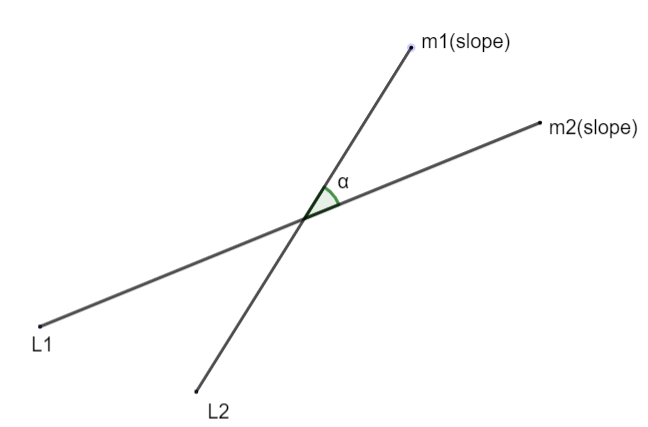
If slope of two lines are given then \[\tan \alpha =\left| \dfrac{{{m}_{1}}-{{m}_{2}}}{1+{{m}_{1}}{{m}_{2}}} \right|\]as \[\alpha \]is angle between two lines.
\[\begin{align}
& {{\tan }^{2}}\alpha =\dfrac{{{\left( {{m}_{1}}-{{m}_{2}} \right)}^{2}}}{{{\left( 1+{{m}_{1}}{{m}_{2}} \right)}^{2}}} \\
& {{\tan }^{2}}\alpha =\dfrac{{{\left( {{m}_{1}}+{{m}_{2}} \right)}^{2}}-4{{m}_{1}}{{m}_{2}}}{{{\left( 1+{{m}_{1}}{{m}_{2}} \right)}^{2}}}\left\{ \because {{\left( a-b \right)}^{2}}={{\left( a+b \right)}^{2}}-4ab \right\} \\
& {{\tan }^{2}}\alpha =\dfrac{{{\left( \dfrac{2hk}{{{h}^{2}}-{{a}^{2}}} \right)}^{2}}-4\left( \dfrac{{{k}^{2}}-{{b}^{2}}}{{{h}^{2}}-{{a}^{2}}} \right)}{{{\left( 1+\dfrac{{{k}^{2}}-{{b}^{2}}}{{{h}^{2}}-{{a}^{2}}} \right)}^{2}}} \\
& {{\tan }^{2}}\alpha =\dfrac{4{{h}^{2}}{{k}^{2}}-4\left( {{h}^{2}}-{{a}^{2}} \right)\left( {{k}^{2}}-{{b}^{2}} \right)}{{{\left( {{h}^{2}}+{{k}^{2}}-{{a}^{2}}-{{b}^{2}} \right)}^{2}}} \\
\end{align}\]
Replacing (h, k) by (x, y) to get locus: -
\[{{\left( {{x}^{2}}+{{y}^{2}}-{{a}^{2}}-{{b}^{2}} \right)}^{2}}=4{{\cot }^{2}}\alpha \left( {{x}^{2}}{{b}^{2}}+{{a}^{2}}{{y}^{2}}-{{a}^{2}} \right)\]is required locus.
Note: Using formula \[\tan \alpha =\left| \dfrac{{{m}_{1}}-{{m}_{2}}}{1+{{m}_{1}}{{m}_{2}}} \right|\]and writing relations from tangent equation \[y=mx\pm \sqrt{{{a}^{2}}{{m}^{2}}+{{b}^{2}}}\]or \[{{\left( y-mx \right)}^{2}}={{a}^{2}}{{m}^{2}}+{{b}^{2}}\]which is quadratic in m and using relations of roots with coefficients of quadratic is a key point of this equation.
We can use the direct formula of tangent of ellipse i.e. \[y=mx\pm \sqrt{{{a}^{2}}{{m}^{2}}+{{b}^{2}}}\]standard equation \[\dfrac{{{x}^{2}}}{{{a}^{2}}}+\dfrac{{{y}^{2}}}{{{b}^{2}}}=1\]which can be proved by following approach: -
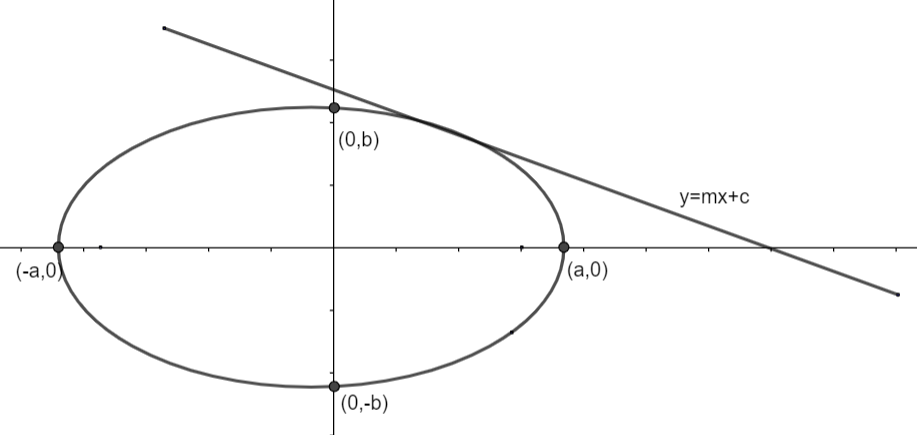
Now, y=mx + c and \[\dfrac{{{x}^{2}}}{{{a}^{2}}}+\dfrac{{{y}^{2}}}{{{b}^{2}}}=1\]have only one intersection point (touching the ellipse). So, if we substitute y=mx + c in \[\dfrac{{{x}^{2}}}{{{a}^{2}}}+\dfrac{{{y}^{2}}}{{{b}^{2}}}=1\]at place of y then we will get quadratic in x which should have one solution (as tangent and ellipse have only one intersection point). Then we will get \[c=\pm \sqrt{{{a}^{2}}{{m}^{2}}+{{b}^{2}}}\]by making decrement of that quadratic to 0.
Second approach to the solution can be: -
We can suppose A and B points as a parametric coordinates of ellipse as \[A\left( a\sin {{\theta }_{1}},b\cos {{\theta }_{1}} \right)\And B\left( a\sin {{\theta }_{2}},b\cos {{\theta }_{2}} \right)\]and write tangent equations from A and B as ‘T=0’ or
\[\begin{align}
& \dfrac{a\sin {{\theta }_{1}}}{a}+\dfrac{y\cos {{\theta }_{1}}}{b}=1 \\
& \dfrac{a\sin {{\theta }_{2}}}{a}+\dfrac{y\cos {{\theta }_{2}}}{b}=1 \\
\end{align}\]
And then find the intersection of above two tangent and trying to eliminate \[{{\theta }_{1}}\And {{\theta }_{2}}\]by using the given condition with using same formula \[\tan \alpha =\left| \dfrac{{{m}_{1}}-{{m}_{2}}}{1+{{m}_{1}}{{m}_{2}}} \right|\].
Where \[{{m}_{1}}=\dfrac{\dfrac{-\sin {{\theta }_{1}}}{a}}{\dfrac{\cos {{\theta }_{1}}}{b}}=\dfrac{-b\sin {{\theta }_{1}}}{a\cos {{\theta }_{1}}}\]
\[{{m}_{2}}=\dfrac{\dfrac{-\sin {{\theta }_{2}}}{a}}{\dfrac{\cos {{\theta }_{2}}}{b}}=\dfrac{-b\sin {{\theta }_{2}}}{a\cos {{\theta }_{2}}}\]
Complete step-by-step answer:
We have considered ellipse equation as \[\dfrac{{{x}^{2}}}{{{a}^{2}}}+\dfrac{{{y}^{2}}}{{{b}^{2}}}=1\left\{ \because a>b \right\}\]
Let the point of intersection be P (h, k).
As we know,
Equation to the tangent \[\dfrac{{{x}^{2}}}{{{a}^{2}}}+\dfrac{{{y}^{2}}}{{{b}^{2}}}=1\]in slope form is
\[y=mx\pm \sqrt{{{a}^{2}}{{m}^{2}}+{{b}^{2}}}\]
As, this equation will pass through (h, k).
Hence,
\[k=mh\pm \sqrt{{{a}^{2}}{{m}^{2}}+{{b}^{2}}}\]
\[k-mh=\pm \sqrt{{{a}^{2}}{{m}^{2}}+{{b}^{2}}}\]
Squaring both sides
\[\begin{align}
& {{\left( k-mh \right)}^{2}}={{a}^{2}}{{m}^{2}}+{{b}^{2}} \\
& {{k}^{2}}+{{m}^{2}}{{h}^{2}}-2kmh={{a}^{2}}{{m}^{2}}+{{b}^{2}} \\
& \left( {{h}^{2}}-{{a}^{2}} \right){{m}^{2}}-2mhk+{{k}^{2}}-{{b}^{2}}=0-(1)\left\{ \because {{\left( APB \right)}^{2}}={{A}^{2}}+{{B}^{2}}+2AB \right\} \\
\end{align}\]
This equation is quadratic in m and has two roots. Let’s suppose \[{{m}_{1}}\]and \[{{m}_{2}}\]which are slopes of \[{{T}_{1}}\]and \[{{T}_{2}}\]tangents shown in diagram: -
As, if we have quadratic \[A{{X}^{2}}+BX+C=0\]
Then sum of roots \[=\dfrac{-B}{A}\]
Product of roots \[=\dfrac{C}{A}\]
Hence, from the equation (1)
\[\begin{align}
& {{m}_{1}}+{{m}_{2}}=\dfrac{2hk}{{{h}^{2}}-{{a}^{2}}} \\
& {{m}_{1}}.{{m}_{2}}=\dfrac{{{k}^{2}}-{{b}^{2}}}{{{h}^{2}}-{{a}^{2}}} \\
\end{align}\]
As, \[\tan \alpha =\left| \dfrac{{{m}_{1}}-{{m}_{2}}}{1+{{m}_{1}}{{m}_{2}}} \right|\]
If slope of two lines are given then \[\tan \alpha =\left| \dfrac{{{m}_{1}}-{{m}_{2}}}{1+{{m}_{1}}{{m}_{2}}} \right|\]as \[\alpha \]is angle between two lines.
\[\begin{align}
& {{\tan }^{2}}\alpha =\dfrac{{{\left( {{m}_{1}}-{{m}_{2}} \right)}^{2}}}{{{\left( 1+{{m}_{1}}{{m}_{2}} \right)}^{2}}} \\
& {{\tan }^{2}}\alpha =\dfrac{{{\left( {{m}_{1}}+{{m}_{2}} \right)}^{2}}-4{{m}_{1}}{{m}_{2}}}{{{\left( 1+{{m}_{1}}{{m}_{2}} \right)}^{2}}}\left\{ \because {{\left( a-b \right)}^{2}}={{\left( a+b \right)}^{2}}-4ab \right\} \\
& {{\tan }^{2}}\alpha =\dfrac{{{\left( \dfrac{2hk}{{{h}^{2}}-{{a}^{2}}} \right)}^{2}}-4\left( \dfrac{{{k}^{2}}-{{b}^{2}}}{{{h}^{2}}-{{a}^{2}}} \right)}{{{\left( 1+\dfrac{{{k}^{2}}-{{b}^{2}}}{{{h}^{2}}-{{a}^{2}}} \right)}^{2}}} \\
& {{\tan }^{2}}\alpha =\dfrac{4{{h}^{2}}{{k}^{2}}-4\left( {{h}^{2}}-{{a}^{2}} \right)\left( {{k}^{2}}-{{b}^{2}} \right)}{{{\left( {{h}^{2}}+{{k}^{2}}-{{a}^{2}}-{{b}^{2}} \right)}^{2}}} \\
\end{align}\]
Replacing (h, k) by (x, y) to get locus: -
\[{{\left( {{x}^{2}}+{{y}^{2}}-{{a}^{2}}-{{b}^{2}} \right)}^{2}}=4{{\cot }^{2}}\alpha \left( {{x}^{2}}{{b}^{2}}+{{a}^{2}}{{y}^{2}}-{{a}^{2}} \right)\]is required locus.
Note: Using formula \[\tan \alpha =\left| \dfrac{{{m}_{1}}-{{m}_{2}}}{1+{{m}_{1}}{{m}_{2}}} \right|\]and writing relations from tangent equation \[y=mx\pm \sqrt{{{a}^{2}}{{m}^{2}}+{{b}^{2}}}\]or \[{{\left( y-mx \right)}^{2}}={{a}^{2}}{{m}^{2}}+{{b}^{2}}\]which is quadratic in m and using relations of roots with coefficients of quadratic is a key point of this equation.
We can use the direct formula of tangent of ellipse i.e. \[y=mx\pm \sqrt{{{a}^{2}}{{m}^{2}}+{{b}^{2}}}\]standard equation \[\dfrac{{{x}^{2}}}{{{a}^{2}}}+\dfrac{{{y}^{2}}}{{{b}^{2}}}=1\]which can be proved by following approach: -
Now, y=mx + c and \[\dfrac{{{x}^{2}}}{{{a}^{2}}}+\dfrac{{{y}^{2}}}{{{b}^{2}}}=1\]have only one intersection point (touching the ellipse). So, if we substitute y=mx + c in \[\dfrac{{{x}^{2}}}{{{a}^{2}}}+\dfrac{{{y}^{2}}}{{{b}^{2}}}=1\]at place of y then we will get quadratic in x which should have one solution (as tangent and ellipse have only one intersection point). Then we will get \[c=\pm \sqrt{{{a}^{2}}{{m}^{2}}+{{b}^{2}}}\]by making decrement of that quadratic to 0.
Second approach to the solution can be: -
We can suppose A and B points as a parametric coordinates of ellipse as \[A\left( a\sin {{\theta }_{1}},b\cos {{\theta }_{1}} \right)\And B\left( a\sin {{\theta }_{2}},b\cos {{\theta }_{2}} \right)\]and write tangent equations from A and B as ‘T=0’ or
\[\begin{align}
& \dfrac{a\sin {{\theta }_{1}}}{a}+\dfrac{y\cos {{\theta }_{1}}}{b}=1 \\
& \dfrac{a\sin {{\theta }_{2}}}{a}+\dfrac{y\cos {{\theta }_{2}}}{b}=1 \\
\end{align}\]
And then find the intersection of above two tangent and trying to eliminate \[{{\theta }_{1}}\And {{\theta }_{2}}\]by using the given condition with using same formula \[\tan \alpha =\left| \dfrac{{{m}_{1}}-{{m}_{2}}}{1+{{m}_{1}}{{m}_{2}}} \right|\].
Where \[{{m}_{1}}=\dfrac{\dfrac{-\sin {{\theta }_{1}}}{a}}{\dfrac{\cos {{\theta }_{1}}}{b}}=\dfrac{-b\sin {{\theta }_{1}}}{a\cos {{\theta }_{1}}}\]
\[{{m}_{2}}=\dfrac{\dfrac{-\sin {{\theta }_{2}}}{a}}{\dfrac{\cos {{\theta }_{2}}}{b}}=\dfrac{-b\sin {{\theta }_{2}}}{a\cos {{\theta }_{2}}}\]
Recently Updated Pages
Master Class 12 Social Science: Engaging Questions & Answers for Success

Master Class 12 Physics: Engaging Questions & Answers for Success
Master Class 12 Maths: Engaging Questions & Answers for Success
Master Class 12 Economics: Engaging Questions & Answers for Success
Master Class 12 Chemistry: Engaging Questions & Answers for Success
Master Class 12 Business Studies: Engaging Questions & Answers for Success
Trending doubts
Which are the Top 10 Largest Countries of the World?
Draw a labelled sketch of the human eye class 12 physics CBSE
Explain the structure of megasporangium class 12 biology CBSE
What are the major means of transport Explain each class 12 social science CBSE
How many chromosomes are found in human ovum a 46 b class 12 biology CBSE
The diagram of the section of a maize grain is given class 12 biology CBSE